
What Evidence Do You Need for Small Claims Court? A Complete Guide
Winning your small claims case hinges on the quality of your evidence. Discover the essential documentation and presentation strategies needed to build a winning argument, including specific insights for New York courts.
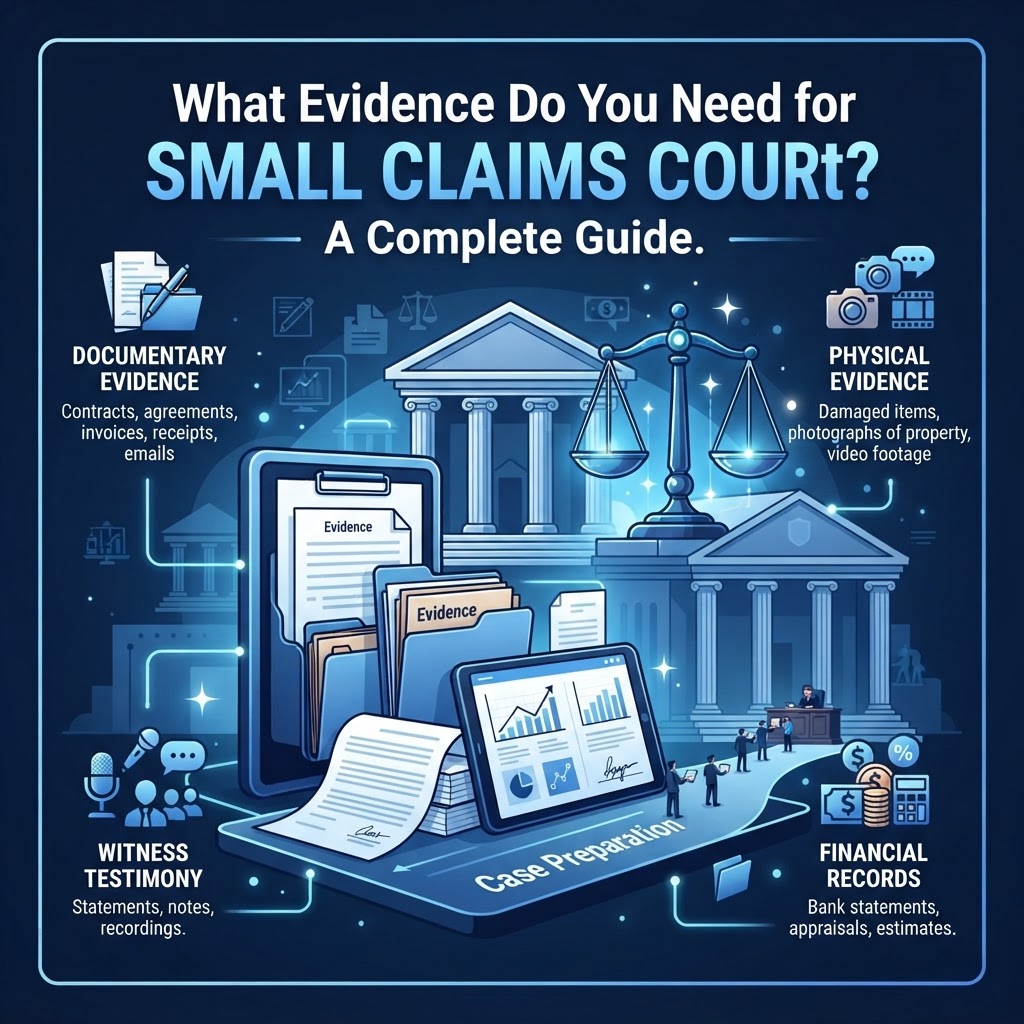
To prevail in small claims court, you must provide a preponderance of evidence, meaning your version of the facts is more likely true than not. Success requires organizing your documentation into a clear, chronological narrative that supports your specific legal claim for monetary damages. ## Understanding the Small Claims Burden of Proof In the New York small claims system, the burden of proof rests entirely on the plaintiff. You are not just telling a story, you are proving a cause of action. Whether you are suing for a breach of contract, property damage, or unpaid rent, you must link your evidence to the specific legal theory of your case. Under the Uniform District Court Act, the Uniform City Court Act, or the New York City Civil Court Act, which govern these proceedings, you do not need formal rules of evidence, but you do need competent evidence. This means your proof must be reliable and directly related to the issues in dispute. If you are preparing to file a small claims case, you should begin gathering your proof before you ever pay your filing fee. If you haven't yet formally notified the defendant, consider using a demand letter service to establish a written record of your attempt to resolve the issue out of court, which judges often view as a sign of good faith. The burden of proof is a legal standard requiring you to present enough evidence to convince the judge that your claim is true. Because the defendant is not required to prove anything, your failure to produce documentation for each element of your claim will result in a dismissal, regardless of the merits of your case. You must be prepared to show that a contract existed, that a duty was breached, and that this breach caused a specific financial loss. ## The Essential Evidence Checklist Before you appear before an arbitrator or judge, categorize your evidence into these four pillars: * Contracts and Agreements: Original signed contracts, service agreements, invoices, and purchase orders are foundational. If the agreement was oral, gather emails, text messages, or notes from phone conversations that confirm the terms. For contracts under the Statute of Frauds, you may need written evidence for agreements that cannot be performed within one year. * Financial Records: Cancelled checks, credit card statements, bank transfers, and receipts are mandatory. If you paid cash, try to obtain a signed receipt or a written acknowledgment from the defendant. For complex cases, a summary table detailing each payment made against an invoice can help the judge verify your math instantly. * Visual Proof: Dated photographs of property damage, video footage of an incident, or screenshots of communication threads are critical. For physical damage, consider including repair estimates from at least two reputable companies to demonstrate the reasonableness of your claim. Digital metadata in photos can often prove the time and location of a specific event. * Expert or Witness Testimony: Sworn statements or letters from individuals who witnessed the event. If the case involves specialized knowledge, such as building code violations or medical issues, have a written report from a professional ready to present. If you rely on a witness, their live testimony is far more persuasive than a written letter, as it allows the judge to assess credibility through cross-examination. ## Step-by-Step Procedure for Evidence Presentation Navigating court procedures can be daunting, but the process is structured to ensure fairness. 1. Filing the Claim: You initiate the case at the clerk's office in the city or county where the defendant lives, works, or has a place of business. Filing fees for claims up to $1,000 are $15, and fees for claims between $1,000.01 and $5,000 are $20. Ensure you have the exact name and address of the defendant, as a misnamed defendant can lead to a case being dismissed. 2. Service of Process: You must ensure the defendant is properly notified. The court clerk usually handles the mailing via certified mail, return receipt requested. If the service is returned as undeliverable, you must arrange for personal service by a non-party over the age of 18, which follows the requirements of the Civil Practice Law and Rules. Keep all proof of mailing or affidavits of service in your binder. 3. Organizing Your Exhibit Binder: Prepare three sets of your evidence. One for the judge, one for the defendant, and one for yourself. Use index tabs to clearly label each document so you can reference them quickly. A sample index includes: Tab 1: Contract, Tab 2: Proof of Payment, Tab 3: Correspondence, Tab 4: Photos. This organization demonstrates professionalism and respect for the court time. 4. Pre-Trial Hearing or Arbitration: Many small claims courts mandate a mediation phase. Use your evidence here to show the defendant that you have a strong case, which may encourage a settlement. If a settlement is reached, ensure it is written and signed by both parties and filed with the court as a stipulation of settlement. 5. The Trial: When you speak, follow the evidence. Do not ramble about emotional details. State the facts, present the document that proves the fact, and explain how it supports the dollar amount you are requesting. For more information on jurisdictional limits, consult our small claims guides by state. ## Worked Example: The Residential Deposit Dispute Imagine you moved out of an apartment on May 1st. Your landlord refuses to return your $2,500 security deposit, claiming damages. You argue the apartment was left in good condition. Under New York Real Property Law Section 7-108, landlords must provide an itemized statement of damages within 14 days of move-out. Your evidence should include: * The original lease showing the deposit amount. * A move-in checklist signed by both parties documenting pre-existing conditions. * Dated photographs taken on the day of move-out showing the apartment was clean and undamaged. * A copy of the certified letter you sent requesting the return of the deposit within the timeframe required by law. By presenting the move-in checklist alongside the move-out photos, you create a before and after comparison that acts as objective proof. If the landlord fails to provide the itemized list within the statutory 14-day window, you have a strong legal argument that they forfeited their right to withhold any portion of the deposit. ## Worked Example: The Unpaid Contractor Invoice Imagine you were hired to paint a room for $1,200. You completed the work on June 15th, but the client refuses to pay, claiming the color was incorrect. Your evidence should include: * A written contract or work order showing the agreed-upon paint brand and color code. * A text message chain where the client confirmed the color choice before you purchased the supplies. * Receipts for the paint purchased showing the specific color code that matches the contract. * A log of your labor hours and a copy of the invoice sent on June 16th. By matching the contract specs to the paint purchase receipts, you neutralize the defendant's defense. If the client refuses to pay, you present these documents to show that you performed exactly what was requested and that the denial of payment is a breach of the service contract. ## Common Mistakes to Avoid When Presenting Evidence 1. Relying on Hearsay: Simply telling the judge what someone else told you is rarely sufficient. Bring the person who witnessed the event to court, or have them sign a notarized affidavit if they cannot appear. Courts prioritize primary evidence over secondhand accounts. 2. Presenting Illegible Copies: Blurry, dark, or incomplete copies of documents will frustrate the judge and may be excluded. Always bring original documents to court alongside your clear, readable copies. If a document is too dark to read, the judge may treat it as non-existent. 3. Excessive Documentation: Do not dump five hundred pages of irrelevant emails. Select only the communications that directly establish the terms of the agreement or the breach of that agreement. A focused binder with 20 pages of high-quality evidence is always superior to a three-ring binder stuffed with irrelevant records. 4. Failing to Calculate Damages Accurately: Courts do not guess. If you sue for $3,000, you must show exactly how you arrived at that figure through receipts or valid estimates. Do not include pain and suffering or speculative losses in small claims, as these are generally not recoverable in breach of contract cases. If you sue for repairs, you should provide two estimates to show the court you are seeking market-rate pricing. 5. Losing Your Cool: The courtroom is not a place for shouting. The judge is evaluating your credibility. If you become argumentative, the judge may be less likely to credit your version of the facts. Remain objective, polite, and focused on the documentary evidence. ## Jurisdictional Nuances and Deadlines In New York, the monetary limit for small claims court is typically $5,000 in city courts and up to $3,000 in town or village courts. Be aware of the statute of limitations, which generally dictates that you must file your claim within six years for most contract disputes under CPLR 213. For property damage or negligence, the limit is three years under CPLR 214. Missing these deadlines results in a permanent loss of your right to sue. County-to-county variations also apply. For instance, New York City Small Claims court has specific rules regarding the use of commercial entities as defendants. If you are a corporation, you must ensure you have the correct legal entity name, often searchable through the Department of State database. If you are unsure about your specific county's rules, visit the local court clerk's office or check their official website. CourtLinked prepares documents as a paralegal service, is not a law firm, and does not give legal advice. Organizing your evidence properly is the single most important factor in determining the outcome of your case. By treating your claim with the professional rigor it deserves, you shift the odds significantly in your favor, ensuring the court sees the truth behind your argument. Preparing for trial is not merely about finding proof, but about structuring that proof into a persuasive legal narrative that the court can easily adopt into a final judgment.
Last reviewed Nov 4, 2026 · Preparing and filing across all 50 states since 2004. Not a law firm, no legal advice. Editorial standards
Related CourtLinked services
Need help filing your small claims case?
File My CaseRelated State Guides
Related Articles
More guides from the CourtLinked Law Library on similar small claims topics.