
Defendant RightsBy CourtLinked Published Oct 19, 2026 9 min read
How to Write a Demand Letter Before Filing Small Claims in Illinois
Sending a formal demand letter is a critical prerequisite to winning a small claims case in Illinois. Learn how to craft a professional document that increases your chances of a pre-court settlement.
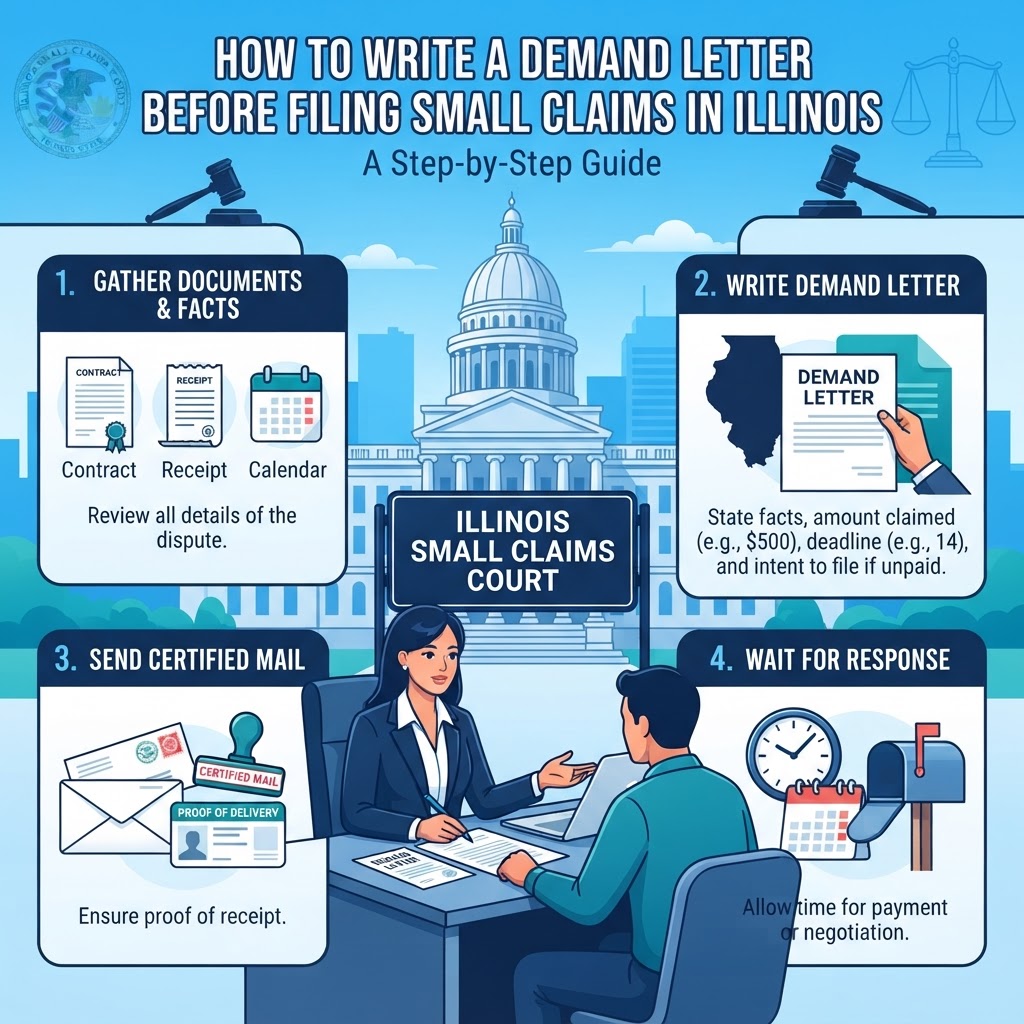
Why a Demand Letter is Your Most Important Pre-filing Tool. Sending a formal demand letter is often a mandatory step to demonstrate you attempted to resolve the dispute before bothering the court, and it serves as the foundation for your evidence if a trial becomes necessary. In Illinois small claims, a well-crafted demand letter acts as your final warning to the debtor, establishing a clear paper trail that proves you gave them an honest chance to avoid litigation costs. Under the Illinois Code of Civil Procedure, which governs the procedures for small claims in the circuit courts, demonstrating a "good faith effort" to resolve a dispute can significantly influence a judge’s perception of your case. While not every county in Illinois strictly mandates a demand letter for all claims, failing to send one often makes you look unreasonable, and it may prevent you from recovering certain pre-judgment interest or court costs depending on the nature of your contract. By clearly outlining the facts and demanding specific payment, you shift the psychological burden onto the defendant, forcing them to acknowledge the risk of a public judgment. If you are struggling to structure your correspondence, professional assistance can be found through our demand letter service to ensure your document carries the appropriate legal weight. Under the Illinois Code of Civil Procedure 735 ILCS 5/2-101, venue is critical, and a demand letter often serves as the initial notice of where the potential litigation will be anchored, signaling that you have done your due diligence. When you present this letter as evidence in court, you are signaling to the judge that you are not a litigious person by nature but a claimant seeking a reasonable resolution, which aligns with the spirit of the Small Claims Act. Failure to issue this notice can occasionally result in a judge denying motions for interest calculations allowed under 815 ILCS 205/2, which governs interest on judgments and settlements. ## Understanding Illinois Small Claims Limits. Before you send your letter, you must ensure your claim falls within the jurisdiction of the Illinois small claims court. In Illinois, small claims courts typically handle civil cases where the amount claimed is $10,000 or less, excluding interest and court costs. This cap can vary slightly based on specific county circuit court rules, so it is vital to check with your local Clerk of the Circuit Court before you draft your demand. If your dispute exceeds this amount, you may need to waive the excess to stay within small claims, or file a small claims case in the regular civil division, which follows much stricter procedural rules. Knowing your jurisdiction is the first step in our comprehensive small claims guides by state resources. It is important to note that the $10,000 limit is defined by the Supreme Court of Illinois in its rules for small claims cases (Rule 281). If your claim is for $10,001, you are automatically ineligible for the simplified small claims process. However, some counties have implemented pilot programs for alternative dispute resolution that may allow for minor deviations. Always confirm with the clerk in the specific county where the defendant resides. If you are suing in Cook County, note that the Clerk of the Circuit Court of Cook County has specific digital filing requirements and specialized forms for pro se litigants. In smaller counties like DuPage or Lake, the filing process might be more manual, requiring physical copies of your evidence. Remember, the $10,000 threshold strictly excludes interest and statutory costs, but it does include the principal amount of the debt plus any late fees explicitly agreed upon in a contract. ## The Anatomy of an Effective Illinois Demand Letter. A professional demand letter should be concise, factual, and devoid of emotional outbursts. You are not writing a character reference or a rant. You are writing a business notice that will eventually be read by a judge. ### 1. Contact Information and Date. Clearly state your name and address, the date of the letter, and the recipient's name and address. Ensure the address matches where the defendant can actually receive legal notice, which is essential for potential service of process later. ### 2. The Narrative of Facts. Provide a chronological summary of the dispute. Use dates, contract numbers, or invoice numbers to add objective weight to your claims. Do not skip the history of your previous attempts at communication. If you have sent three previous emails, mention them by date. ### 3. The Specific Demand. State exactly what you are owed in clear terms. Do not offer a range. If you are owed $4,500 for home repairs, state that amount clearly and explain how you arrived at that figure. If there are late fees specified in a contract, you may include them, but ensure they comply with Illinois usury laws. ### 4. A Deadline for Response. Give the recipient a reasonable time to respond, typically 10 to 14 business days from the date they receive the letter. Mention that if you do not hear from them by this date, you will pursue all available legal remedies. A date of 14 days is safer because it allows for postage delays and ensures the defendant has time to consult with others. ### 5. Delivery Method. Send your letter via Certified Mail with a Return Receipt Requested. This is your proof of delivery. Without a signature card, you cannot prove the defendant ever received your notice, which could be a requirement for proving service if you eventually move for a default judgment under Illinois rules. ## Worked Example: The Unpaid Contractor Dispute. Imagine you performed landscaping services for a homeowner in Cook County. You provided a written quote for $3,200. The work was completed on July 1, but the homeowner has ignored your invoices for three months. Your demand letter should look like this: "Dear [Name], On July 1, I completed the landscaping project at [Address] for the agreed-upon price of $3,200, as outlined in our contract dated May 15. Despite my invoices sent on July 15 and August 15, payment remains outstanding. Please remit the total of $3,200 to the address above by October 15. If payment is not received by this date, I will proceed to file a claim in the Cook County Small Claims Court, where I will also seek reimbursement for court filing fees and applicable service of process costs." This structure is effective because it is precise, professional, and warns the defendant of the financial consequences of inaction. ## Worked Example 2: The Security Deposit Dispute. Imagine you are a tenant in Champaign County who moved out on August 30. You provided a forwarding address in writing. The landlord failed to return your $1,200 security deposit within the 30-day statutory window mandated by the Illinois Security Deposit Return Act (765 ILCS 710/1). Your letter should say: "Dear [Landlord Name], As of October 1, the 30-day period for the return of my security deposit for the property at [Address] has expired. Under 765 ILCS 710/1, you were required to return the $1,200 deposit or provide an itemized statement of damages within 30 days of my move-out date on August 30. Because you have failed to do so, I am formally demanding the full amount of $1,200 by October 15. If I do not receive payment by this date, I will file a lawsuit in the Champaign County Small Claims Court to recover the deposit and potential attorney fees as allowed under state law." ## Essential Evidence to Gather. Your demand letter is useless if you cannot back up your claims in front of a judge. Before you even send the letter, organize the following documentation: * The original written contract or signed agreement signed by both parties. * Invoices sent to the defendant, including dates and proof of mailing or email delivery logs. * Email threads or text message logs showing the defendant acknowledged the work or debt or failed to object to an invoice. * Photographs of the completed work or the damaged property, date-stamped and printed in color. * Receipts for materials or labor expenses incurred for the specific project. * A detailed ledger showing the balance due, including any credits given. * Copies of any previous correspondence, such as letters or emails requesting payment. * A copy of the Certified Mail receipt and the return receipt (the "green card") showing the signature of the recipient. ## Five Costly Mistakes to Avoid. Even with a strong case, the following errors can derail your effort: 1. Being overly aggressive or using threats. Threats of physical harm or harassment are illegal and can be used against you in court. Keep your tone professional. Avoid using capitalization for emphasis or aggressive language that could be interpreted as harassment under Illinois law. 2. Including irrelevant personal complaints. The court only cares about the contract and the breach. Do not include long stories about how the defendant was rude to you or why you are personally offended. Judges have heavy dockets and want the facts of the breach, not the drama of the relationship. 3. Setting an impossible deadline. Giving someone two days to pay is unreasonable and makes you appear litigious. A 14-day window is the standard for professional disputes. A judge may view an extremely short deadline as a sign that you were looking for a fight rather than payment. 4. Failing to send via certified mail. If you send the letter via regular mail, the defendant can simply claim they never received it. Certified mail provides the physical proof you need to show the court that the defendant was properly notified. Always retain the tracking number. 5. Inconsistency in your demand amount. Ensure the amount you request in the letter exactly matches the amount you claim in your formal court filing. Changing the amount later confuses the judge and weakens your credibility. If you add interest after the demand letter, document clearly why that interest is accrued and how it is calculated per the original agreement. ## The Step-by-Step Filing Process. Once the deadline in your demand letter passes, you are ready to escalate. 1. Compile all proof: Ensure you have the certified mail receipt, a copy of the demand letter, and your supporting documents. 2. Prepare the Complaint: File your summons and complaint forms at the office of the Clerk of the Circuit Court in the county where the defendant resides or where the incident occurred. In most Illinois counties, you will fill out a Summons (form provided by the court) and a Complaint (a short document stating the amount owed and the reason). 3. Pay the Filing Fee: Filing fees vary by county, ranging from roughly $50 to $200 depending on the amount of your claim and the specific circuit court rules. In Cook County, for instance, the fee for claims under $2,500 is significantly lower than for claims between $2,500 and $10,000. You must also pay a fee for the sheriff or a private process server to deliver the papers. 4. Serve the Defendant: You must provide formal legal notice to the defendant through a process server or the sheriff. You cannot serve these papers yourself. You must provide the server with a copy of the Summons and Complaint. If the defendant is an individual, they must be served at their home or place of work. If it is a business, you must serve the registered agent. 5. Prepare for Court: Once served, the court will set a return date, usually 21 to 45 days after the summons is issued. If you do not appear on the return date, your case will be dismissed. Bring three copies of all your evidence: one for the judge, one for the defendant, and one for yourself. Organize these in a binder with tabs. CourtLinked prepares documents as a paralegal service, is not a law firm, and does not give legal advice. By following these steps and documenting every interaction, you greatly increase the likelihood of a settlement without the need for a full trial. Preparation is the primary factor that separates winners from losers in Illinois small claims court.
C
CourtLinked
Last reviewed Nov 4, 2026 · Preparing and filing across all 50 states since 2004. Not a law firm, no legal advice. Editorial standards
Related CourtLinked services
Need help filing your small claims case?
File My CaseRelated State Guides
Related Articles
More guides from the CourtLinked Law Library on similar small claims topics.
Defendant RightsHow to File a Small Claims Case for a Bad Check in IllinoisRead article →Defendant RightsWhat Evidence Do You Need for Small Claims Court? A Complete GuideRead article →Defendant RightsUnderstanding the Small Claims Statute of Limitations: Your Rights and DeadlinesRead article →Defendant RightsHow to Handle a Security Deposit Dispute in Virginia Small Claims CourtRead article →Defendant RightsSmall Claims Court Tips: How to Win Your Case as a Defendant in WashingtonRead article →Defendant RightsHow to Sue for Breach of Contract in Small Claims Court: A California GuideRead article →