
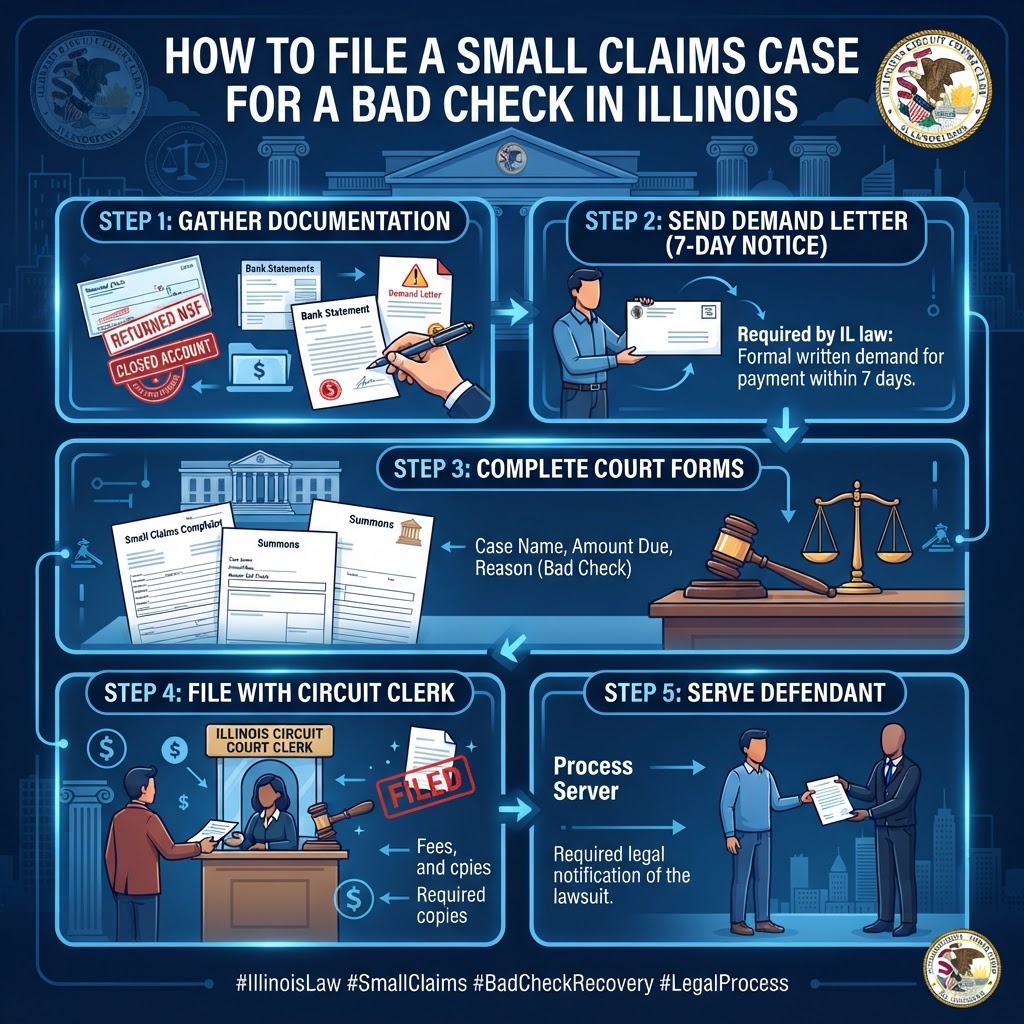
How to File a Small Claims Case for a Bad Check in Illinois
Receiving a bad check can be frustrating and financially damaging. This guide walks you through the legal steps to recover your funds in Illinois small claims court, ensuring you follow the correct procedures to increase your chances of success.
Filing a Small Claims Suit for Dishonored Checks in Illinois. Pursuing a bad check case in Illinois small claims court requires serving a formal written demand, filing a complaint in the appropriate county, and presenting clear documentary evidence of the debt to a judge. Recovering funds involves navigating the Illinois Criminal Code regarding deceptive practices and the civil statutes governing breach of contract.
Understanding the Legal Grounds for Recovery
In Illinois, a bad check is generally treated as a breach of contract or an act of civil fraud. Under the Illinois Deceptive Practices Act, creditors have specific pathways to seek restitution. When a check is returned for non-sufficient funds (NSF) or because the account is closed, you are entitled to recover the face value of the check, plus potential interest and attorney fees if applicable under your specific agreement. Small claims court in Illinois is designed to handle civil disputes where the amount claimed does not exceed $10,000.
Before heading to the courthouse, it is essential to determine if your case qualifies for the small claims track. If your claim is for less than the $10,000 threshold, the small claims division provides an expedited process compared to general civil litigation. If you need assistance preparing these filings, our file a small claims case resources can help you get started.
Illinois law allows for the recovery of treble damages in specific instances of deceptive practices, but this often requires proving intent to defraud under the Criminal Code. For standard civil recovery, you are entitled to the face amount of the instrument. Under the Illinois Code of Civil Procedure, section 2-101, venue is proper in the county where the transaction occurred or where the defendant resides. In cases of bounced checks, the debt is generally deemed to have occurred at the place of the failed payment or where the services were rendered.
The Mandatory Demand Letter
Illinois law strongly favors informal resolution before litigation. Sending a formal demand letter is not just a suggestion; it is a vital prerequisite that provides the debtor a final opportunity to make payment. Your demand letter must include the check number, the amount, the reason for the return, and a firm deadline for payment. If you are unsure how to structure this correspondence, utilizing a demand letter service ensures your communication meets all legal formalities to stand up in court.
To satisfy the requirements for a potential claim of bad faith, you should send the letter via certified mail, return receipt requested. This provides you with proof of delivery. Under the statute, if the debtor does not satisfy the check within thirty days of the written notice, you may be entitled to seek additional damages, including the cost of the check, reasonable attorney fees, and potential civil penalties. Your letter should state clearly that payment must be received by a date certain, usually fourteen to thirty days from the date of the notice. Retain a copy of the letter and the postal receipt to attach as an exhibit to your complaint.
Step-by-Step Filing Process
-
Verify Jurisdiction: Identify the county where the check was written or where the debtor resides. You must file your suit in the county that has proper venue over the defendant. Filing in the incorrect county may result in a motion to transfer venue, which will delay your case and may cost you additional filing fees.
-
Prepare Your Documents: Obtain a certified copy of the dishonored check from your bank. Gather all correspondence related to the transaction. You must have the physical, returned check or a bank-certified image. A simple digital photocopy is often insufficient to establish the evidentiary foundation required for a judgment.
-
File the Complaint: Complete a Small Claims Complaint form provided by the Clerk of the Circuit Court. You will list yourself as the plaintiff and the person or business who issued the bad check as the defendant. You must also include an Affidavit for Small Claim, which verifies the truthfulness of your allegations.
-
Pay Filing Fees: Costs vary by county. For example, in Cook County, the filing fee for a claim under $2,500 is typically around $130, while larger claims up to $10,000 can exceed $300. Smaller counties like Lake or DuPage may have different fee schedules. Check the website of the Clerk of the Circuit Court in your specific county to confirm current fee structures before arriving at the window.
-
Effectuate Service: You must serve the defendant with a Summons and a copy of the Complaint. This must be done by the county sheriff or a licensed private process server. If using the sheriff, include the service fee, which generally ranges from $20 to $60. If the defendant cannot be found, you may need to apply for alias summons, which adds more time to the process.
-
Prepare for Court: Bring all evidence to the hearing. If the defendant does not appear, you may move for a default judgment. Under Illinois Supreme Court Rules, you must present proof of service to the judge to request this default.
For more information on procedural variances, review our small claims guides by state.
Evidence You Must Gather
To prevail in court, your case must be built on a foundation of undeniable evidence. The judge will look for specific items to confirm the debt is valid and unpaid.
- The original dishonored check, stamped by the bank as NSF or Account Closed. If the bank processed the check multiple times, obtain a statement reflecting all attempted presentments.
- A copy of the formal demand letter sent via certified mail with a return receipt requested. Ensure the receipt is signed by the defendant or their representative.
- A clear ledger or contract showing why the check was issued. If the check was for a service, provide an itemized invoice detailing the date of performance.
- Correspondence or emails confirming the transaction details. These serve to defeat any claims by the defendant that the debt was disputed or that the product was defective.
- A statement from your bank confirming the check was presented for payment and rejected. This statement should show the specific date of the rejection to align with your demand letter timeline.
Worked Example: Calculating Your Claim
Consider a scenario where you are a freelance contractor and you provide a website design service for a client. The agreed price is $4,000. The client pays with a check, but it bounces.
- Initial debt: $4,000 (face value of the bad check).
- Bank processing fees: $35 (charged by your bank for the NSF item).
- Certified mail service for demand letter: $10.
- Initial court filing fee: $175 (incurred in your specific county).
- Sheriff service of process fee: $45.
- Total claim in your complaint: $4,265.
In this instance, you would attach the NSF notice from your bank, the original check, the green card from your certified mailing, the invoice sent to the client, and the receipts from the clerk of court and the sheriff. By including these in your prayer for relief, you are asking the court to reimburse you for the actual costs incurred due to the defendant's failure to maintain sufficient funds in their account.
Common Mistakes to Avoid
-
Suing the Wrong Entity: If you are suing a business, ensure you have the correct legal name registered with the Illinois Secretary of State. You can use the Secretary of State Business Search tool to find the official registered agent. Suing a trade name or a d/b/a without identifying the parent corporation can result in the defendant filing a motion to dismiss for lack of standing.
-
Ignoring the Statute of Limitations: The statute of limitations for a written contract in Illinois is ten years under 735 ILCS 5/13-206. For an oral contract, it is five years under 735 ILCS 5/13-205. However, waiting years to file makes it difficult to track down the defendant or evidence.
-
Failing to Serve the Defendant Correctly: Service of process is a strict procedural requirement. If the defendant is not served according to Illinois Supreme Court Rule 102, the court will lack personal jurisdiction. You must ensure the return of service is filed with the clerk at least three days before your first court appearance.
-
Improper Documentation: Relying on oral testimony alone is rarely enough. If you do not have the original instrument, you may be barred from recovery under the best evidence rule unless you can prove the check was lost or destroyed through no fault of your own.
-
Poor Record Keeping: Losing the return receipt from your certified demand letter will prevent you from proving you complied with pre-filing requirements. Many judges will continue your case and order you to send a new letter if you cannot prove you gave the required notice.
Preparing for the Hearing
When you arrive at the courthouse, maintain professional conduct. Present your evidence clearly and concisely. Small claims courts operate on tight schedules. You will likely have five to ten minutes to present your case. Focus on the core facts: the existence of the agreement, the issuance of the check, the bank's rejection of the check, and the failure of the defendant to pay after notice.
Do not attempt to argue points of law that are irrelevant to the debt. If the judge asks a question, answer directly. If you have copies of all documents for the judge and the defendant, you will appear organized and prepared. Having an extra set of documents in a binder, organized by exhibit number, significantly speeds up the hearing process and impresses the court with your readiness.
Post-Judgment Collection
A judgment is not a payment. Once the court rules in your favor, the clerk will enter a judgment order. If the defendant does not pay immediately, you have several collection options. You may record the judgment in the county where the defendant owns real estate to create a lien. You may also serve a Citation to Discover Assets upon the defendant. This is a court order requiring the defendant to appear and answer questions under oath about their income and property.
If the defendant fails to appear at the citation hearing, you may move for a rule to show cause, which can lead to a finding of contempt of court. You can also utilize bank levies or wage garnishment once you have identified the defendant's bank or employer. These procedures are governed by the Illinois Code of Civil Procedure and require specific forms, such as a Wage Deduction Summons, which must be served on the employer. Always keep track of your collection costs, as these are often recoverable as judgment interest.
Professional Considerations
CourtLinked prepares documents as a paralegal service, is not a law firm, and does not give legal advice. If your case involves complex business fraud or massive financial losses, consulting with an attorney may be necessary to navigate specific evidentiary burdens that go beyond standard small claims procedures. Large claims involving corporate defendants often result in the defendant hiring counsel, which changes the dynamic of the litigation.
Keep your records orderly throughout the life of the case, as documentation is the deciding factor in the majority of small claims disputes involving dishonored checks. By adhering to the Illinois Code of Civil Procedure and maintaining thorough records of all attempts to resolve the debt, you maximize the probability of a successful outcome in court. Ensure you review local court rules, as every circuit in Illinois, from the 1st Judicial Circuit to the 22nd, may have unique mandates regarding mediation, case management conferences, or electronic filing systems.
Last reviewed Nov 4, 2026 · Preparing and filing across all 50 states since 2004. Not a law firm, no legal advice. Editorial standards
Related CourtLinked services
Need help filing your small claims case?
File My CaseRelated State Guides
Related Articles
More guides from the CourtLinked Law Library on similar small claims topics.