
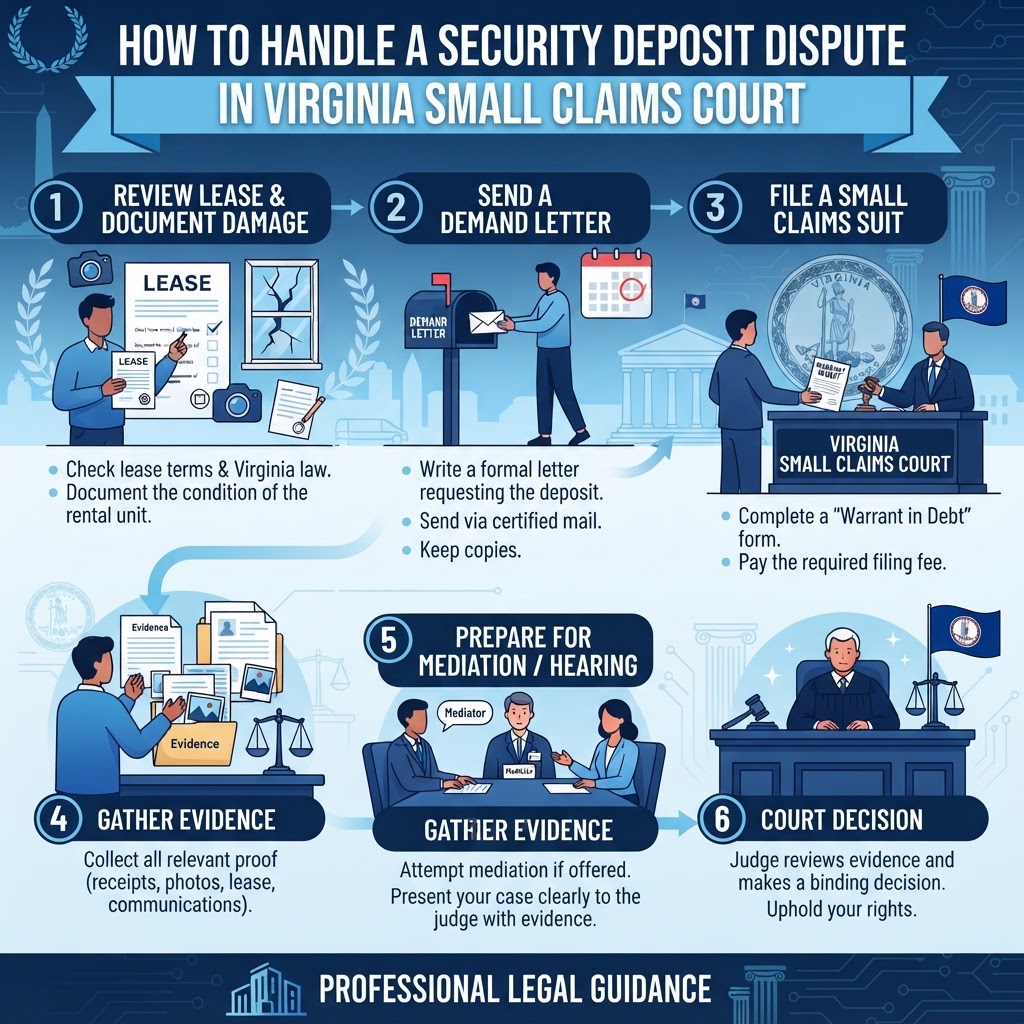
How to Handle a Security Deposit Dispute in Virginia Small Claims Court
Facing a security deposit lawsuit in Virginia? Learn how to navigate the small claims process, protect your rights, and prepare a strong defense against unreasonable landlord claims.
Understanding Virginia Security Deposit Laws
When a landlord files a claim against your security deposit in Virginia, you are protected by the Virginia Residential Landlord and Tenant Act (VRLTA). Under this law, which is codified in the Code of Virginia Title 55.1 Chapter 12, landlords must strictly adhere to timelines and documentation requirements before they can withhold any portion of your deposit for damages. If a landlord fails to follow these rules, they may forfeit their right to keep the deposit or even face liability for double the amount withheld plus reasonable attorney fees as governed by Virginia Code Section 55.1-1226. This statute serves as your primary shield in General District Court.
The Legal Framework in Virginia
Most residential leases in Virginia fall under the VRLTA. This statute mandates that landlords must perform a move-out inspection and provide an itemized list of deductions within 45 days of the termination of the tenancy. If the landlord fails to send this written notice within the statutory window, they lose the legal right to retain any portion of the deposit for damages to the premises. The burden of proof rests entirely on the landlord to show that the damages are beyond reasonable wear and tear. Furthermore, under Virginia Code Section 55.1-1226(A), if a landlord fails to provide the move-in inspection report within five days of occupancy, they cannot claim damages to the unit at the end of the lease unless they provide clear evidence of the condition at move-in. The total security deposit held by a landlord cannot exceed an amount equal to two months of periodic rent, as defined by Virginia Code Section 55.1-1226(A).
What Constitutes Reasonable Wear and Tear
Small claims judges in Virginia generally differentiate between normal aging and actual neglect. Reasonable wear and tear refers to the natural deterioration that occurs from standard daily use. This includes minor scuffs on walls, slight fading of paint, or light wear on carpets. Conversely, damage that justifies a deduction includes holes in drywall, pet stains, burns, or broken fixtures caused by misuse. A landlord cannot charge you to replace an entire carpet because it is aged if only a small, repairable portion is damaged. In many General District Courts, judges apply a depreciation schedule to major items like carpet or appliances. For example, if a carpet has a useful life of seven years and it was five years old at the start of your three-year lease, the landlord cannot charge you for full replacement costs because the item had exceeded its expected life span. You should always document the age of fixtures if possible.
The Small Claims Process for Defendants
If you have been served with a warrant in debt, you are being sued in General District Court. Small claims court in Virginia is a division of the General District Court where the amount in controversy is $5,000 or less. If your landlord is suing you for an amount above this threshold, the case will be heard in the regular civil division, where formal rules of evidence apply more strictly. If you find yourself needing to file a small claims case to countersue for your deposit, you must be prepared to navigate the procedural nuances of the General District Court. Note that the filing fee for a warrant in debt varies by the amount claimed but typically ranges from $35 to $65 plus service of process fees. Service of process by the Sheriff usually costs around $12 to $25 per defendant. If you reside in a large jurisdiction like Fairfax County or the City of Richmond, be aware that dockets move quickly, and you must file your responsive pleadings well in advance of the return date listed on the warrant.
Preparing Your Defense
Your defense begins the moment you receive the court paperwork. Do not ignore the court date, even if you believe the claim is entirely without merit. Failing to show up will result in a default judgment against you. To defend yourself effectively, you must organize your evidence to counter the landlord's itemized list of deductions point by point. If you have not yet sent a formal response, consider our demand letter service to establish a clear paper trail before your court appearance. If the landlord claims $1,000 in damages, they must provide an itemized list with receipts. If they provide a general estimate from a friend, you can challenge the legitimacy of the costs as non-actual damages. Remember that under Virginia law, landlords are limited to recovering actual expenses incurred, not speculative repair costs.
Step-by-Step Defense Guide
-
Review the Landlord’s Statement: Carefully examine the itemized list provided by the landlord. Note the dates, costs, and the specific reasons for each charge. Compare these against your move-in and move-out inspection checklists. If the notice arrived 46 days after you vacated, you may be entitled to the full deposit back regardless of the condition of the unit.
-
File an Answer or Counterclaim: In Virginia, you are not strictly required to file a written answer in small claims court, but it is highly recommended. If you believe the landlord owes you money, you must file a counterclaim before the trial date. This ensures the judge hears your side of the dispute during the same hearing. Failure to file a formal counterclaim in advance might require the judge to grant a continuance.
-
Gather Evidence: Compile your documentation, photos, and receipts. Ensure you have the original lease agreement and any correspondence regarding maintenance issues that were never addressed. If you have emails showing you reported a leaky ceiling that caused water damage, use them to prove you were not negligent.
-
Appear in Court: Arrive early on your court date. Dress professionally and bring three copies of every document: one for the judge, one for the landlord, and one for your own reference. Being organized shows the judge you take the matter seriously.
-
Present Your Case: When the judge calls your case, remain calm and stick to the facts. Address each deduction disputed, explain why it falls under wear and tear, or prove that the damage was pre-existing. Do not talk over the judge or the opposing party.
Essential Evidence Checklist
To maximize your chances of success, ensure your binder of evidence contains the following:
- The Original Lease: Highlighting clauses related to security deposits and move-out requirements.
- Move-in and Move-out Inspection Reports: If these were not provided, document this failure in your testimony. Virginia Code Section 55.1-1226 requires a move-in inspection report to be provided to the tenant.
- Timestamped Photographs: Before-and-after photos of every room, specifically focusing on areas where the landlord claims damage. Digital metadata showing dates are essential.
- Maintenance Request Records: Emails, texts, or letters sent to the landlord requesting repairs that were ignored or improperly fixed. These establish that you attempted to maintain the property.
- Receipts and Invoices: Proof of any cleaning or professional services you hired upon moving out. If you had a professional cleaning company perform a move-out clean, the receipt is vital evidence.
- Witnesses: If a third party helped you clean or witnessed the condition of the property, bring a written statement or have them present in court.
Worked Example: The Security Deposit Calculation
Imagine you moved out of a Virginia apartment after a two-year lease. Your security deposit was $1,500. The landlord keeps $800, claiming $300 for carpet cleaning, $200 for painting, and $300 for a broken window.
Your defense strategy:
-
Carpet: You prove the carpet was already six years old based on the lease addendum. You argue that the carpet reached its useful life, meaning the landlord cannot charge you for replacement or cleaning if it is depreciated to zero. You save $300.
-
Painting: You provide photos showing the walls were clean and had no marks. The landlord failed to provide an inspection report at move-in to prove the paint was pristine. The judge rules this as normal wear and tear. You save $200.
-
Broken Window: You admit the window was broken due to an accident but provide a receipt showing you had it repaired by a licensed contractor for $150. The landlord is only entitled to actual costs, not an inflated estimate. Since you paid $150 but the landlord charged $300, you have already overpaid. You request a refund of the $150 difference.
Total saved: $650. You effectively reduce the landlord’s claim from $800 to $150.
Example 2: A Security Deposit Dispute involving double damages. Your deposit was $2,000. You moved out on January 1. The landlord did not send an itemized list until March 15, which is 73 days later. This violates the 45-day rule in Virginia Code Section 55.1-1226(B). You file a counterclaim in General District Court. The judge determines the landlord forfeited the right to the deposit because they exceeded the 45-day window. The landlord is ordered to return your $2,000. Because the landlord withheld the money in bad faith, you argue for damages under 55.1-1226(E). The judge may grant you the return of the deposit plus reasonable attorney fees and costs, potentially totaling $2,500 including legal representation.
Common Mistakes to Avoid
-
Ignoring the Court Summons: This is the most costly error. A default judgment means the court accepts the landlord’s claims as true without you ever having a chance to speak. Always show up.
-
Failing to Provide a Forwarding Address: Under Virginia law, if you do not provide your forwarding address, the landlord is relieved of the requirement to send you the itemized statement within 45 days. Ensure this is sent via certified mail or a documented email to ensure proof of delivery.
-
Paying for Repairs Without Documentation: Never pay for damage out of pocket without documenting the repair cost. If you fix it, keep the receipts. If the landlord fixes it, demand receipts and invoices as proof of their actual expenses.
-
Losing Your Move-In Checklist: This is your primary shield. If the landlord did not provide one, document that fact. Without a record of the unit's initial condition, it is very difficult for a landlord to prove that new damages occurred during your tenancy.
-
Arguing Emotional Points: Judges are only interested in facts, statutes, and evidence. Avoid bringing up the landlord's personality, your personal hardships, or general grievances about the housing market. Focus exclusively on the financial claims in front of the court.
Resources and Further Learning
For more detailed information regarding specific jurisdictional requirements, please refer to our small claims guides by state. While many resources exist, focus your research on the Virginia Residential Landlord and Tenant Act as found in the Code of Virginia, Title 55.1. Always verify if your specific city or county has local rules that supplement the state-wide statutes, as some larger jurisdictions in Northern Virginia or the Tidewater area may have specific filing procedures. Remember that you may appeal any decision from the small claims division to the circuit court within 10 days, but be aware that an appeal to the circuit court often requires the posting of an appeal bond. In the circuit court, the rules of evidence and procedure are far more formal and generally require professional legal assistance.
CourtLinked prepares documents as a paralegal service, is not a law firm, and does not give legal advice.
Last reviewed Nov 4, 2026 · Preparing and filing across all 50 states since 2004. Not a law firm, no legal advice. Editorial standards
Related CourtLinked services
Need help filing your small claims case?
File My CaseRelated State Guides
Related Articles
More guides from the CourtLinked Law Library on similar small claims topics.