
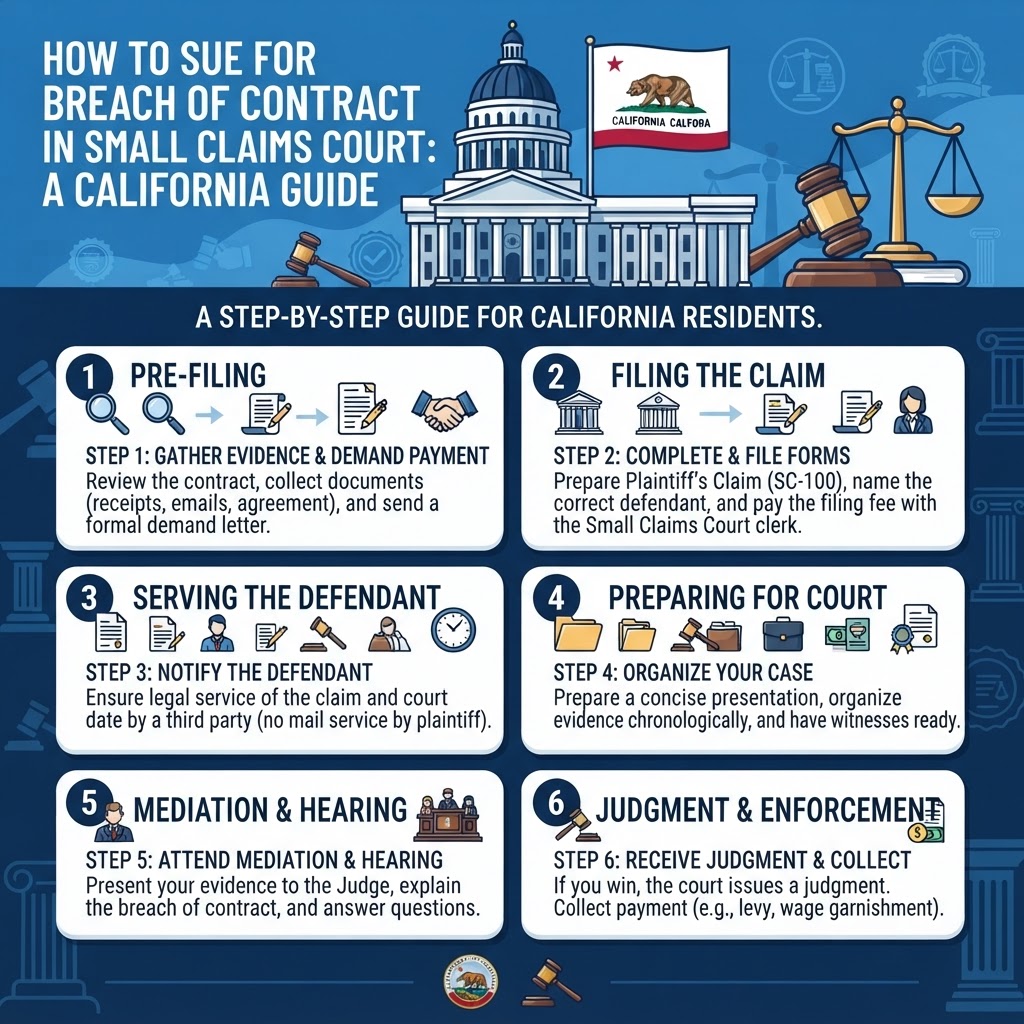
How to Sue for Breach of Contract in Small Claims Court: A California Guide
Facing a broken agreement? Learn how to navigate a breach of contract lawsuit in California small claims court with our step-by-step guide on gathering evidence and filing your claim.
Understanding Breach of Contract in California Small Claims
To sue for breach of contract in California small claims court, you must first prove a valid contract existed, show that you performed your obligations, demonstrate the other party failed to perform, and establish that you suffered actual financial damages. You initiate this process by serving a formal demand letter, filing a Plaintiff’s Claim and ORDER to go to Small Claims Court (form SC-100) in the county where the defendant resides or where the contract was signed, and appearing before a judge to present your evidence. A breach of contract occurs when one party fails to fulfill their promises as outlined in a legally binding agreement. Under the California Civil Code Section 1550, a contract requires parties capable of contracting, their mutual consent, a lawful object, and sufficient cause or consideration. Without these elements, a judge may rule that no contract existed, regardless of how unfair the situation feels.
The Legal Framework for Small Claims
California small claims court operates under the authority of the California Code of Civil Procedure Section 116.110 et seq. This system is designed to be accessible to non-lawyers and encourages swift resolution of disputes. Under California law, an individual can sue for up to $12,500. If you are a business entity or a corporation, the limit is $6,250. It is crucial to note that under California Code of Civil Procedure Section 116.231, you cannot split a single claim into multiple lawsuits to bypass these limits. If your damages exceed the jurisdictional cap, you must either waive the excess amount or file in the Superior Court, where the process is far more formal, involves discovery, and often requires legal counsel. Be aware that filing in Superior Court may subject you to paying the other party’s legal fees if you lose, a risk that generally does not exist in small claims court.
Jurisdictional Limits and Deadlines
The statute of limitations is your first hurdle. Under the California Code of Civil Procedure Section 337, you generally have four years to sue for breach of a written contract and, under Section 339, two years for an oral contract. Missing these windows results in your case being dismissed permanently because the court lacks authority to grant relief on stale claims. Before you file a small claims case, verify that your claim has not aged beyond these statutory limits. Filing fees are set by state law but vary slightly by county depending on the number of claims you have filed in the last year. Typically, if you have filed 12 or fewer claims in the last 12 months, the fee is $30 for claims under $1,500, $50 for claims between $1,500 and $5,000, and $75 for claims between $5,000 and $12,500. If you have filed more than 12 claims, the fee is $100. Always check your local Superior Court website, such as Los Angeles County or San Francisco County, as they may have local rules regarding electronic filing or mandatory mediation. If you are struggling with the initial requirements, professional demand letter service can often resolve disputes before court becomes necessary.
A Worked Example of Breach of Contract
Consider this scenario: You hire a contractor to renovate your kitchen for a total of $10,000. You sign a written agreement and pay a $4,000 deposit. The contractor fails to show up on the agreed date, ignores your phone calls, and performs zero work. You hire a different contractor who charges $5,000 to perform the exact same work. In this case, your damages are the $4,000 deposit plus the $1,000 difference in price for the new contractor, totaling $5,000. You would file your claim for $5,000, attaching the contract, the proof of payment of the $4,000, and the new written estimate for $5,000 as evidence of your loss.
Now, consider a second scenario: You lease a professional commercial printer for $500 per month. The contract has a 12-month term. After 3 months, the printer breaks down and the vendor refuses to repair it, despite their service contract obligation. You stop using the printer and lease a replacement for $700 per month for the remaining 9 months. Your damages consist of the $1,500 you paid for months you could not use the machine, plus the $1,800 difference in cost for the replacement printer ($200 extra per month for 9 months), totaling $3,300. You would file for $3,300 in small claims court, providing the lease agreement, bank statements showing the payments, and the new lease agreement for the replacement machine as evidence.
Step-by-Step Filing Process
- Verify Jurisdiction: Ensure the defendant lives or works in the county where you are filing, or that the contract was executed there, as per Code of Civil Procedure Section 116.370.
- Attempt Resolution: Send a demand letter via certified mail with a return receipt requested. This provides the court with proof that you attempted to resolve the issue before litigation, which is a requirement for certain types of claims.
- Complete Form SC-100: This is the primary document to open your case. It requires the names and addresses of all parties and a concise explanation of the claim. If the defendant is a business, search the California Secretary of State website to get their registered agent address.
- File with the Clerk: Submit your form to the small claims clerk in your county. You will pay the filing fee at this time. If you cannot afford it, you may file a Request to Waive Court Fees (form FW-001).
- Serve the Defendant: You must serve the defendant with a copy of the SC-100. You cannot serve these papers yourself. You must use a process server, the sheriff, or a friend over the age of 18 who is not a party to the lawsuit. You have specific deadlines; for an individual, it is 15 days before the hearing if they live in the county, or 20 days if they live outside the county.
- File Proof of Service: The person who delivered the documents must sign form SC-104 (Proof of Service), which you must file with the clerk at least 5 days before your hearing date.
Essential Evidence Checklist
Success in small claims court relies almost entirely on the quality of your documentation. The judge does not have time to listen to long, rambling stories. You must provide clear evidence that connects your claim to the law.
- Original written contract or agreement signed by both parties.
- Email threads, text messages, or letters showing an offer and acceptance.
- Proof of payment, such as canceled checks, credit card statements, or bank transfers showing the exact date funds were transferred.
- Receipts for any expenses incurred due to the breach, such as hiring a replacement service.
- Photographs or videos showing the incomplete or defective work.
- A log of all communication attempts, including dates, times, and summaries of what was discussed, which helps establish the timeline of the breach.
- Witness statements or affidavits if a third party observed the contract being signed or broken. Remember that written declarations must comply with the requirements of Code of Civil Procedure Section 2015.5 to be admissible.
Common Mistakes to Avoid
Many plaintiffs lose their cases due to avoidable errors. Here are five costly mistakes:
- Suing the Wrong Party: You must sue the exact legal name of the business or person. Use the fictitious business name registry in your county to verify the owner of a DBA (Doing Business As). If you sue a business owner personally for a corporate debt without a personal guarantee, the case will likely fail.
- Failing to Prove Damages: You cannot sue for pain and suffering or abstract anger. You must show a concrete dollar amount that you are out of pocket. Documentation is the only way to prove these financial losses.
- Lack of Proper Service: If the defendant is not served according to the strict requirements of the California Code of Civil Procedure, the judge cannot hear the case. Always ensure your Proof of Service is filed correctly. If the defendant is hiding or avoiding service, you may need to apply for an Order for Substituted Service (form SC-104A).
- Providing Excessive Evidence: Judges are busy. Present only the most relevant documents in an organized binder. Do not overwhelm them with non-essential background information. Tab your documents so you can quickly point to relevant clauses in the contract.
- Arriving Unprepared for Mediation: Many counties require mediation before the judge hears the case. Treating mediation as a waste of time rather than a chance to settle can negatively influence the mediator and the judge. Mediation allows for a structured discussion that can resolve the matter without the uncertainty of a judge's final decision.
Preparing for Your Court Date
On the day of your hearing, arrive at least 30 minutes early. Dress professionally, as this is a formal court proceeding. When the judge calls your name, state your case clearly and concisely. Reference your evidence by pointing the judge to the specific page in your prepared binder. Avoid interrupting the defendant while they speak, as this reflects poorly on your temperament and credibility. If the judge asks a question, answer it directly and honestly. Never lie or exaggerate. If you need more information about how different jurisdictions handle these cases, review our small claims guides by state to ensure you are following local procedures correctly. Remember that if the judge rules against you, you have the right to appeal by filing form SC-140 within 30 days of the mailing of the Notice of Entry of Judgment. However, defendants have different appeal timelines if they are sued, and they must attend the original hearing to preserve their rights to request a new trial.
The Role of Paralegal Support
Navigating the nuances of California small claims procedures can be daunting for someone without a legal background. While the court is designed for individuals to represent themselves, the paperwork requirements remain strict and unforgiving. Errors in the filing process can lead to significant delays or the dismissal of a valid claim. CourtLinked prepares documents as a paralegal service, is not a law firm, and does not give legal advice. Utilizing professional document preparation services ensures that your forms are completed to the required standards, allowing you to focus on gathering the facts that support your case. By handling the logistical aspects of the filing correctly, you position yourself for the best possible outcome in your pursuit of justice. Professional help ensures that you have accounted for local court rules, correct venue selection, and the precise formatting required by the local clerks who process thousands of filings each month. While you remain the lead in your case, having expertly prepared documents provides the structure needed to present your evidence with the authority and clarity that judges expect in the courtroom.
Last reviewed Nov 4, 2026 · Preparing and filing across all 50 states since 2004. Not a law firm, no legal advice. Editorial standards
Related CourtLinked services
Need help filing your small claims case?
File My CaseRelated State Guides
Related Articles
More guides from the CourtLinked Law Library on similar small claims topics.