
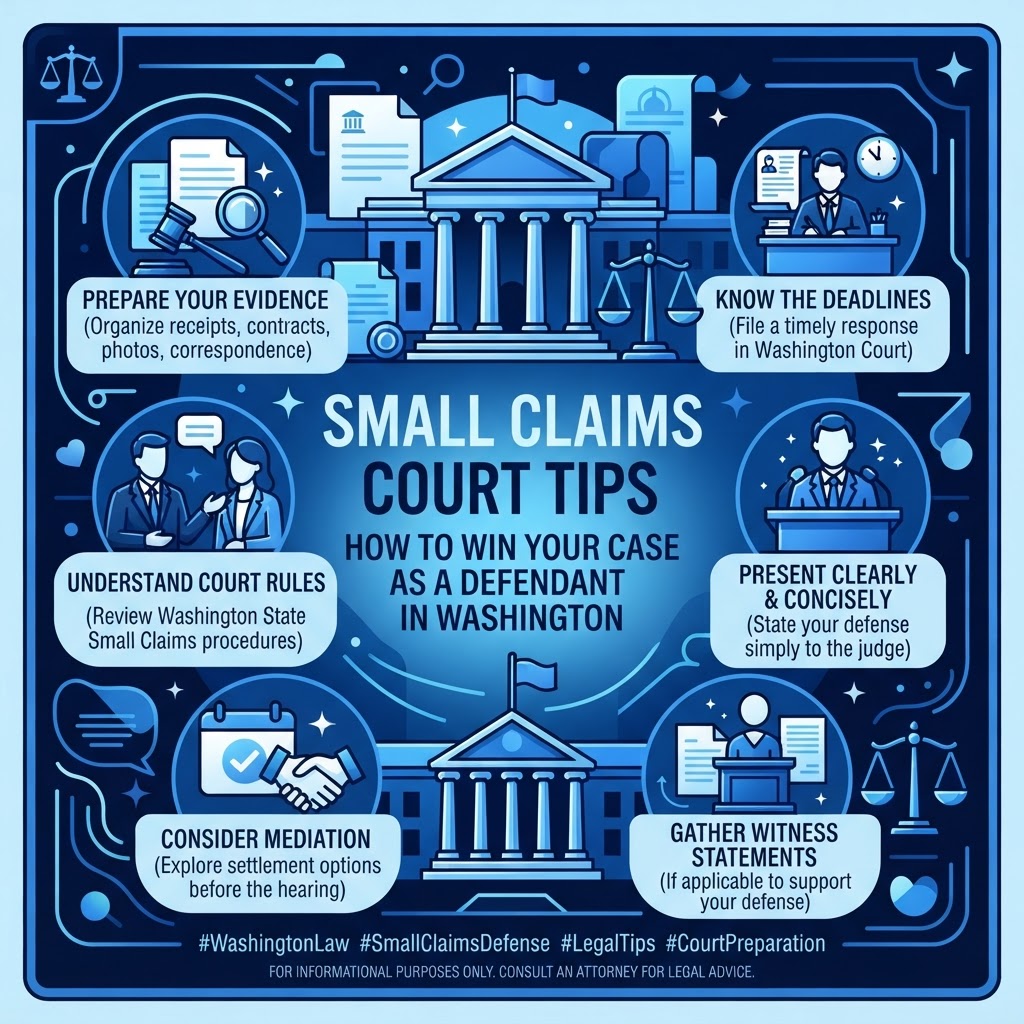
Small Claims Court Tips: How to Win Your Case as a Defendant in Washington
Facing a small claims lawsuit can be stressful, but as a defendant, you have rights and strategies to build a strong defense. This guide provides practical tips and Washington-specific insights to help you navigate the process and increase your chances of a favorable outcome.
Understanding Your Position as a Defendant in Washington Small Claims
Receiving a notice that you are being sued in Washington small claims court means you have been served with a Notice of Small Claim, which requires you to take action within a specific timeframe to avoid an automatic default judgment. Your primary goal is to present your side of the dispute clearly, as Washington small claims courts are designed to resolve disputes informally, focusing on evidence and testimony rather than complex procedural maneuvers. When a plaintiff files a claim, the court will issue a Notice of Small Claim and a Notice of Hearing. These documents constitute your official notification. As a defendant, you are the party against whom the complaint is filed. Because Washington small claims are governed by RCW Chapter 12.40, the process is streamlined to avoid the heavy costs associated with formal civil litigation in Superior Court.
Washington small claims court is a department of the District Court. The jurisdictional limit for claims is $10,000 for individuals and $5,000 for businesses. Because the process is simplified, attorneys are generally not allowed to represent parties unless the judge grants special permission. This levels the playing field, but it places the burden of preparation squarely on your shoulders. If you have been sued, you must act promptly to protect your assets and your reputation. Failing to address a valid claim can result in a judgment being recorded against your credit, potentially affecting your ability to rent housing or secure loans for years to come.
The Legal Framework and Your Rights
The Washington Revised Code (RCW) Chapter 12.40 governs small claims actions in the state. These rules prioritize equity and fairness. As a defendant, your fundamental right is to be notified of the claim against you through proper service of process. Under state law, service must be completed at least ten days prior to the hearing date. If you were not served correctly, such as through improper delivery or failure to meet the minimum notice period, you may have grounds to challenge the court's jurisdiction through a motion to dismiss. Furthermore, you have the right to present evidence, call witnesses, and cross-examine the plaintiff. If you believe the plaintiff actually owes you money related to the same incident, you may be able to file a counterclaim, which effectively turns the table in the same proceeding.
Filing a Response
Unlike superior court, small claims procedures are less rigid, but missing deadlines is fatal to your defense. Upon receiving the Notice of Small Claim, you should check the paperwork for the exact date and time of your mediation or trial. Some counties require you to file a written answer or a notice of intent to defend, while others simply require your appearance on the scheduled date. For example, King County and Pierce County have specific local court rules that mandate certain procedural filings prior to the hearing. Always check with the clerk of the district court in the county where the claim was filed to verify if a formal written answer is mandatory. If you fail to appear at the hearing, the court will likely enter a default judgment against you, which can lead to wage garnishment or bank account levies. If a default judgment is entered, you may need to file a Motion to Vacate Judgment, which carries its own filing fees—often ranging from $20 to $50 depending on the county—and requires showing good cause for your absence.
Step-by-Step Defense Process
- Review the Claim Immediately: Analyze the details provided in the Notice of Small Claim. Note the date of the alleged incident, the amount claimed, and the legal theory of the case. Determine if the claim is legitimate or if it lacks merit. Check if the plaintiff is suing in the correct venue. Generally, the case must be filed in the district where the defendant resides or where the cause of action occurred.
- Consult the Clerk: Call the district court clerk listed on your notice. Confirm the local rules regarding mandatory filings. Ask if mediation is required before the trial. In many Washington counties, mandatory mediation is the first step before a judge ever sees the case. If you are struggling with paperwork, services like CourtLinked can assist with the preparation of necessary documents.
- Gather Your Evidence: Organize every document that pertains to the dispute. This includes receipts, contracts, emails, text messages, and photos. A well-organized file is often the deciding factor in a judge's ruling. Do not wait until the morning of the trial to look for these documents.
- Consider a Counterclaim: If you have a valid claim against the plaintiff arising from the same transaction, you must file a counterclaim at least 72 hours before the hearing date. Failing to do so may result in the court refusing to hear your side of the financial dispute. You will need to pay a small filing fee to process your counterclaim, typically consistent with local fee schedules for small claims countersuits.
- Prepare Your Testimony: Write a brief, chronological summary of your version of events. Keep it factual and avoid emotional outbursts. Judges appreciate conciseness. Practice your statement to ensure it fits within the typical time window afforded to defendants, which is usually five to ten minutes.
- Attend the Hearing: Arrive early. If the court offers mediation, be open to it. Mediation can settle the case without a formal judgment on your record. If you settle, ensure the terms are put in writing and signed by both parties, and submitted to the court clerk as a Stipulation of Settlement.
The Importance of Evidence
You cannot rely on oral arguments alone. Documentation is the backbone of any small claims defense. You must gather:
- Original contracts or written agreements signed by both parties. Ensure these show the date and the specific obligations of both sides.
- Proof of payment such as canceled checks, credit card statements, or bank records. If you paid cash, try to find a receipt or a contemporaneous note confirming the transfer.
- Written correspondence including emails, letters, and text messages that provide context to the dispute. Print these out clearly. Do not expect the judge to look at your phone screen.
- Photographic or video evidence of the condition of property if the case involves damage or breach of contract. High-quality prints are better than digital files on a tablet.
- Statements from credible witnesses who have personal knowledge of the facts. If they cannot appear in person, inquire with the clerk about submitting a written declaration or affidavit.
- Estimates or invoices from third-party professionals if the case involves faulty services or repairs. These provide objective valuation for your defense.
If you find the process of gathering these items overwhelming, review our small claims guides by state for more localized information on how to build a winning case file.
Worked Example: A Typical Construction Dispute
Imagine you hired a contractor to install a fence for $4,000. You paid an initial deposit of $2,000. The contractor abandoned the job after setting only four posts. The contractor sues you for the remaining $2,000, claiming the work is complete. You, as the defendant, argue that the work was incomplete and defective.
- The Claim: $2,000 for unpaid labor and materials.
- Your Defense: You bring photos showing the incomplete fence, a copy of the original contract showing the completion date has passed, and a quote from a new contractor showing it will cost $3,000 to finish the work.
- The Outcome: If you present this evidence clearly, the judge may dismiss the plaintiff's claim for the remaining $2,000 and potentially grant your counterclaim for the $1,000 difference in cost, or at the very least, rule that you owe nothing because the plaintiff breached the contract first.
Worked Example 2: Security Deposit Dispute
Suppose you moved out of an apartment and your landlord sues you for $1,500, claiming you damaged the carpet and walls. You paid a security deposit of $1,000. You argue that the damages claimed are actually normal wear and tear and that the landlord failed to provide a move-out inspection report as required by state law. If you produce a copy of the signed move-in checklist and photos from the day you moved out, you can prove that the carpet was already stained. If the landlord did not provide a written statement of deductions within 21 days as required under Washington's Residential Landlord-Tenant Act, the judge may deny the landlord's claim entirely and even order the return of your $1,000 deposit plus interest.
Five Costly Mistakes to Avoid
- Ignoring the Summons: This is the most expensive mistake. A default judgment is difficult and costly to overturn. If you are served, you must respond or appear. The court has no obligation to search for you if you do not show up.
- Failing to Organize Evidence: Dumping a stack of unorganized papers on a judge's bench will not help your case. Use binders and labeled tabs to make your evidence easy to digest. A judge with a heavy docket will appreciate an organized folder.
- Becoming Emotional in Court: Avoid interrupting the plaintiff or the judge. Treat the courtroom with professional respect, as your behavior influences the judge's perception of your credibility. Stay focused on the evidence rather than personal grievances.
- Forgetting the Counterclaim Deadline: If you wait until the day of the trial to introduce a counterclaim, the court will almost certainly deny it. File it at least 72 hours in advance. Check your local court calendar to ensure you meet this timing.
- Relying on Hearsay: You cannot simply tell the judge what someone else said. You need personal knowledge or admissible documentation. If a witness is essential, bring them to court. Hearsay is often excluded, meaning your testimony about what a third party said may carry no legal weight.
Seeking Professional Assistance
Navigating the procedural aspects of small claims court often causes unnecessary stress. While you do not need an attorney to win your case, correctly drafted documents are essential for ensuring your arguments are placed before the court in the proper format. If you need help drafting a response or a formal counterclaim, demand letter service and document preparation can provide the foundation you need. CourtLinked prepares documents as a paralegal service, is not a law firm, and does not give legal advice. By utilizing these resources, you can ensure that your filings are accurate and meet all court requirements, allowing you to focus on the facts of your defense. Remember that while paralegal services help with the form of the documents, the strategy and the narrative remain your responsibility.
Final Preparation for the Hearing
Before you step into the courtroom, run through your opening statement in your head. State who you are, your relationship to the plaintiff, and the specific reason you disagree with their claim. If you have been asked to submit evidence beforehand, ensure the plaintiff receives a copy of everything you plan to use, as the judge will not consider surprise evidence that the other side has not had the chance to review. Dress professionally, arrive at least twenty minutes early to navigate security, and remain calm throughout the proceedings. If you have been ordered to pay and disagree with the result, note that you generally have 30 days to file an appeal in the Superior Court, though the filing fees for an appeal are significantly higher than the original small claims filing fees. If you have followed the steps outlined in this guide and presented your evidence with clarity, you have maximized your opportunity to receive a fair judgment in Washington small claims court.
Last reviewed Nov 4, 2026 · Preparing and filing across all 50 states since 2004. Not a law firm, no legal advice. Editorial standards
Related CourtLinked services
Need help filing your small claims case?
File My CaseRelated State Guides
Related Articles
More guides from the CourtLinked Law Library on similar small claims topics.