
GeneralBy CourtLinked Published Sep 26, 2026 9 min read
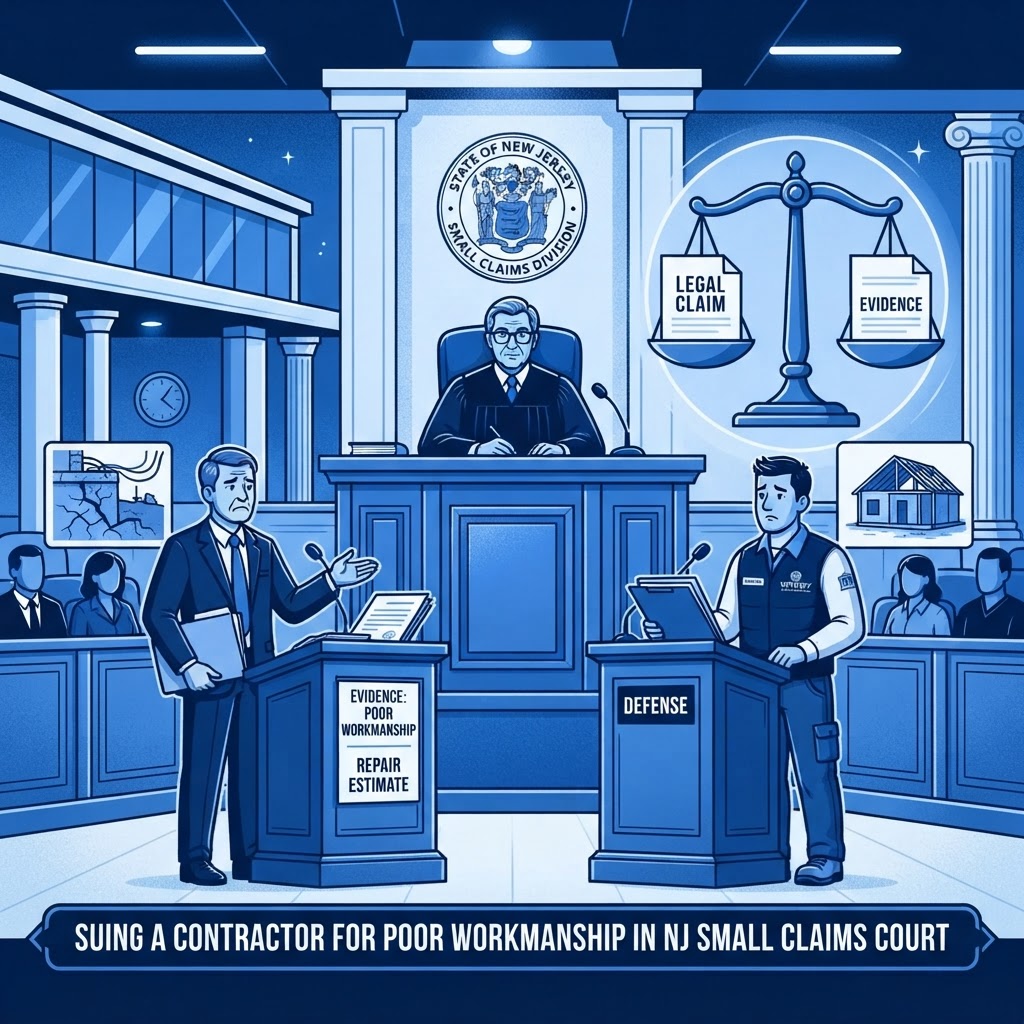
Suing a Contractor for Poor Workmanship in New Jersey Small Claims Court
Discover how to navigate the New Jersey small claims court process when dealing with defective home improvements. This guide covers documentation, legal requirements, and how to file your claim effectively.
Navigating Small Claims for Contractor Disputes in New Jersey. When a contractor performs substandard work in New Jersey, you can pursue compensation through the Special Civil Part of the Superior Court, commonly known as small claims court, provided your claim does not exceed the statutory limit of $3,000. For disputes involving damages between $3,001 and $20,000, your case will be heard in the Special Civil Part, where the rules of procedure are slightly more formal but still accessible to those without an attorney. It is critical to note that the $3,000 limit is exclusive of court costs and interest, meaning you can still recover your filing fees if you win a judgment. In the Special Civil Part, you must comply with the Rules Governing the Courts of the State of New Jersey, specifically Part VI, which governs civil actions in the Special Civil Part. Unlike traditional civil lawsuits in the Law Division, the Special Civil Part is designed to be streamlined, often bypassing some of the more tedious discovery phases found in higher-stakes litigation. ## Understanding Your Legal Standing. In New Jersey, consumer protections for home improvements are primarily governed by the New Jersey Consumer Fraud Act (CFA) and the associated Home Improvement Contractor Registration regulations enforced by the New Jersey Division of Consumer Affairs. Any contractor performing home improvements costing more than $500 must be registered with the state. This requirement is found under the Contractors' Registration Act. If you are dealing with a contractor who performed poor work, failed to obtain required permits, or abandoned the project, you are dealing with a breach of contract and potentially a violation of state consumer protection laws. A failure to comply with these regulations is often a per se violation of the Consumer Fraud Act. Before you file a small claims case, it is essential to determine if your damages qualify as a 'Consumer Fraud' violation. Under the CFA, you may be entitled to 'treble damages,' which means you can be awarded three times the amount of your actual loss plus reasonable attorney fees if you can prove an unlawful practice. However, small claims court judges are often hesitant to award treble damages, so if your damages are significant, you should weigh the cost of a formal lawsuit against the simplicity of the small claims process. To succeed with a CFA claim, you must demonstrate an ascertainable loss of moneys or property as a result of the contractor's unlawful practice. While the CFA is a powerful tool, it often involves complex litigation that may exceed the simplified nature of small claims court. For example, if you seek treble damages, you are legally obligated to prove the contractor committed a deceptive act, such as making false promises about the quality of materials, which requires a higher standard of evidence than a simple breach of contract. ## The Financial Thresholds and Filing Fees. New Jersey Small Claims courts handle disputes involving claims up to $3,000. If your damages exceed this amount, you must file in the Special Civil Part, which handles claims up to $20,000. The filing fee varies by county but generally falls between $55 and $75 for a single defendant, plus a service of process fee. Service of process is usually handled by certified mail, which costs approximately $7 to $15 depending on the clerk's office requirements. If the court requires a sheriff or professional process server to deliver the complaint, expect to pay an additional $30 to $50. In counties like Essex or Hudson, you may face higher administrative surcharges compared to more rural counties like Sussex or Warren. Always verify the current fee schedule with your specific county clerk as these are subject to legislative adjustments. You must also account for a $55 fee for a judgment collection if the contractor fails to pay after the court rules in your favor. If you are a low-income plaintiff, you may apply for a fee waiver by filing a Certification in Support of Motion to Proceed as an Indigent. ## Documenting the Defective Work. Documentation is the bedrock of your case. Without a comprehensive paper trail, a judge has no way to distinguish between a difference of opinion and actual poor workmanship. Before taking legal action, you should utilize a professional demand letter service to provide the contractor with one final, formal opportunity to rectify the defects. This serves as vital evidence that you acted in good faith to resolve the dispute before litigation. Your documentation should be organized in a three-ring binder, with copies for yourself, the defendant, and the judge. ### Essential Evidence Checklist. 1. The original written contract including all change orders. Ensure every signature is dated. 2. A record of all payments made to the contractor, including cancelled checks or credit card statements. 3. Photos and videos showing the 'before' and 'after' states of the work. Use a digital timestamp or print photos with dates marked on the back. 4. A written report from a licensed third-party contractor detailing the defects and providing a quote for the cost of repairs. This expert opinion is often the deciding factor in court. 5. Copies of all correspondence including text messages, emails, and certified mail receipts. If you sent messages via WhatsApp or social media, take clear screenshots. 6. A copy of the contractor's registration status from the New Jersey Division of Consumer Affairs website. This verifies they were legally authorized to work at the time of your contract. 7. Any local building department inspection reports or notices of violations regarding the work performed. Official reports from municipal inspectors hold significant weight in court as they are considered neutral, expert testimony. ## Worked Example: Calculating Damages. Imagine you hired a contractor to install a new deck for $5,000. You paid an initial deposit of $2,500. The contractor installed the framing but used the wrong wood, failed to secure the posts, and abandoned the job. You hired a second contractor to inspect the work, and they provided a written estimate of $1,800 to fix the safety issues and $1,200 to complete the work as originally agreed. In this scenario, your actual damages for the poor workmanship are $1,800. While the total project was $5,000, your specific loss caused by the contractor's failure is the cost of the repair. You would file your claim for $1,800 in the small claims division. If the contractor committed fraud, you might argue for higher damages, but the $1,800 is the tangible, provable loss that the judge will focus on in a standard breach of contract claim. To add a second worked example: Suppose a contractor was hired to renovate a bathroom for $8,000. They failed to show up for 75 percent of the work but kept your $6,000 deposit. You had to hire a new contractor to finish the project at a cost of $9,000. Your total financial loss is the $6,000 deposit plus the $1,000 premium you paid for the new contractor compared to your original budget. You would file a claim for $7,000 in the Special Civil Part, as it exceeds the $3,000 small claims limit. You would present the original contract for $8,000, the proof of the $6,000 payment, and the contract with the new party showing a $9,000 cost. ## Step-by-Step Filing Procedure. 1. Confirm the contractor is registered: Use the NJ Division of Consumer Affairs portal to verify their credentials. Print the registration verification sheet. 2. Attempt resolution: Send a final demand letter via certified mail with a clear deadline for a response, typically 14 days. 3. Prepare the Complaint: File your Small Claims Complaint (Form DC-177) with the Clerk of the Special Civil Part in the county where the contractor does business. You must include a concise statement of the facts. 4. Pay the Filing Fee: Submit the required fees as determined by your specific county clerk, usually via check or money order. 5. Serve the Defendant: Once the clerk processes the complaint, ensure the defendant is served via certified mail or personal service as per the court's instructions. Keep your green return receipt card as proof of service. 6. Attend the Return Date: Most New Jersey courts require an initial appearance. This is not the trial but a chance for mediation. If mediation fails, a trial date will be set. 7. Present at Trial: Organize your evidence chronologically and be prepared to explain the breach of contract clearly and concisely to the judge. ## Common Mistakes to Avoid. 1. Failing to Put it in Writing: Relying on verbal agreements is the most common reason for lost cases. Always ensure change orders are signed. 2. Missing the Statute of Limitations: New Jersey generally allows six years to file a breach of contract claim, but waiting too long makes gathering evidence significantly harder. Do not delay. 3. Improper Service: If the contractor does not receive the paperwork in the exact manner prescribed by the court, the judge will dismiss your case immediately. 4. Over-complicating the Story: Judges in small claims court handle high volumes of cases. Keep your testimony focused strictly on the facts of the breach rather than personal grievances. 5. Neglecting Mediation: Many New Jersey courts mandate mediation before a judge will hear your case. Refusing to participate in good faith can look poorly on you in the eyes of the court. 6. Ignoring Jurisdictional Rules: Filing in your own county when the contract states the contractor's business is in a different county can lead to a change of venue request by the defendant, which creates delays. Always check the business address on the contractor's registration. ## Why Process Matters in New Jersey. New Jersey procedural rules are rigid regarding deadlines and notice requirements. For those seeking more information on regional variations or specific filing tips, refer to our comprehensive small claims guides by state. Understanding these local nuances can be the difference between a judgment in your favor and a procedural dismissal. Always ensure that the name you use on your complaint matches the legal business name filed with the State of New Jersey, not just the name on the contractor's business card. You can verify this by checking the name with the New Jersey Secretary of State business search. Using a 'doing business as' name without the actual legal entity name can cause issues during the collection phase of a judgment. If you are suing a corporation, you must identify the Registered Agent for Service of Process, which is typically found on the Business Entity Search page of the New Jersey Division of Revenue and Enterprise Services. Failure to serve the registered agent of a corporation will result in the court finding that service was not proper, essentially nullifying your filing until the error is corrected. CourtLinked prepares legal documents as a paralegal service, is not a law firm, and does not provide legal advice. If you find yourself overwhelmed by the paperwork requirements, remember that preparation is half the battle. By gathering your evidence, verifying the contractor's status, and strictly following the procedural steps outlined by the county clerk, you significantly increase your chances of recovering the funds lost to poor workmanship. Ensure that you keep copies of everything you submit to the court. Clerks are helpful, but they are not permitted to give legal advice, so having your forms filled out correctly the first time is essential. Pay close attention to the local rules of each county, as Bergen County may have slightly different requirements for mediation scheduling than Monmouth or Ocean County. Stay organized, remain professional, and keep your focus on the contractual obligation that was not met.
C
CourtLinked
Last reviewed Nov 4, 2026 · Preparing and filing across all 50 states since 2004. Not a law firm, no legal advice. Editorial standards
Related CourtLinked services
Need help filing your small claims case?
File My CaseRelated State Guides
Related Articles
More guides from the CourtLinked Law Library on similar small claims topics.
GeneralHow to File a Small Claims Case for a Bad Check in New JerseyRead article →GeneralWhat is the Maximum Amount You Can Sue for in Small Claims Court?Read article →GeneralHow to Sue for Property Damage in Ohio Small Claims Court: A Step-by-Step GuideRead article →GeneralHow to Win a Security Deposit Dispute in Michigan Small Claims CourtRead article →GeneralHow to Sue for Breach of Contract in Georgia Small Claims Court: A Step-by-Step GuideRead article →GeneralHow to Appeal a Small Claims Court Decision: A Comprehensive GuideRead article →