
GeneralBy CourtLinked Published Oct 22, 2026 9 min read
How to File a Small Claims Case for a Bad Check in New Jersey
Dealing with a bounced check can be frustrating and costly. This guide explains the step-by-step process of filing a small claims lawsuit in New Jersey to recover your funds.
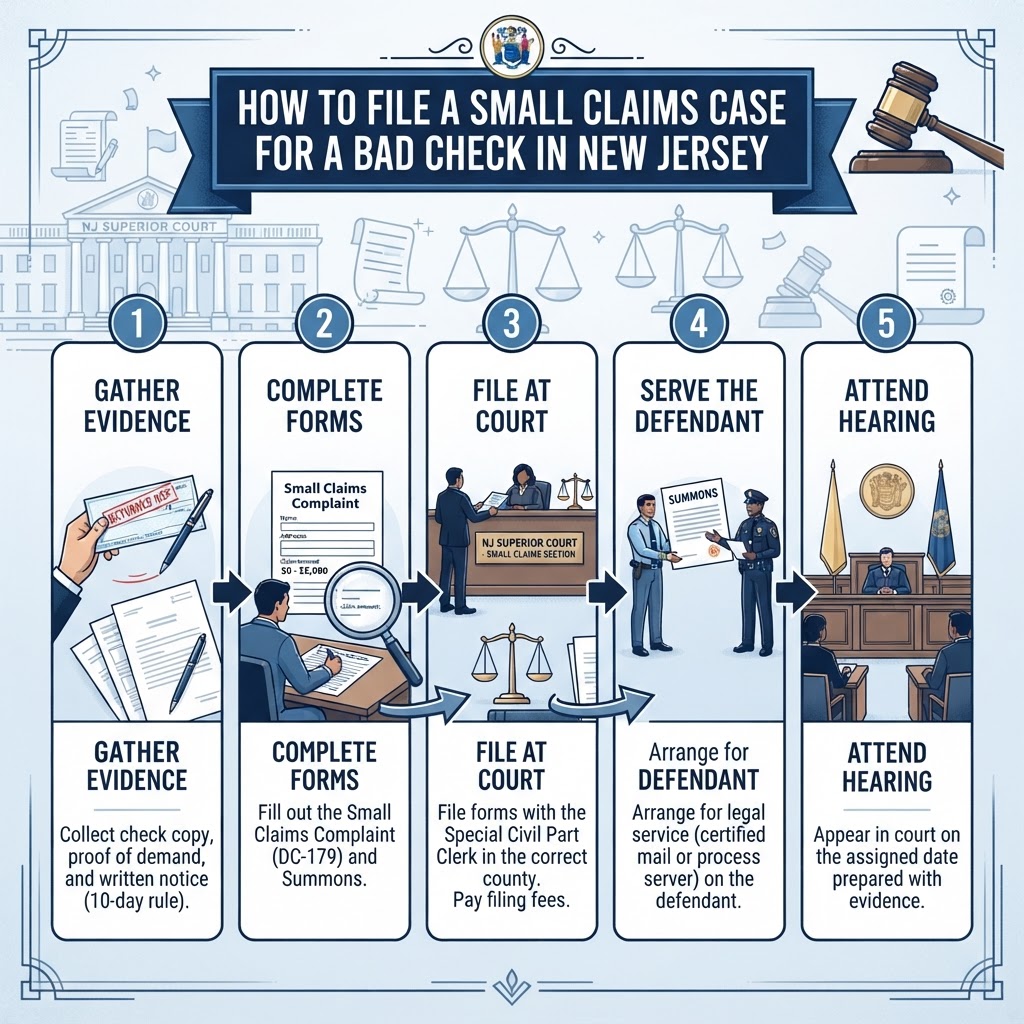
Understanding Your Legal Rights When Dealing With Bad Checks in New Jersey. If you have received a bounced check, you can recover your money by filing a lawsuit in New Jersey Small Claims Court for the total amount of the check plus potential damages. Small Claims Court handles disputes involving claims of $3,000 or less, providing a streamlined path for individuals and businesses to seek justice without the necessity of expensive legal counsel. Under New Jersey law, the issuer of a dishonored check may be liable not only for the face value of the check but also for additional damages if they fail to pay after being notified. The New Jersey Bad Check Statute, found under the New Jersey Statutes Annotated 2C:21-5, allows for specific recovery efforts, provided you follow the strict procedural requirements set by the state courts. Before moving forward, ensure you understand the jurisdictional limits and the necessity of proper documentation as outlined in our [small claims guides by state]. The $3,000 limit represents the current ceiling for the Small Claims section of the Special Civil Part. If your claim exceeds this amount, you must file in the regular Special Civil Part, which handles claims up to $20,000, or the Superior Court for amounts exceeding $20,000. Note that filing in the higher court division may subject you to more complex pleading requirements and higher filing fees. When calculating your total damages, remember that the court will only award you the face value of the check and documented expenses, unless you can prove a specific contractual provision for additional damages. ## The Legal Framework for Recovering Funds. When a check is returned for insufficient funds, you are dealing with a civil breach of contract matter. New Jersey Small Claims Court is a division of the Special Civil Part, governed by the Rules Governing the Courts of the State of New Jersey, specifically Part VI. These rules are designed to be user-friendly, but they do not excuse a plaintiff from meeting the burden of proof. To succeed, you must prove that the check was issued for a valid debt and that the bank refused payment. The process of file a small claims case involves specific filings that demonstrate your diligence in attempting to collect the debt before involving the court. Under Rule 6:1-2, the Special Civil Part is the designated venue for these actions. Because a bad check is often a violation of basic contract law, you do not necessarily need to prove criminal intent under the penal code, though the existence of such intent can sometimes influence the court's view of the defendant's credibility. The civil action focuses strictly on the financial liability of the drawer of the instrument. Per Rule 6:3-1, the process begins with the filing of a complaint and the issuance of a summons. You must ensure that the defendant is served in strict accordance with Rule 6:2-3, which governs the service of process for the Special Civil Part. Proper service is the bedrock of jurisdiction. If you cannot establish that the defendant was served, the court lacks the legal authority to enter a judgment against them, even if the check is clearly fraudulent. ## A Worked Example of Financial Recovery. Consider a scenario where a local vendor, ABC Services, provides catering for a client. The client pays with a check for $1,200. When ABC Services deposits the check, the bank returns it marked as insufficient funds, adding a $25 bank fee to the account. First, the vendor must send a formal demand letter. If the client fails to pay the $1,225 within the statutory window, the vendor files a claim. In court, the vendor seeks the $1,200 face value, the $25 bank fee, and the court filing fee of approximately $50. If the judge rules in favor of the vendor, the judgment amount becomes $1,275 plus post-judgment interest, which the vendor can then attempt to collect through wage garnishment or a levy on the defendant's bank account. To further illustrate the math, suppose the catering contract had a specific clause stating: Any dishonored check will result in a $50 administrative fee plus the actual bank costs. In this case, ABC Services could claim $1,200 for the check, $25 for the bank fee, and $50 for the administrative fee, totaling $1,275. Adding the $50 filing fee and approximately $10 for service of process, the total claim becomes $1,335. If the court grants this, and the defendant fails to pay, the judgment earns post-judgment interest at the rate set by the New Jersey Rules of Court, Rule 4:42-11. As of recent years, this rate is calculated based on the annual judgment rate. For a $1,335 judgment, if payment is delayed by one year, you may be entitled to additional interest of approximately $30 to $50, depending on the current annual rate, significantly increasing the total amount you are owed. ## Mandatory Pre-filing Steps. Before you set foot in the clerk’s office, you must make a genuine effort to collect the debt outside of court. This is not just a suggestion but a practical necessity to show the judge that the litigation is a last resort. We recommend professional demand letter service to ensure your correspondence meets the formal requirements to serve as evidence of your collection attempts. Your letter must clearly state the amount owed, the date of the check, the reason for the dishonor, and a specific deadline for payment, typically 10 to 14 days. Keep a copy of this letter and the return receipt from the certified mail as proof that the defendant received your notice. Why is this mandatory? Many judges require proof of a good faith effort to resolve the dispute before ordering a trial. The demand letter serves as your notice to the defendant that they are in default. If the matter proceeds to trial, showing the judge that you sent a clear, professional, and firm demand letter demonstrates that you are a responsible plaintiff, which can be helpful if the defendant tries to claim they never knew the check was returned. Ensure the demand letter is sent via Certified Mail with a Return Receipt Requested. This provides you with a physical slip from the post office and a card signed by the recipient, which is vital documentation when you appear before the judge. Keep this in a secure file alongside the original bank return notice. Do not wait longer than necessary to send this, as state laws often look favorably upon plaintiffs who move promptly to notify the defendant of the error. ## Essential Documentation and Evidence. To win a small claims case in New Jersey, you must provide the court with a clear paper trail. Judges rely on documents to verify the validity of the debt. Organize the following items into a folder before your hearing: * The original dishonored check (if returned by the bank). * The bank statement showing the check was returned for insufficient funds. * A copy of the formal demand letter sent via certified mail with a return receipt requested. * The original contract, invoice, or receipt that explains why the check was issued. * Any correspondence, including text messages or emails, where the defendant acknowledges the debt or promises payment. * A calculation sheet detailing the total amount requested, including the face value of the check, bank fees, and court costs. When organizing your folder, use labeled dividers. If the judge asks for the contract, you should be able to produce it in five seconds or less. Your calculation sheet is perhaps the most important document. It should list every itemized cost, the date it was incurred, and the total current balance. If you are claiming bank fees, ensure you have a copy of the bank fee schedule or the specific notice from your bank regarding the charge, as the judge will require proof that the $25 or $35 charge was a real loss you suffered. If you do not have the original check, you must have a clear photocopy or an electronic image provided by your bank. ## Step-by-Step Filing Process. 1. Determine the Correct Venue: You must file your claim in the county where the defendant resides, works, or where the check was originally delivered. For example, if you live in Bergen County but the defendant lives in Hudson County, you generally file in Hudson County. If you are a business, you may file in the county where your office is located if the contract was signed there. 2. Prepare the Complaint: Fill out the Small Claims Complaint form available through the New Jersey Judiciary website. You must state the names and addresses of both the plaintiff and the defendant accurately. If the defendant is a business, look them up on the New Jersey Division of Revenue website to get the registered agent's name and address. 3. Pay the Filing Fee: Fees vary slightly by county, but expect to pay between $50 and $75, plus the cost of serving the defendant. Check with the county clerk in your jurisdiction for the exact current rate. In some counties, there is an additional small fee for the electronic filing system, if applicable. 4. Serve the Defendant: Once the complaint is filed, you must serve the defendant with a copy of the lawsuit. This is typically done via certified mail by the court, which costs roughly $10 to $15. If that fails, you may need a process server or sheriff. A process server may charge $50 to $100 depending on the difficulty of locating the individual. 5. Attend the Mediation: Most New Jersey Small Claims courts require parties to participate in mediation before seeing a judge. This is an opportunity to settle the debt without a trial. Mediators are not judges; they are trained volunteers who help you negotiate. Anything you say in mediation is confidential and cannot be used against you in court if a settlement is not reached. 6. Trial Day: If mediation fails, you will appear before a judge. Present your evidence clearly and concisely. Do not interrupt the defendant; simply answer the judge’s questions and provide your documentation when requested. ## Five Common Mistakes That Cost You the Case. Many plaintiffs lose simple bad check cases because they overlook procedural requirements. Avoid these five pitfalls: 1. Suing the Wrong Entity: If you provided services to a corporation, you must name the corporation as the defendant, not the individual who signed the check. Check the New Jersey Secretary of State business records to verify the correct legal name. A judgment against a person who is not the legal owner of the company may be unenforceable. 2. Inaccurate Address: If the defendant cannot be served because the address provided is incorrect, your case will be dismissed. Verify the address through tax records or public property registries before filing. A common mistake is using a PO Box; most courts require a physical address for service. 3. Missing the Statute of Limitations: In New Jersey, the statute of limitations for a contract claim is generally six years under N.J.S.A. 2A:14-1. Do not wait too long to file, as evidence becomes harder to authenticate over time. 4. Including Unverifiable Fees: You cannot add arbitrary penalty fees to your claim unless they were clearly stipulated in a written contract signed by both parties. If the contract is silent on additional penalties, stick to the face value, bank fees, and court costs. 5. Failing to Bring Copies: The court will not make copies of your documents for you. Bring at least three sets of all evidence: one for the judge, one for the defendant, and one for your own records. Arriving without enough copies can delay your case or cause the judge to postpone the hearing until you are properly prepared. ## Frequently Asked Questions. Does the court provide a lawyer? No. Small Claims Court is designed for self-represented litigants. If you feel the case is too complex, you may consult an attorney, though it is often not cost-effective for amounts under $3,000. Many people find the rules of evidence in Special Civil Part are relaxed enough that an attorney is not required for a simple check recovery. What happens if the defendant doesn't show up? If the defendant is properly served and fails to appear, you may ask the judge for a default judgment. You must still prove your case by presenting your evidence, but the absence of the defendant makes the process much faster. You will need to submit a certification of proof to the court to solidify the judgment. How do I collect if I win? Winning a judgment does not automatically result in payment. If the defendant refuses to pay, you may need to pursue collection efforts like bank levies or wage executions through the court clerk. A wage execution, or garnishment, involves serving the defendant's employer, which can be an effective way to recover funds from an individual. A bank levy involves the sheriff or a court officer freezing the defendant's assets in a specific bank account. Both processes require an additional fee paid to the court for each application. CourtLinked prepares documents as a paralegal service, is not a law firm, and does not give legal advice. By preparing your own documents with care and maintaining organized records, you increase your chances of recovering the funds owed to you in the New Jersey court system.
C
CourtLinked
Last reviewed Nov 4, 2026 · Preparing and filing across all 50 states since 2004. Not a law firm, no legal advice. Editorial standards
Related CourtLinked services
Need help filing your small claims case?
File My CaseRelated State Guides
Related Articles
More guides from the CourtLinked Law Library on similar small claims topics.
GeneralSuing a Contractor for Poor Workmanship in New Jersey Small Claims CourtRead article →GeneralWhat is the Maximum Amount You Can Sue for in Small Claims Court?Read article →GeneralHow to Sue for Property Damage in Ohio Small Claims Court: A Step-by-Step GuideRead article →GeneralHow to Win a Security Deposit Dispute in Michigan Small Claims CourtRead article →GeneralHow to Sue for Breach of Contract in Georgia Small Claims Court: A Step-by-Step GuideRead article →GeneralHow to Appeal a Small Claims Court Decision: A Comprehensive GuideRead article →