
GeneralBy CourtLinked Published Oct 30, 2026 9 min read
How to Win a Security Deposit Dispute in Michigan Small Claims Court
Did your landlord unfairly withhold your security deposit? Learn the legal steps to recover your funds in Michigan small claims court with our comprehensive guide.
Understanding Your Rights Under Michigan Security Deposit Law. Recovering an unfairly withheld security deposit in Michigan starts with the Truth in Renting Act and the specific provisions of the Landlord and Tenant Relationships Act, codified under Michigan Compiled Laws (MCL) 554.601 through 554.616. These statutes create a rigid framework that prevents landlords from arbitrary fee retention. To win a dispute in small claims court, you must demonstrate that you provided a forwarding address within four days of vacating the property and that the landlord failed to provide an itemized list of damages within 30 days of your move-out. Under MCL 554.611, the landlord must provide this notice of damages, including an itemized list of specific costs, via a format that specifies the exact nature of the damage and the cost of repair. If the landlord fails to meet these procedural requirements, they waive their right to retain any portion of the deposit, often entitling you to double the amount withheld. This is a punitive provision designed to enforce strict compliance with Michigan law. Small claims court proceedings operate under the Michigan Court Rules (MCR) 4.301 through 4.306, which govern the simplified practice and procedure in these divisions. Understanding that you have the law on your side is the first step toward recovering your funds, as Michigan courts prioritize these statutory timelines above almost all other arguments presented by a landlord.
The Statutory Framework and Deadlines. Under Michigan law, a security deposit cannot exceed one and a half months of rent, as dictated by MCL 554.602. When your lease ends, the landlord has exactly 30 days to return the deposit or provide a written, itemized list of damages. If you disagree with these deductions, you must respond in writing within seven days of receiving the itemized list to satisfy the requirement of MCL 554.612. This written response is legally essential. If the landlord ignores your written objection or fails to send the list entirely, they forfeit their claim to the money. This strict timeline is your strongest weapon. If you are preparing to initiate a claim, you can file a small claims case once these statutory deadlines have clearly passed. Note that Michigan counties, such as Wayne, Oakland, or Kent, may have slight variations in local court rules regarding electronic filing or mandatory mediation, but the underlying MCL statutes remain uniform across the state. The deadline for your lawsuit is governed by the general statute of limitations for contract disputes, typically six years under MCL 600.5807, but waiting this long is ill-advised as evidence becomes difficult to substantiate over time.
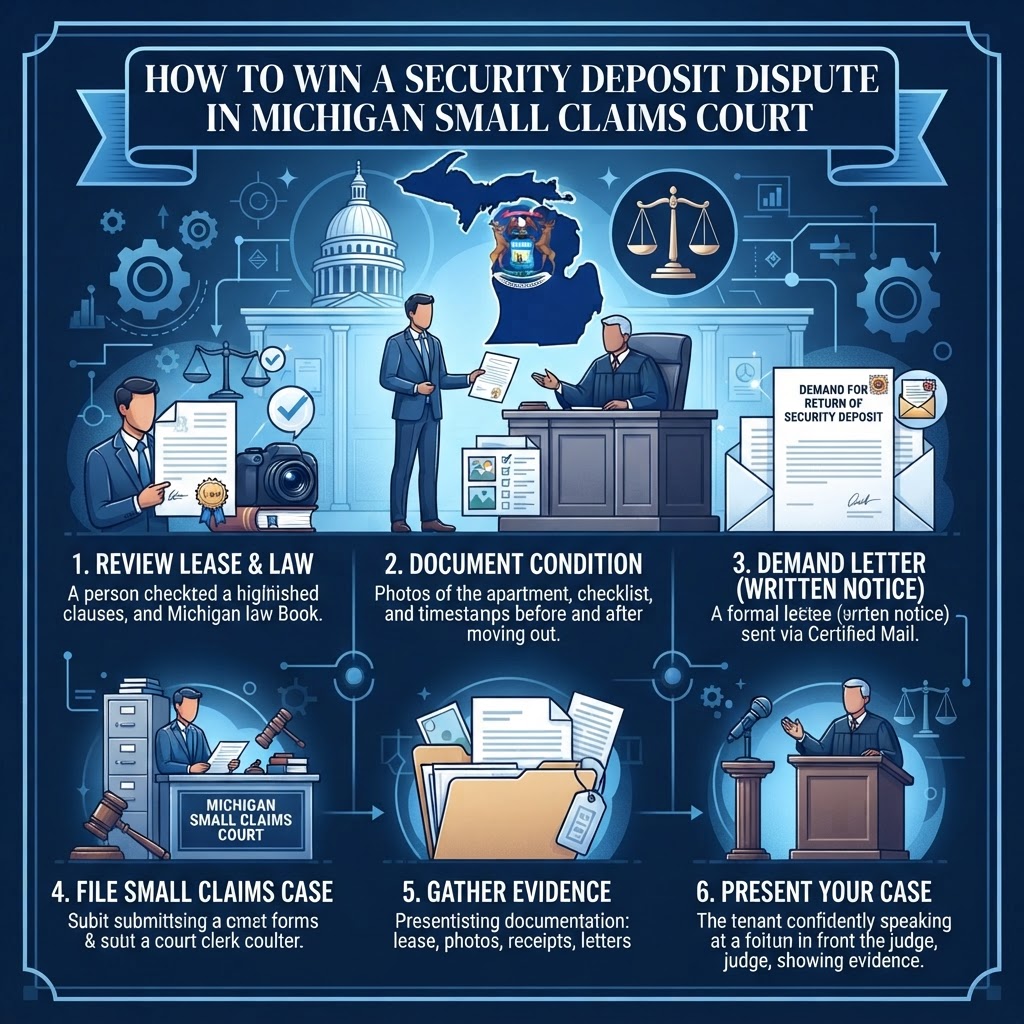
Evidence You Must Prepare. Small claims court judges base their decisions on the preponderance of evidence, meaning you must prove that your version of events is more likely true than not. You cannot rely on your word alone. Before filing, you must organize your documentation into a coherent file. Your evidence packet should include: * A copy of your signed lease agreement including all addendums. * The move-in and move-out inspection checklists required by MCL 554.608, which serves as a baseline for the unit condition. * High-resolution dated photographs showing the condition of every room upon vacating, specifically focusing on corners, flooring, and appliances. * Copies of all correspondence with the landlord, including emails, texts, and letters. * Proof of your forwarding address notification sent to the landlord via certified mail, which provides a tracking number and delivery date. * A copy of the move-out inspection report signed by both parties if applicable. * Receipts or invoices for any cleaning or professional services you performed before leaving, which refute claims of professional cleaning fees. * A detailed, chronological log of all interactions regarding the security deposit dispute, noting dates, times, and the content of conversations. Having this organized before entering the courtroom creates an impression of professionalism and preparedness, which frequently works in a claimant's favor.
The Step-by-Step Recovery Process. 1. Final Inspection and Move-Out: Conduct a walk-through with the landlord or an agent if possible. Always take photos after you have removed your belongings and cleaned the unit to prove you left it in broom-clean condition. 2. Forwarding Address: Send your new address to the landlord in writing within four days of moving out. Use certified mail with a return receipt requested to ensure you have a legal trail. 3. Demand Letter: Before filing a lawsuit, send a final written demand. This letter should explicitly state the amount owed, reference MCL 554.613, and provide a firm deadline for payment. If you find the process daunting, professional demand letter service can ensure your letter cites the appropriate statutes and demands the correct amount in a professional format. 4. Filing the Claim: Visit the district court clerk in the county where the property is located. You will fill out an Affidavit and Claim form (DC 84). Filing fees vary by county but typically range from $60 to $150 depending on the amount sought and the complexity of the filing. 5. Service of Process: You must serve the landlord with a copy of the claim and a summons. You can do this via certified mail or through a court-approved process server, usually costing an additional $20 to $50. 6. Preparation for the Hearing: Organize your evidence in a binder with tabs. Be prepared to present your case clearly and concisely. 7. The Hearing: Attend the hearing on the scheduled date. If the landlord fails to appear, you may move for a default judgment under MCR 2.603.
Worked Example: Calculating Your Claim. Consider a scenario where your monthly rent was $1,000. You paid a security deposit of $1,500. Upon moving out, the landlord sends an itemized list deducting $400 for general cleaning and $600 for carpet shampooing, despite you having professionally cleaned the unit. You sent a letter objecting to these charges within seven days, but the landlord ignored you. You sue for the withheld $1,000. Because the landlord failed to justify the deductions per the lease or failed to prove damages exceeded normal wear and tear, the judge may rule in your favor. If the judge finds the landlord acted in bad faith, you might be awarded double the withheld amount, meaning you could walk away with $2,000 plus your court filing fees and potential service of process costs. For a second example, assume your rent was $1,200 and you paid a deposit of $1,800. The landlord provides no list of damages within 30 days. You sue for the $1,800. Under MCL 554.613, the court may find the landlord liable for double the amount withheld because they ignored the 30-day notice requirement entirely. You would seek a judgment for $3,600, plus the $120 filing fee and $40 process server fee, totaling $3,760 in potential recovery.
Common Mistakes to Avoid. Many tenants lose their cases not because they are wrong, but because they commit procedural errors. 1. Missing the Notification Window: Failing to provide a forwarding address within four days of vacating allows the landlord to retain the deposit without providing an itemized list, as the landlord no longer has a legal requirement to find you. 2. Paying Without Protesting: If you receive a list of damages and you do not send a written objection within seven days, you are legally presumed to have accepted those charges. Silence is treated as consent in the eyes of the court. 3. Failing to Document Wear and Tear: Distinguish between damage and normal wear and tear. A landlord cannot charge you to replace a carpet that reached the end of its functional life while you were a tenant. Be prepared to argue that items like worn paint or minor carpet traffic are ordinary depreciation. 4. Improper Service: If the landlord is not served the claim according to court rules, the case will be dismissed regardless of the facts. Always verify service via the return receipt or the process server affidavit. 5. Aggressive or Disorganized Testimony: Judges in small claims court value facts over emotional outbursts. Stick to the dates, the statutes, and your documented proof. Avoid bringing hearsay or complaints about non-deposit issues, as these distract from the core legal argument.
Jurisdiction and Small Claims Limits. Michigan small claims courts allow for a maximum judgment of $7,000 per the current statutory ceiling. If your deposit dispute involves an amount higher than this, you may need to file in the civil division of the district court, which follows more formal rules of evidence and procedure, including the requirement for attorneys to be present or at least heavily involved. For those looking for broader information, our small claims guides by state offer additional context for navigating various jurisdictions. Note that if a case is filed in small claims, parties generally waive their right to a jury trial and the right to be represented by an attorney unless specific conditions are met. This keeps the process accessible, but it also places the burden on you to understand the local district court's specific filing procedures. Remember that while small claims court is designed to be accessible to non-lawyers, being prepared is the single greatest factor in your success. CourtLinked prepares documents as a paralegal service, is not a law firm, and does not give legal advice. If you have a complex situation or feel overwhelmed by the legal technicalities, consult with an attorney to ensure your rights are fully protected. Always verify the current filing fees with the specific district court clerk, as these are adjusted periodically by local administrative orders.
C
CourtLinked
Last reviewed Nov 4, 2026 · Preparing and filing across all 50 states since 2004. Not a law firm, no legal advice. Editorial standards
Related CourtLinked services
Need help filing your small claims case?
File My CaseRelated State Guides
Related Articles
More guides from the CourtLinked Law Library on similar small claims topics.
GeneralHow to Appeal a Small Claims Court Decision: A Comprehensive GuideRead article →GeneralWhat is the Maximum Amount You Can Sue for in Small Claims Court?Read article →GeneralHow to Sue for Property Damage in Ohio Small Claims Court: A Step-by-Step GuideRead article →GeneralHow to Sue for Breach of Contract in Georgia Small Claims Court: A Step-by-Step GuideRead article →GeneralHow to Serve a Defendant in Small Claims Court: A Complete GuideRead article →GeneralHow to File a Small Claims Case for a Bad Check in New JerseyRead article →