
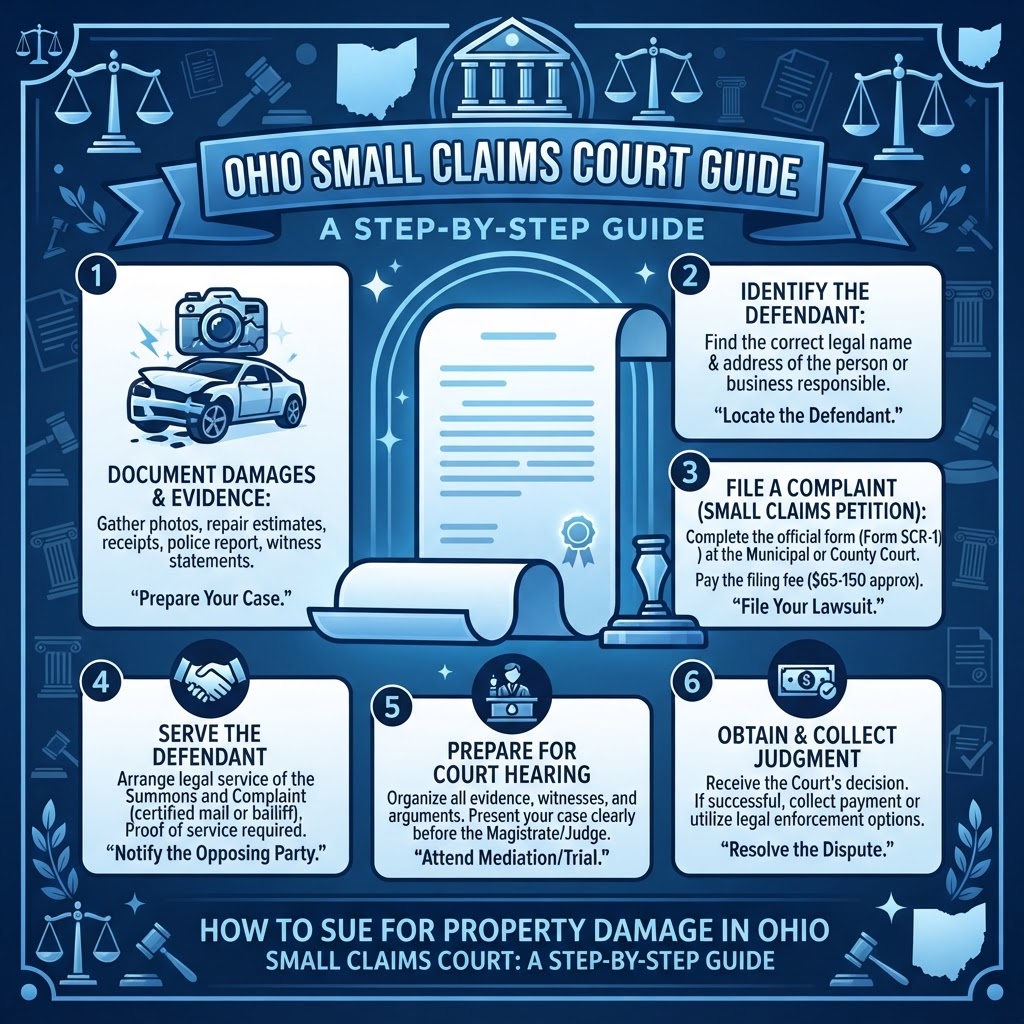
How to Sue for Property Damage in Ohio Small Claims Court: A Step-by-Step Guide
Discover how to effectively sue for property damage in Ohio small claims court. This guide walks you through filing procedures, evidence collection, and navigating the legal process to recover your losses.
Recovering Property Damage in Ohio Small Claims Court
To sue for property damage in Ohio small claims court, you must file a complaint in the municipal or county court where the defendant resides or where the damage occurred, ensuring your claim does not exceed the statutory limit of $6,000. Success requires formal documentation, a clear narrative of the incident, and strict adherence to local filing procedures and statutory deadlines known as the statute of limitations. Navigating this legal process effectively ensures you protect your right to compensation for damaged personal or real property without the necessity of expensive legal representation. Small claims courts in Ohio are intended to be accessible to pro se litigants, meaning you represent yourself without an attorney.
Understanding Ohio Small Claims Jurisdiction
Ohio small claims courts, which are divisions of municipal or county courts, are designed to handle civil disputes involving smaller amounts of money. Under the Ohio Revised Code (ORC) Section 1925.02, these courts provide a simplified procedure for resolving claims. The most critical constraint is the jurisdictional limit. In Ohio, you can sue for property damage up to $6,000. If your damages exceed this amount, you have two choices: abandon the excess to remain within the court's jurisdiction or file your case in a court of general jurisdiction, which generally requires a formal attorney. It is important to remember that small claims courts do not have the authority to grant injunctions or order specific performance. They are exclusively focused on monetary judgments. If you are struggling with the initial steps, you can file a small claims case through resources designed to simplify the paperwork.
Jurisdiction is strictly territorial. If you file in a county where neither the defendant lives nor the damage occurred, the court may dismiss your case for improper venue. For instance, in a large county like Franklin or Cuyahoga, there may be multiple municipal courts. You must file in the specific municipal court that covers the zip code where the incident took place. While the $6,000 limit is a state-wide ceiling under ORC 1925.02, individual courts cannot raise this limit, though they may have varying internal local rules regarding electronic filing or mandatory mediation sessions prior to the hearing.
Determining the Statute of Limitations and Deadlines
The statute of limitations for property damage in Ohio is generally two years from the date the damage occurred, as governed by ORC 2305.10. If you fail to file your lawsuit within this two-year window, you permanently lose the right to pursue the claim. There are limited exceptions, such as if the defendant hides or leaves the state, which may toll the clock under ORC 2305.15, but these are rare and difficult to prove. You should always aim to file well before the deadline to avoid procedural delays that might push your filing past the date.
Beyond the two-year filing window, watch for court-specific deadlines. After filing, the clerk will issue a summons. If service is not perfected within six months, the court may dismiss your case without prejudice under Ohio Rule of Civil Procedure 4.E. If you are filing against a government entity, notice requirements can be much shorter, sometimes as brief as 60 or 90 days depending on the political subdivision. Always verify the filing fee deadlines; some courts require the fee at the exact moment of filing, while others may offer a grace period for costs, though this is rare. When preparing your timeline, count the days carefully starting the day after the damage occurred.
The Procedural Sequence to Recover Damages
Filing a lawsuit is a structured process that requires precision. If your paperwork is incomplete, the clerk of courts will reject your filing.
- Identify the Proper Defendant: You must determine the legal name of the individual or business that caused the damage. If it is a business, search the Ohio Secretary of State database to find the registered agent. Do not sue a trade name, as it is not a legal entity. Suing 'Bob's Repairs' will fail; you must sue the registered owner or the formal corporate entity.
- Send a Demand Letter: Before filing, it is professional and often legally advantageous to send a formal demand letter. This document notifies the other party of your intent to sue and offers a final opportunity for settlement. You may use professional demand letter service to ensure your document meets professional standards. Keep a copy of this letter and the return receipt if sent via certified mail.
- File the Complaint: Visit the clerk of court in the appropriate jurisdiction. You will fill out a complaint form detailing the facts of the damage and the amount sought. You must attach a copy of the contract, invoice, or estimate that proves your damages.
- Pay Filing Fees: Fees vary significantly by county. Expect to pay between $50 and $150 depending on the local court's fee schedule. For example, some municipal courts in larger cities may charge $80 for the initial filing, plus an additional $20 per defendant for service. Check the court's website for the current fee schedule.
- Service of Process: Once filed, the court must serve the defendant with a copy of the complaint and the summons. This is usually handled by the court via certified mail. If that fails, you may need to request alias service by residential service or service by publication, which adds to your costs.
- The Hearing: Both parties will appear before a magistrate or judge. You must be prepared to present your evidence and prove the defendant is liable for the damages.
Concrete Worked Example: Property Damage Scenario
Imagine your neighbor accidentally backs their vehicle into your high-end fence, causing damage totaling $4,200. You obtain two independent quotes from licensed contractors, both confirming the repair cost is $4,200. The neighbor refuses to pay. First, you calculate your damages: $4,200 in repairs plus a $100 filing fee and $40 in certified mail costs. Your total claim is $4,340. You file your complaint for $4,340. At the hearing, you present the police report from the incident, the two written repair estimates, and photos of the fence before and after the collision. The judge rules in your favor, awarding the full $4,340. This recovery covers your repair costs and recovers the out-of-pocket expenses incurred by filing the lawsuit.
Consider a second scenario: You hire a contractor to fix a roof, and they damage your siding in the process. The repair for the siding is $1,500. You pay $95 to file the claim and $35 for certified mail. You add these costs to the $1,500 claim, totaling $1,630. If the contractor does not show up to court, you can ask for a default judgment. However, you must still provide the court with your evidence, such as the contract with the contractor, photos of the siding before and after, and the invoice for the repair. If the judge grants the judgment, you are then responsible for collecting the money, which may involve garnishing the defendant's bank account if they refuse to pay voluntarily.
Essential Evidence List
To succeed in court, you must provide a preponderance of the evidence. This means your version of the facts is more likely true than not. Gather the following:
- Photographic or video evidence of the property damage from multiple angles. Print these in color to ensure the details are visible.
- Written repair estimates from two reputable, licensed contractors or repair professionals. These should be on company letterhead and include the contractor's contact information.
- Proof of ownership or lease interest in the damaged property, such as a deed or a signed lease agreement.
- Police reports or incident reports if the damage was caused by a criminal act or a major accident. Ensure these are certified copies if possible.
- Receipts for any temporary repairs made to prevent further damage. Under the law, you have a duty to mitigate, and these receipts prove you acted responsibly to stop the loss from growing.
- Correspondence with the defendant, including emails, texts, or letters discussing the incident and their refusal to pay.
- A detailed timeline of the events leading up to and following the damage. This acts as your outline during testimony to keep you focused on the facts.
Avoiding Costly Mistakes
Many plaintiffs lose cases not because they are wrong, but because they are unprepared.
- Suing the Wrong Entity: If you sue a business owner individually instead of the corporate entity, or vice versa, the court may dismiss your case. Always check the business name exactly as registered with the Secretary of State.
- Poor Documentation: If you show up with no paper trail, the judge has little basis to award you the full amount you request. Always bring printed copies for yourself, the judge, and the defendant. Bring three sets of every document.
- Failing to Mitigate Damages: Ohio law requires you to take reasonable steps to prevent further damage. If you leave a window broken for months and water damage occurs, the court may refuse to award costs for the water damage. Document every action you take to secure the property immediately following the incident.
- Missing Court Dates: This is the most common reason for loss. If you miss your scheduled hearing, the judge will likely dismiss your case with prejudice, meaning you cannot refile. If you absolutely cannot attend, file a motion for a continuance at least one week before the hearing.
- Emotional Testimony: Courts deal in facts, not emotions. Avoid shouting, interrupting, or focusing on how unfair the situation feels. Stick to the evidence and the sequence of events. A judge will appreciate brevity and clarity.
If you find the process of identifying defendants or calculating damages confusing, you can review our small claims guides by state for region-specific advice that supplements this general Ohio procedural overview. Always remember that the burden of proof rests entirely on you, the plaintiff.
Preparing for the Hearing
The hearing is your only chance to present your side. Dress professionally and arrive at least 20 minutes early. When the judge or magistrate calls your case, speak clearly and answer questions concisely. Do not argue with the defendant when they are speaking. Wait for your turn. Bring your original documents and at least two copies. The court will keep one set, and you will need to provide one set to the defendant if they have not already received them. If you feel overwhelmed by the procedural requirements, CourtLinked prepares documents as a paralegal service, is not a law firm, and does not give legal advice. By following these steps and maintaining rigorous organization, you maximize your chances of recovering your losses in Ohio small claims court.
Last reviewed Nov 4, 2026 · Preparing and filing across all 50 states since 2004. Not a law firm, no legal advice. Editorial standards
Related CourtLinked services
Need help filing your small claims case?
File My CaseRelated State Guides
Related Articles
More guides from the CourtLinked Law Library on similar small claims topics.