
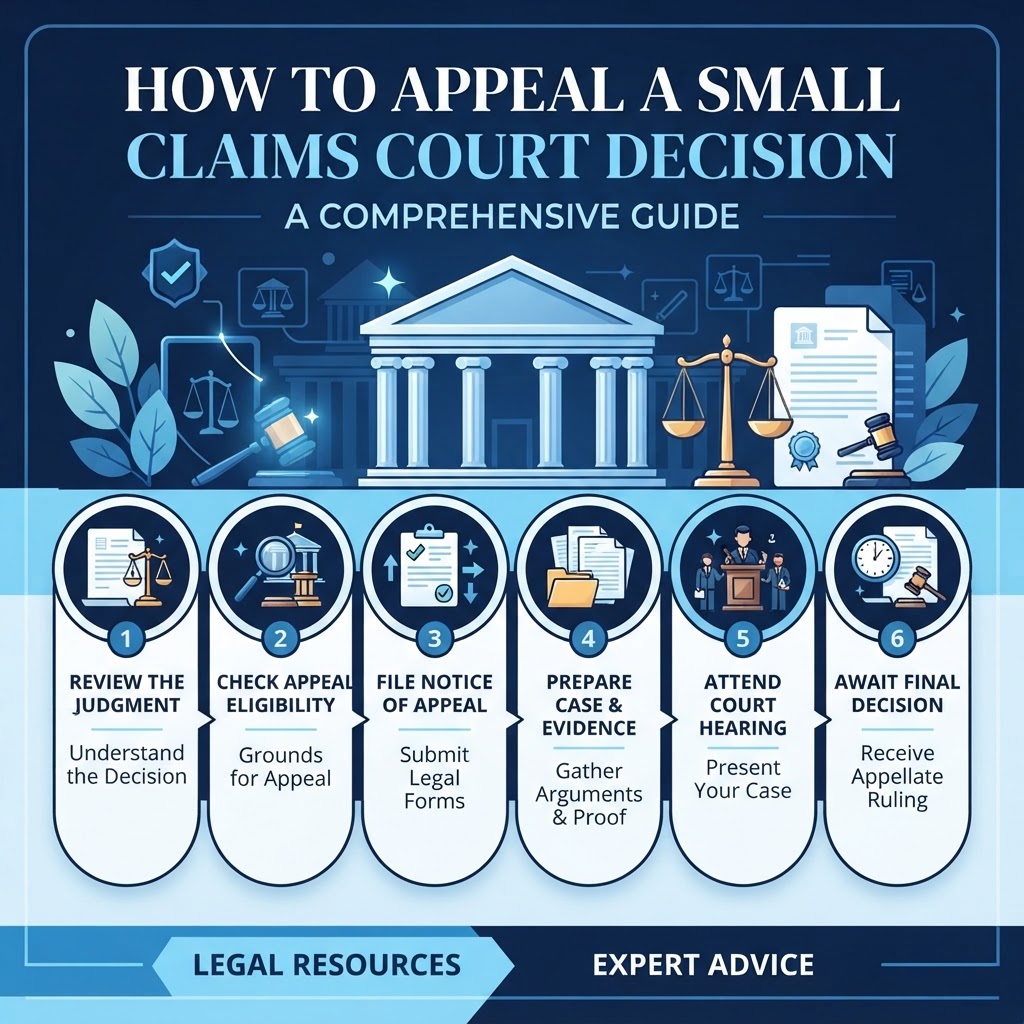
How to Appeal a Small Claims Court Decision: A Comprehensive Guide
Lost your case in small claims court? Learn the essential steps, strict deadlines, and specific legal considerations—including Michigan-specific rules—for filing an appeal.
The Comprehensive Guide to Appealing a Michigan Small Claims Judgment
Losing a small claims case is not the end of the road, but the right to appeal is strictly time-bound and requires adherence to specific procedural rules. In Michigan, the process is governed by the Michigan Court Rules, specifically the MCR 7.100 series, which dictates how a judgment from a district court small claims division moves to the circuit court for review. Understanding these rules is vital because small claims court in Michigan is designed to be a forum of last resort for modest disputes, where the judge's decision is usually final unless a significant procedural error occurred.
The Legal Foundation for Appealing a Michigan Small Claims Judgment
Small claims courts are designed for efficiency, which is why the law imposes limitations on the appellate process. Because these proceedings are intended to be informal, you cannot appeal a decision simply because you disagree with the judge. You must identify a legal error, such as a misapplication of state law or a violation of due process. Michigan law mandates that you must file your claim of appeal within 20 days after the date the judgment was entered. Missing this window effectively waives your right to appeal, and the district court judgment will become permanent.
It is important to understand that small claims appeals in Michigan are governed by MCR 4.305, which notes that the appeal is heard in the circuit court for the county where the district court is located. The scope of review is not a trial de novo unless there was no record made of the original proceeding. In most modern courtrooms, digital recording devices capture the proceedings, meaning the circuit court will review the existing record rather than re-hearing the evidence. You must familiarize yourself with small claims guides by state to confirm if there are any specific local administrative orders in your county that supplement the Michigan Court Rules. For instance, Wayne County may have different electronic filing protocols compared to a rural county in the Upper Peninsula.
The Procedural Roadmap
Appealing a small claims decision requires precision. You are moving from an informal district court setting to a circuit court, which carries more formal requirements.
- Review the Judgment: Obtain a copy of the written judgment from the district court clerk. Ensure you understand exactly what the court decided. The judgment form usually identifies the final amount of damages, interest, and costs awarded.
- Prepare the Claim of Appeal: You must complete the state-approved form, typically identified as Form CC 265, which is the official "Claim of Appeal." This document notifies the court and the opposing party that you are initiating an appellate review.
- Pay the Filing Fee: You are required to pay a filing fee to the circuit court. While the base fee is set by state statute, the total often varies between $150 and $200 because of additional local library fees or electronic filing technology surcharges. Always call the specific clerk of the court in the county where the trial occurred to get the exact check amount required.
- Bond Requirements: Under MCR 4.305(C), the court may require you to post an appeal bond. This ensures that if the judgment is upheld, the prevailing party is protected. The amount is often set at the judgment amount plus additional costs and potential interest. If you cannot afford the bond, you must request a waiver or stay, though this is rarely granted without a high showing of financial hardship.
- Service of Process: You must serve the opposing party with a copy of the filed claim of appeal within the statutory time frame. Under MCR 2.107, service is usually accomplished by first-class mail or personal delivery. You must strictly follow the rules for proof of service.
- Filing Proof of Service: You must return to the clerk with proof that the other party received the document. This is typically done by filing the affidavit of service or the signed postal receipt.
Evidence and Documentation Checklist
Success on appeal often hinges on your ability to point to concrete errors in the original record. To prepare your case, organize the following:
- The original small claims complaint and any countersuits filed. These establish the jurisdictional basis for the claim, which is capped at $7,000 under Michigan law (as of recent updates to MCL 600.8401).
- A complete copy of the judgment entry signed by the district court judge. Ensure it is date-stamped, as the 20-day clock begins from the entry date, not the hearing date.
- Any exhibits that were presented to the judge during the initial trial. If you have copies, ensure they are marked exactly as they were in the lower court, such as "Plaintiff Exhibit 1."
- A transcript of the hearing. Note that you may need to hire a court reporter if the district court did not provide a digital record. This is a critical piece of evidence. You must request this promptly, as court reporters have specific statutory timelines for delivery.
- Your notice of intent to appeal, showing you complied with the 20-day window.
- Records of any demand letter service used prior to the original litigation to prove you attempted to resolve the dispute before court intervention. While not usually "evidence" for the appeal, it helps demonstrate that you acted in good faith during the underlying dispute.
Worked Example of Financial Requirements
Scenario A: You were sued for $4,500 and the judge ruled against you. You decide to appeal.
- Step 1: Circuit Court Filing Fee: $175 (Average).
- Step 2: Transcript Fees: Assuming a 1-hour hearing, you may pay a court reporter $200 to $400 depending on the complexity of the testimony.
- Step 3: Appeal Bond: The judge orders a bond of $4,500 (Judgment) + $250 (Costs/Interest) = $4,750.
- Total Cash Needed Upfront: $5,125.
Scenario B: You sue a neighbor for $6,000 for property damage, but the judge awards you only $1,000. You appeal seeking the full amount.
- Step 1: Filing Fee: $175.
- Step 2: Transcript: $250.
- Step 3: Bond: Often required by the court to cover potential costs of the appeal process itself, even if you are the appellant. The total investment here is approximately $425 in fees plus time, with no guarantee of success.
If you decide to file a small claims case in the future, remember that documenting every interaction with the defendant is your best insurance against an unfavorable outcome that leads to an expensive appeal.
Common Mistakes to Avoid
- Filing Late: The 20-day rule is absolute. If you file on day 21, the clerk will reject your documents, and you lose all appellate rights. There is no "mailbox rule" that counts the postmark date as the filing date; the document must be received by the clerk.
- Ignoring the Transcript Requirement: Many litigants assume the circuit court judge knows what happened in the district court. Without a certified transcript of the trial, the appellate judge cannot review the evidence, and your case will likely be dismissed for failing to provide a record.
- Failing to Serve the Opposing Party: Filing with the clerk is only half the battle. If you do not serve the defendant with your appeal documents properly, the court lacks personal jurisdiction to proceed with the appeal.
- Providing New Evidence: An appeal is not a new trial. You cannot introduce new receipts, updated estimates, or witnesses that were available but not used during the original small claims hearing. You are strictly confined to the record created at the first trial.
- Miscalculating Costs: Do not forget to account for the costs of hiring a court reporter for the transcript. This can often cost more than the court filing fees, and failing to budget for it often stalls the appeal process by months.
- Failure to comply with MCR 7.100: Some litigants forget that the circuit court appeal is governed by the same appellate rules as higher court cases. You must format your briefs according to court standards, including font size and page limits.
The Role of the Circuit Court
The circuit court acts as an appellate body in these instances. They do not hear new testimony. Instead, they review the transcript and the briefs submitted by both parties to determine if the district court judge made a significant error of law. This is a much more rigid process than the initial district court hearing. The judge will look for instances where the court misapplied the law or ignored facts that were clearly established by the evidence. For example, if the law requires a written contract for a specific type of service and the judge ignored the lack of one, this is a legal error that the circuit court can rectify. If the judge simply decided one witness was more credible than another, that is a factual finding, and the circuit court is very unlikely to overturn that decision.
Understanding the Burden of Proof
In the district court, the burden of proof is typically a preponderance of the evidence, meaning you have to show that your version of events is more likely true than not. On appeal, the burden shifts entirely. You bear the burden of proving that the lower court committed a reversible error. This is a heavy lift. You must show that the outcome would have been different had the judge not made the identified error. If the error was "harmless," meaning the judge would have reached the same conclusion even without the mistake, the appellate court will affirm the original judgment. It is not enough to show that the judge could have ruled differently. You must demonstrate that the judge made a legal error that invalidated the outcome.
Preparing for the Appeal Hearing
If your appeal is accepted, the circuit court may schedule an oral argument. Prepare a concise summary of the legal errors you identified. Do not re-argue the entire case. Focus strictly on the specific rulings or procedures that violated your rights or the law. Keep your presentation professional and stick to the facts recorded in the trial transcript. When addressing the court, refer to the judge as "Your Honor" and remain within the time limits provided by the court clerk. If you are not comfortable with the legal filing process, consider that CourtLinked prepares documents as a paralegal service, is not a law firm, and does not give legal advice.
Closing Considerations
Appealing a small claims judgment is a serious decision that carries financial risk and requires a strong grasp of court procedures. Before committing the time and money, ensure your case meets the standard for an appeal. If you simply feel the judge did not like you or made a choice between two equally plausible versions of events, an appeal is unlikely to be successful. Only move forward if you can pinpoint a definitive mistake in the legal process used by the court.
Consider whether the amount in controversy justifies the effort. If you won $500 but wanted $1,000, spending $500 in filing and transcript fees might result in a net loss or a zero-sum game even if you win the appeal. Always consult the Michigan Court Rules online or visit your local law library if you are unsure about the specific requirements of your jurisdiction. By following the steps outlined above and adhering to the strict Michigan deadlines, you give yourself the best possible chance to overturn an incorrect judgment.
Last reviewed Nov 4, 2026 · Preparing and filing across all 50 states since 2004. Not a law firm, no legal advice. Editorial standards
Related CourtLinked services
Need help filing your small claims case?
File My CaseRelated State Guides
Related Articles
More guides from the CourtLinked Law Library on similar small claims topics.