
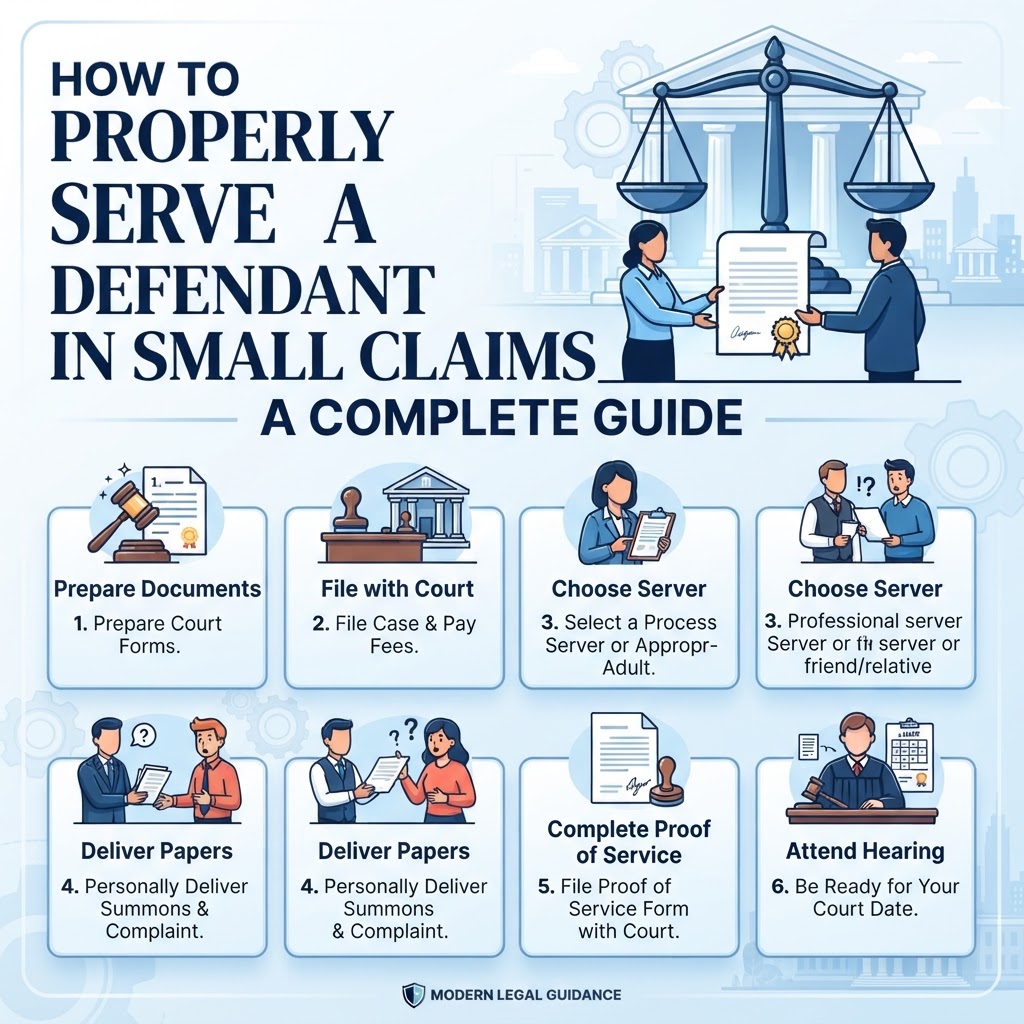
How to Serve a Defendant in Small Claims Court: A Complete Guide
Service of process is the step that makes or breaks a small claims case. This guide covers every approved method, how to prove service, and exactly what to do when the defendant dodges the process server.
The Definitive Guide to Serving a Defendant in Small Claims Court
Serving a defendant is the legal foundation of your small claims case. It is the formal process by which the court gains personal jurisdiction over the opposing party. Without proper service of process, the court lacks the constitutional authority to hear your case, and any judgment you obtain could be declared void. This guide provides a comprehensive procedural roadmap to ensure your service is legally valid, compliant with due process, and effectively executed.
Understanding the Legal Significance of Service
In the justice court system, which handles small claims disputes involving amounts up to 20,000 dollars under Texas Government Code Section 27.031, service of process is more than a mere notification. It is a constitutional requirement of due process under both the Texas Constitution and the Fourteenth Amendment of the U.S. Constitution. Proper service is the legal trigger that compels the defendant to appear in court; failure to adhere to the strict procedural rules set out in the Texas Rules of Civil Procedure (TRCP) will result in your case being dismissed or delayed indefinitely.
Before you initiate the service process, ensure you have correctly file a small claims case by checking your local county justice court requirements. Filing fees vary by precinct and county, typically ranging from 50 to 150 dollars depending on the county and the number of defendants named in the suit. It is essential to contact your specific Justice of the Peace (JP) office to confirm their local standing orders, as some counties mandate specific forms for requesting service. If you are still in the early stages, you may also consider professional demand letter service to potentially resolve the matter before resorting to litigation, as a formal demand can often prompt a settlement without the need for court intervention or service costs.
Step-by-Step Execution of Service
- Filing the Petition: You file your original petition in the justice court where the defendant resides, where they have a place of business, or where the incident occurred (venue requirements under TRCP Rule 502.4). You must pay the filing fee at this stage.
- Requesting Issuance of Citation: Once the petition is filed, request the court clerk to issue a citation. The citation is the formal document commanding the defendant to answer the lawsuit within 14 days after the day they are served, as per TRCP Rule 503.2.
- Selecting a Method of Service: You must choose how the citation and petition will reach the defendant. This process is governed by TRCP Rule 501.2.
- Executing Service: The document is delivered by a constable, sheriff, or a private process server authorized by the court. The server acts as an arm of the court to verify delivery.
- Filing Proof of Service: The server must complete a Return of Service and file it with the court clerk. The court cannot proceed until this document is on file for at least three days prior to the trial date, excluding the day of filing and the day of the hearing.
Authorized Methods of Service Under Texas Rules
Texas law provides several specific methods for ensuring the defendant receives notice. Understanding these options is vital to avoiding procedural errors.
Certified Mail with Return Receipt Requested
This is the most common and cost-effective method. You pay the court clerk the required service fee, which is often around 80 to 100 dollars in larger counties, and the clerk sends the documents via certified mail. The defendant must sign for the envelope, and the green return receipt card (USPS Form 3811) is sent back to the court as proof of service. If the green card is signed by someone other than the defendant, verify if your specific judge accepts service on an occupant of the residence.
Personal Service via Constable or Private Process Server
If the defendant is evasive or the case is high-stakes, you may need to hire a constable or a private process server. A private process server must be certified by the Supreme Court of Texas if they are appointed to serve in specific counties. They will physically hand the documents to the defendant or leave them with a person of suitable age at the defendant's residence. The costs for a private server vary widely, often between 75 and 150 dollars depending on the distance traveled and the number of attempts required.
Important Restrictions on Service
Never attempt to serve the defendant yourself, even if you are simply handing them the papers. Texas law strictly forbids the plaintiff from serving the defendant, and doing so will result in the immediate invalidation of the service under TRCP Rule 501.2. Always use a disinterested third party, such as a professional process server, the county sheriff, or a neutral adult over the age of 18 who is not a party to the litigation.
The Importance of the Return of Service
The Return of Service is the formal document that informs the court the defendant has been served. It must include the date and time of delivery, the identity of the person served, and the signature of the process server. Without this document, the court is technically unaware that the defendant knows about the lawsuit.
You are responsible for ensuring the server actually files the proof of service with the clerk. Always follow up with the clerk’s office one week before your scheduled hearing to confirm that the Return of Service is officially in the case file. If the return of service is not in the file at least three days before the trial date, the judge cannot hold the hearing. If it is missing, contact the process server immediately to inquire about the status. Keep a physical copy of the return in your records to ensure that if the original is lost by the court clerk, you have proof of the date of service.
Navigating Evasion Tactics and Alternative Service
When a defendant refuses to answer the door or avoids your server, the burden shifts to you to prove that you acted in good faith to inform them of the suit. Courts generally require at least three failed attempts at different times of the day and different days of the week before considering alternative measures.
Documenting Due Diligence
A process server should create a log containing the date, the precise time (e.g., 8:15 AM), the GPS coordinates of the site, and a narrative description of why service failed, such as "observed movement inside but no answer" or "gate locked and buzzer disconnected." Many courts require the filing of an "Affidavit of Due Diligence" before they will even consider a request for alternative service.
Substituted Service Under Rule 501.2
If you have made multiple failed attempts at personal service, you can request a motion for substituted service under TRCP Rule 501.2(e). You must provide the court with an affidavit detailing the unsuccessful attempts. If the judge grants the motion, you may be allowed to leave the documents with anyone over 16 years old at the defendant's residence or perform service in another manner that the court deems reasonably effective. This order must be specific to the circumstances provided in your affidavit.
For extreme cases where the defendant cannot be found, you may look into service by publication, which is a last-resort measure. This often involves significant expenses, such as newspaper advertisement fees ranging from 200 to 500 dollars, and should only be pursued after all other avenues are exhausted.
What Happens if Service is Quashed?
If the defendant challenges service in court and claims they were not served, or if the court finds the service "defective," the judge may "quash" (invalidate) the service. If this occurs, you will be forced to restart the service process. If the service was improper due to an incorrect address, you will need to perform a "skip trace" or research to find a new, valid address. If the error was procedural, you must ensure the next attempt strictly complies with the Texas Rules of Civil Procedure. Because this can delay your case by weeks or months, accuracy during the initial attempt is paramount.
Financial Planning for Service
Litigation costs can mount quickly. It is critical to calculate these expenses accurately and include them in your "Prayer for Relief" within your petition. If you fail to include these costs in your initial pleading, the judge may be unable to legally tax them against the defendant if you prevail.
- Scenario A: You sue a contractor for 5,000 dollars. Filing fee is 75 dollars. You choose constable service at 90 dollars. Total: 165 dollars.
- Scenario B: You sue a landlord for 8,000 dollars. Filing fee is 50 dollars. The defendant evades service, requiring you to pay a private process server 125 dollars for three attempts. Later, the judge requires an alias citation for a corrected address, costing an additional 25 dollars. Total investment: 200 dollars.
Always keep receipts from the process server or sheriff's office. If you win the judgment, these service costs are typically added to the final award, allowing you to recover your out-of-pocket expenses.
Documents Required for Service Success
To ensure your service is legally valid, compile a folder or binder with the following documentation:
- A copy of your filed Petition with the court stamp.
- The court-issued Citation (ensure the defendant's name matches exactly as per their business registration or legal identity).
- A verified list of the defendant's home and work addresses.
- Any court orders or motions if you are requesting alternative service.
- A list of known aliases for the defendant if they have a common name or use multiple business identities.
- A chronological timeline summary sheet (e.g., "Oct 1: Demand letter sent; Oct 15: Process server attempted service; Oct 17: Motion for Alternative Service filed").
When the judge asks if the defendant has been served, you should be prepared to hand them this entire packet. If the defendant claims in court that they were never served, this organized paper trail helps impeach their testimony and demonstrates your commitment to due process.
Five Common Mistakes and How to Avoid Them
- Providing an Incorrect Address: The most common reason for failed service is providing an outdated residential or business address. Always verify the address through a public records search or by checking the Secretary of State website if the defendant is a business.
- Attempting Self-Service: Texas law strictly forbids the plaintiff from serving the defendant. Doing so will result in the immediate invalidation of the service.
- Failing to Monitor the Return of Service: You are responsible for ensuring the server actually files the proof of service with the clerk. If the return of service is not in the file before the trial date, the judge cannot hold the hearing.
- Neglecting the Three Day Rule: The Return of Service must be on file with the clerk for at least three days before the trial date, excluding the day of filing and the day of the hearing.
- Ignoring Business Entity Requirements: If you are suing a corporation or LLC, you must serve the registered agent on file with the Texas Secretary of State. Serving an employee or a manager who is not the registered agent is insufficient and will be rejected by the court. Use the SOSDirect portal to find the correct agent.
Final Steps and Default Judgments
Once service is confirmed, the clock starts for the defendant to file an answer. If the defendant fails to show up after being properly served, you may move for a default judgment. However, do not assume success. Even in a default scenario, you must present your evidence of the debt and damages to the judge to prove your case.
Furthermore, remember that after obtaining a judgment, you may need to serve the defendant with a "Notice of Entry of Judgment." This secondary notice triggers the period during which the defendant can appeal—usually 30 days. If you fail to serve this, you may inadvertently extend the defendant's window to challenge your victory.
For further clarification on specific procedural nuances, refer to our comprehensive small claims guides by state for updated requirements in your specific jurisdiction.
CourtLinked prepares documents as a paralegal service, is not a law firm, and does not give legal advice. By following these structured steps and maintaining meticulous records, you can navigate the small claims process with confidence. Service is the foundation of your case, and by prioritizing accuracy and diligence, you ensure that your path to seeking justice remains unobstructed by avoidable procedural hurdles.
Last reviewed Nov 4, 2026 · Preparing and filing across all 50 states since 2004. Not a law firm, no legal advice. Editorial standards
Related CourtLinked services
Need help filing your small claims case?
File My CaseRelated State Guides
Related Articles
More guides from the CourtLinked Law Library on similar small claims topics.