
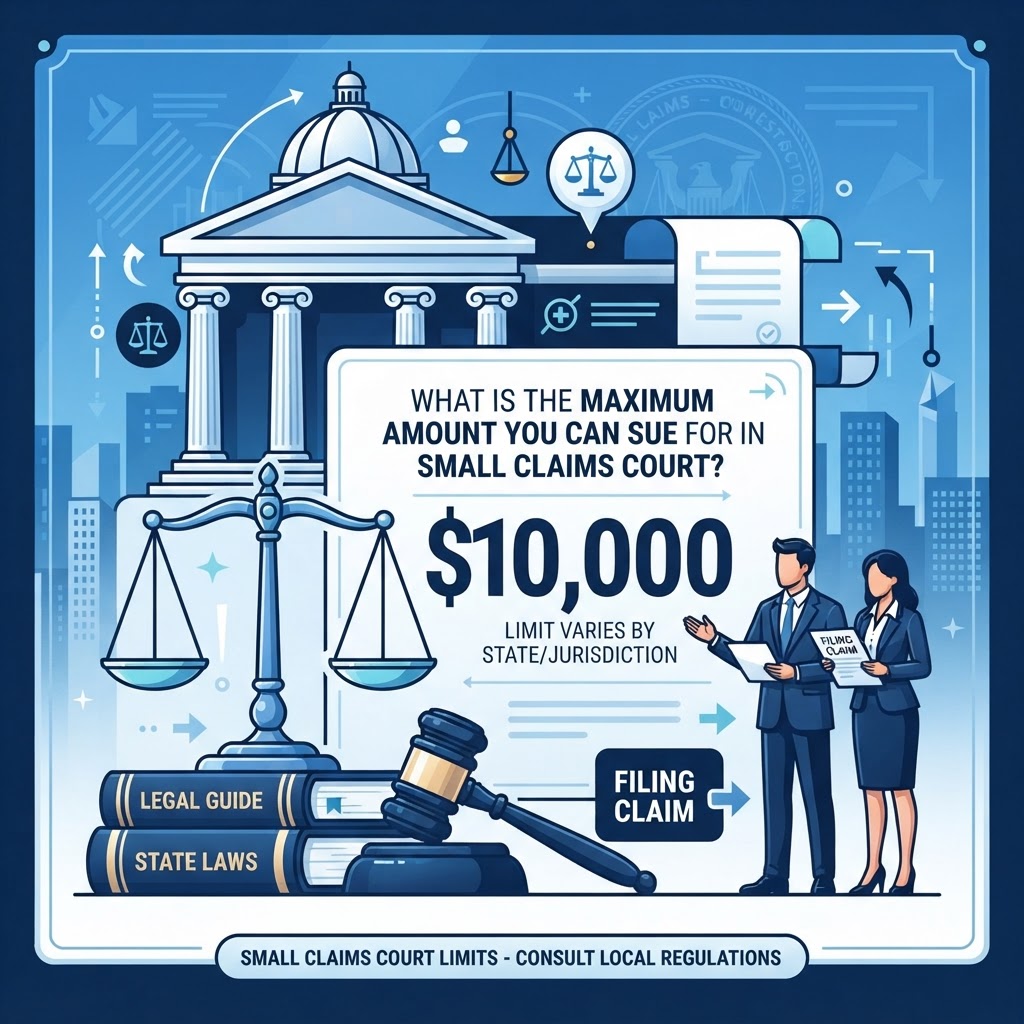
What is the Maximum Amount You Can Sue for in Small Claims Court?
Navigating small claims court requires understanding jurisdictional limits. Learn how much you can sue for, specific rules for Illinois, and how to effectively manage your claim.
Illinois Small Claims Court: A Comprehensive Guide to Legal Recovery
In Illinois, the maximum amount you can sue for in small claims court is $10,000, excluding court costs and interest. If your claim exceeds this threshold, you must either waive the excess amount to remain in small claims or file your case in the Law Division of the Circuit Court. This guide provides an in-depth look at how to navigate the system effectively while adhering to the Illinois Code of Civil Procedure.
Understanding Illinois Small Claims Jurisdiction
The Illinois Supreme Court governs small claims proceedings, which are designed to provide a simplified, cost-effective alternative to formal civil litigation. Under the Illinois Code of Civil Procedure (735 ILCS 5/2-101 et seq.), the jurisdictional cap is set at $10,000 for money damages. This limit applies to the base amount of your claim. It is important to distinguish between the base amount of the claim and the total judgment you might receive. If you are awarded the maximum $10,000, the court may also award you reimbursement for filing fees and service of process costs, as well as statutory interest from the date of the judgment under 735 ILCS 5/2-1303. These additional amounts do not count toward the $10,000 jurisdictional ceiling. If your damages exceed this amount, you have a strategic choice. You can proceed with a lawsuit for exactly $10,000, effectively abandoning the remainder of your claim, or you can pursue the full amount in a higher court. Most litigants choose to stay within the small claims limit because the rules of evidence and procedure are more relaxed, often making legal representation unnecessary. Before you begin the process to file a small claims case, you should carefully calculate your damages to ensure they fall within this limit. The jurisdictional limit is strictly enforced and is not a recommendation, but a hard ceiling on the court's authority to grant monetary relief in this specialized division.
The Cost and Mechanics of Filing Claims
While Illinois law provides a uniform limit across the state, local court rules regarding filing fees and forms can vary significantly by county. Cook County, for instance, has different procedural nuances compared to DuPage or Lake County. For example, in Cook County, the filing fee for a small claims case under $2,500 is significantly lower than for cases between $2,501 and $10,000. In contrast, smaller counties may have a flat fee structure regardless of the amount. Before heading to the courthouse, it is wise to consult small claims guides by state to identify the specific requirements for your local jurisdiction.
Calculating Your Damages
To determine if your case qualifies for small claims, you must total your losses. This includes out-of-pocket expenses, property damage repair costs, and documented lost wages. You must perform a rigorous accounting of every cent. Do not include potential emotional distress or punitive damages unless they are strictly supported by a contract or statute, as these are often difficult to prove in a simplified setting. Furthermore, you must subtract any payments already received from the defendant toward the debt. Only the outstanding balance is eligible for the lawsuit.
A Worked Example of Claim Calculation
Scenario 1: The Landlord Dispute Imagine you are a landlord suing a former tenant for unpaid rent and damages. Your records show:
- Unpaid rent for three months totaling $4,500.
- Costs for professional carpet cleaning and repair of a damaged wall totaling $2,800.
- Lost income from being unable to rent the unit for one month while performing repairs, totaling $1,500. Your subtotal is $8,800. Since $8,800 is less than the $10,000 limit, you are well within the jurisdictional boundaries of small claims court. You could also add court filing fees, which are usually around $100 to $200 depending on the county, to your requested judgment. If your total had reached $11,000, you would have to waive $1,000 of the claim to stay in small claims or risk having your case dismissed or transferred to a higher court.
Scenario 2: The Breach of Service Contract Suppose you hired a contractor for a kitchen renovation for $9,000. You paid an upfront deposit of $3,000. The contractor abandoned the job after performing 10% of the work. You had to hire a new contractor to finish the job for an additional $7,500 over the original contract price to fix the previous work and complete the project. Your total damages would be:
- Return of the unearned portion of the deposit ($2,700).
- Extra costs to complete the job ($7,500). Your total claim is $10,200. To file in small claims court, you would be required to waive $200 of your claim. By doing so, you can file for $10,000 and proceed immediately, avoiding the expense and time of a full civil trial in the Law Division, where costs could easily eclipse the $200 you sacrificed.
The Step-by-Step Filing Process
- Demand Payment: Before filing, always send a formal demand letter. This is a prerequisite in many eyes to show the court you attempted to resolve the issue out of court. If you need assistance, consider our demand letter service to ensure your initial contact is professional and legally sound.
- Identify the Defendant: You must sue the correct legal entity. If suing a business, check the Illinois Secretary of State website to ensure you have the registered agent and the correct business name. Incorrect naming can lead to a default judgment that is unenforceable.
- File the Complaint: Complete a Small Claims Complaint form at the Clerk of Court’s office in the county where the defendant resides or where the event occurred. Fees must be paid at the time of filing, typically via credit card, money order, or certified check.
- Serve the Defendant: You are responsible for ensuring the defendant receives a copy of the summons and complaint. In Illinois, you generally have a specific window of time (often 30 days) to effectuate service. You can use the County Sheriff, which usually costs between $30 and $60, or a private licensed process server. If you cannot locate the defendant, you may need to petition the court for service by publication, though this is rare in small claims.
- Prepare for the Hearing: Once served, the defendant will have a return date. Gather all physical evidence and organize your testimony. On the day of your hearing, be prepared to present your case concisely to the judge, who will likely be managing a docket of several dozen cases that same day.
Essential Evidence List
To succeed in small claims court, your testimony alone is rarely enough. You must provide a clear paper trail to meet your burden of proof. Gather the following documentation before your court date:
- Signed contracts or written agreements that establish the relationship between you and the defendant. Ensure these are legible and highlight the specific clauses breached.
- Itemized receipts for all expenses you are seeking to recover. If you are claiming damages, provide at least two written quotes or invoices showing the cost to repair the harm.
- Dated photographs showing the damage or the condition of the property in question. Digital photos should be printed on standard paper for the judge to keep as part of the case file.
- A log of all communications, including emails, text messages, and letters exchanged with the defendant. Chronological order is best.
- Any estimates from professionals for repairs or services rendered.
- Proof of payment, such as bank statements or canceled checks showing the original funds transferred to the defendant.
- Witness statements if someone else has firsthand knowledge of the incident. It is often more effective to have the witness appear in person rather than relying on a written statement, which can be challenged as hearsay.
Common Mistakes to Avoid
Avoiding common pitfalls can significantly increase your chances of a favorable judgment.
- Suing the Wrong Party: Attempting to sue a business manager rather than the business entity itself is a common error. Always confirm the legal name of the defendant through the official Secretary of State "Business Search" database.
- Failing to Serve the Defendant Properly: If you do not follow the specific service of process rules in your county, the judge will not have jurisdiction to hear your case. Ensure you have the return of service filed with the clerk at least 72 hours before the scheduled court date.
- Arriving Unprepared: Small claims judges often hear dozens of cases in a single session. If you show up with disorganized files or are unable to explain your damages clearly, you may lose your case or receive a lower judgment. Practice your opening statement; it should take no longer than two minutes.
- Including Non-Recoverable Damages: Courts generally do not award damages for "pain and suffering" or lost time in small claims. Stick to tangible, economic losses that can be proven with receipts or invoices. Asking for money that is not supported by statute or contract can undermine your credibility.
- Missing the Statute of Limitations: Every cause of action has a deadline. In Illinois, a breach of a written contract generally has a 10-year statute of limitations (735 ILCS 5/13-206), while an oral contract typically has a 5-year limit (735 ILCS 5/13-205). If you wait too long to file, the defendant can move to have your case dismissed permanently with prejudice, meaning you can never sue on that issue again.
Venue and Jurisdictional Nuances
While the $10,000 limit is standard across Illinois, where you file is just as important as how much you sue for. The venue is typically the county where the defendant resides or where the transaction occurred. If you file in the wrong county, the defendant may file a motion to transfer the case to the proper venue under 735 ILCS 5/2-104. This causes significant delays and can lead to unnecessary legal costs where the court may order you to pay the defendant's travel or legal expenses associated with the incorrect filing. Always verify your venue before completing your paperwork to avoid these procedural hurdles. If the defendant moves out of the county after the debt is incurred, venue may still be appropriate in the original county, but this is a fact-intensive inquiry that may require a judge's ruling.
Finally, remember that winning a judgment is only half the battle. If the defendant refuses to pay after the court rules in your favor, you must initiate post-judgment collection proceedings, such as a non-wage garnishment or a citation to discover assets. These are separate filings that require additional fees and serve as a reminder that the court does not collect the money for you; it only provides the legal authority to do so yourself. CourtLinked prepares documents as a paralegal service, is not a law firm, and does not give legal advice. By understanding the jurisdictional limits and following the proper procedural steps, you put yourself in the best possible position to navigate the small claims system effectively and secure the compensation you are owed.
Last reviewed Nov 4, 2026 · Preparing and filing across all 50 states since 2004. Not a law firm, no legal advice. Editorial standards
Related CourtLinked services
Need help filing your small claims case?
File My CaseRelated State Guides
Related Articles
More guides from the CourtLinked Law Library on similar small claims topics.