
GeneralBy CourtLinked Published Oct 29, 2026 9 min read
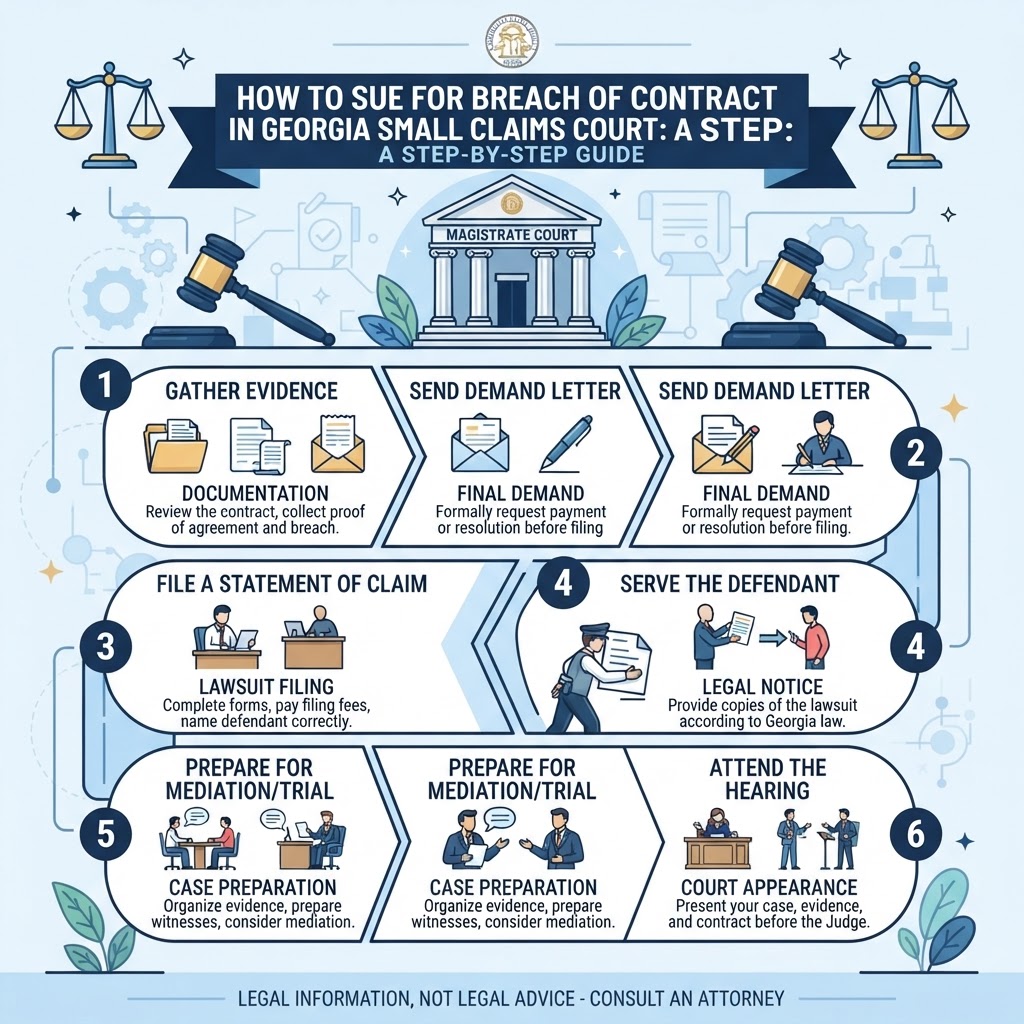
How to Sue for Breach of Contract in Georgia Small Claims Court: A Step-by-Step Guide
Facing a broken agreement? Learn how to navigate the Georgia Magistrate Court system to recover damages for breach of contract and protect your financial interests.
Understanding Breach of Contract in Georgia Magistrate Court. To initiate a breach of contract claim in Georgia, you must file a statement of claim in the Magistrate Court of the county where the defendant resides, ensuring your damages do not exceed the $15,000 jurisdictional limit. This process allows individuals to seek legal remedies without the necessity of retaining an attorney, provided you can present clear evidence of the agreement and the subsequent failure to perform. Magistrate courts in Georgia are designed to be accessible to pro se litigants. However, accessible does not mean informal regarding the rules of civil procedure. You are held to the same standards as an attorney regarding the presentation of evidence and the assertion of legal claims. Before filing, you must verify that the defendant has sufficient minimum contacts with the state of Georgia to establish personal jurisdiction. If the defendant is an out of state entity, this can complicate the process, potentially requiring service through the Georgia Long Arm Statute. Always confirm the specific local rules of the Magistrate Court in your county, as these can supplement the uniform rules promulgated by the state. ## Jurisdictional Limits and Venue Rules. In Georgia, Magistrate Court is the venue designated for small claims. Under the Official Code of Georgia Annotated (O.C.G.A.) Section 15-10-2, Magistrate Courts are authorized to hear civil claims for damages, provided the amount in controversy does not exceed $15,000, excluding interest and court costs. It is vital to note that this limit is strictly enforced. If your damages exceed this cap, you must either waive the excess amount or pursue your claim in Superior or State Court, which involves significantly more complex procedures and higher filing fees. For example, if you are owed $16,000, you can choose to cap your claim at $15,000 to keep it in Magistrate Court, but you permanently waive the right to recover the remaining $1,000. Venue is equally critical. Generally, you must file your action in the county where the defendant resides as provided by the Georgia Constitution. If the defendant is a business, venue is typically proper in the county where the business has its registered office as recorded with the Secretary of State. Failing to file in the correct county often leads to a motion to dismiss for improper venue, which will delay your recovery or cause you to lose your filing fees. While some counties allow for electronic filing, many smaller rural counties still require paper filings delivered in person or via certified mail. Costs vary significantly. In Fulton County, for example, filing fees can approach $150, while in smaller jurisdictions, the total cost for filing and service might be under $100. If you are unsure where to begin, you can file a small claims case through resources that streamline the intake process. ## The Legal Elements of a Contract Breach. For a contract to be enforceable in Georgia, you must demonstrate three core elements: the existence of a valid agreement, performance by the plaintiff, and a breach by the defendant that resulted in damages. A contract does not always need to be a formal, signed document. Georgia law recognizes both oral and implied contracts under O.C.G.A. Section 13-1-5, though these are significantly harder to prove. A valid agreement requires an offer, an acceptance of that offer, and consideration, which is the value exchanged between parties. Consideration does not have to be monetary; it can be a promise to perform an action or refrain from an action. If the other party failed to meet their obligations, you have the right to seek compensation. Before heading to court, it is often prudent to use demand letter service to provide a final opportunity for the other party to settle the debt voluntarily. This demonstrates to the judge that you acted in good faith to resolve the dispute outside of the courtroom. If you must go to court, ensure your claim is based on a breach of an existing duty rather than a tort, as Magistrate Courts have specific limitations on hearing cases involving title to land or certain types of equitable relief. ## Preparing Your Evidence. Your ability to win hinges entirely on the quality of your documentation. The Magistrate judge will not take your word for it; they need tangible proof of your claims. You should gather the following items before initiating your case: * The original written contract, service agreement, or invoice. * Copies of all email correspondence, text messages, or letters discussing the terms of the agreement. * Proof of payment, such as canceled checks, bank statements, or digital transaction records. * A detailed timeline of events, including dates of communication and promised deadlines. * Photos of damaged goods or incomplete work if the breach involves physical property. * Contact information for any witnesses who can testify to the agreement or the breach. Under the Georgia Rules of Evidence, while many courts are more lenient in small claims hearings, you should still prepare your documents in an orderly fashion. If you are submitting digital evidence like text messages, take screenshots that include the date, time, and the phone number or username of the sender. If you have audio recordings, ensure they were obtained legally under Georgia's one-party consent wiretapping laws. If you are researching broader requirements across the country, check our small claims guides by state for comparative insights. ## Step-by-Step Filing Process. 1. Pre-filing Research: Confirm the exact legal name and physical address of the defendant. If you are suing a business, check the Georgia Secretary of State website to ensure the business is active and to identify the registered agent. Searching the registered agent is crucial because if you serve the wrong person or entity, the service will be deemed invalid. 2. Draft the Statement of Claim: This is the formal document that tells the court what happened. You must clearly explain who, what, where, and why the defendant owes you money. You must also include the address where you want the defendant served. 3. Filing: Take your Statement of Claim to the Magistrate Court clerk in the appropriate county. You will be required to pay a filing fee, which varies by county but typically ranges from $50 to $150. You may also need to pay a separate fee for sheriff service, which is the process of physically delivering the court documents to the defendant. In some counties, you may hire a private process server, which can be faster but requires a court order or adherence to specific local rules. 4. Serving the Defendant: The sheriff or a private process server will deliver the summons and copy of your claim to the defendant. This provides the defendant with formal notice of the lawsuit. If the defendant cannot be found, you may need to look into service by publication, though this is rare and complex in Magistrate Court. 5. The Answer Period: Once served, the defendant has 30 days to file a written answer with the court under O.C.G.A. Section 15-10-43. If they fail to answer, you may be eligible to request a default judgment. 6. Trial Preparation: If the defendant answers, the clerk will schedule a hearing date. Use this time to organize your exhibits into binders, one for you, one for the judge, and one for the defendant. Being prepared shows the judge that you are serious and organized. ## Worked Example: The Case of the Unfinished Renovation. Imagine you hired a contractor to install kitchen cabinets for $8,000. You paid a $4,000 deposit. The contractor completed only the demolition and then stopped answering your calls. After waiting two weeks, you sent a demand letter, which was ignored. You then filed a small claims case for the $4,000 deposit, plus $150 in filing fees and $50 in service fees, totaling $4,200. Because you kept receipts of your payments and documented the lack of progress with dated photos, the judge ruled in your favor for the full amount plus court costs. Now consider a second example: A neighbor owes you $12,000 for a car you sold them. They paid $5,000 but defaulted on the remaining $7,000. You sue for the $7,000 balance plus interest at the legal rate. Under Georgia law, the legal rate of interest is often 7% per annum. You calculate interest from the date of the breach to the date of the hearing. If the breach occurred 10 months prior, you add roughly $408 in interest to your claim. You file for the $7,000 principal plus $408 interest plus $125 in court costs, for a total of $7,533. This strategy ensures you recover the full value of your agreement including the time value of money, provided you include these figures clearly in your statement of claim. ## Common Mistakes to Avoid. Even simple claims can fail if you commit procedural errors. 1. Suing the Wrong Entity: Ensure you are suing the actual party that signed the contract. If you sue a business owner personally for a corporate debt, your case may be dismissed because the LLC or corporation is a separate legal entity. 2. Missing Statutes of Limitations: Georgia law provides a four-year statute of limitations for written contracts under O.C.G.A. Section 9-3-25 and a two-year limit for oral contracts under O.C.G.A. Section 9-3-22. These are strict. If you miss the deadline by even one day, the defendant can move to have the case dismissed with prejudice, meaning you can never sue on this matter again. 3. Lacking Proper Documentation: Many plaintiffs assume the judge will believe them without evidence. Without a paper trail, your claim is merely hearsay. Written evidence, especially contemporaneous notes, carries significant weight. 4. Failing to Serve the Defendant Properly: If the defendant is not served according to Georgia law, the court has no authority to hear the case. Always confirm service with the clerk before the hearing date. If the sheriff returns the summons marked as not found, you must update the address or seek an alternative method of service. 5. Emotional Presentation: Magistrate judges prioritize facts over feelings. Keep your testimony focused on the dates, terms, and the specific failure of the contract, rather than your frustration with the defendant. Avoid interrupting the judge or the other party, as this can lead to being held in contempt or damaging your credibility. ## Conclusion. Navigating the Magistrate Court requires patience, organization, and strict adherence to local court rules. By preparing your evidence thoroughly and understanding your rights under Georgia law, you significantly improve your chances of a successful recovery. Always remember that obtaining a judgment is not the same as collecting money. If the defendant refuses to pay after you win, you will need to engage in post-judgment collection efforts, such as garnishing wages or bank accounts. This requires a separate filing with the court and additional fees. You should research the process of a writ of fieri facias, which is the official document used to enforce a money judgment. CourtLinked provides document preparation as a paralegal service, is not a law firm, and does not provide legal advice. Whether you are dealing with a simple commercial dispute or a personal breach of agreement, consistency and clarity remain your most powerful tools in the pursuit of justice. By treating your claim with professional rigor, you ensure that you are presenting your best case to the court. Stay diligent, document every interaction, and always respect the deadlines established by the court.
C
CourtLinked
Last reviewed Nov 4, 2026 · Preparing and filing across all 50 states since 2004. Not a law firm, no legal advice. Editorial standards
Related CourtLinked services
Need help filing your small claims case?
File My CaseRelated State Guides
Related Articles
More guides from the CourtLinked Law Library on similar small claims topics.
GeneralWhat is the Maximum Amount You Can Sue for in Small Claims Court?Read article →GeneralHow to Sue for Property Damage in Ohio Small Claims Court: A Step-by-Step GuideRead article →GeneralHow to Win a Security Deposit Dispute in Michigan Small Claims CourtRead article →GeneralHow to Appeal a Small Claims Court Decision: A Comprehensive GuideRead article →GeneralHow to Serve a Defendant in Small Claims Court: A Complete GuideRead article →GeneralHow to File a Small Claims Case for a Bad Check in New JerseyRead article →