
GeneralBy CourtLinked Published Oct 10, 2026 9 min read
Small Claims Court Fees and Cost Recovery: A Guide for Plaintiffs
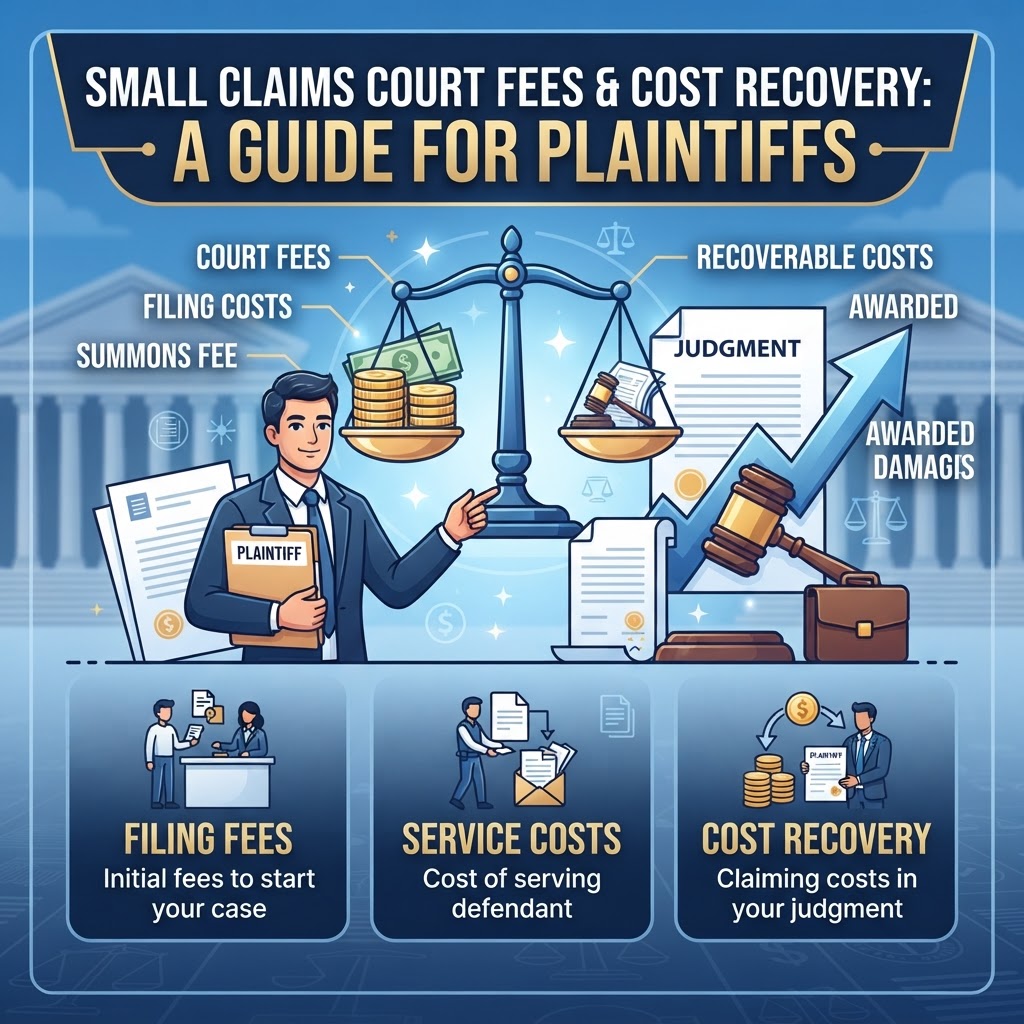
Understanding the costs associated with small claims court is essential for every litigant. This guide explains filing fees, service of process costs, and how to recover your expenses if you win your case.
Understanding Small Claims Filing Fees and Cost Recovery When you pursue a small claims action, you must pay upfront administrative costs that typically range from $30 to $100 depending on the amount of your claim and the county of filing. If you obtain a judgment in your favor, the court generally allows you to recover these specific out of pocket costs by adding them to the final judgment amount against the defendant. Small claims courts operate under specific state statutes, such as the California Code of Civil Procedure Section 116.110 or similar governing statutes in other jurisdictions, which dictate both the court fees and the recovery limits for prevailing plaintiffs. The recovery of these costs is usually contingent upon the plaintiff filing a timely Memorandum of Costs after the entry of judgment, often within 10 to 15 days of the court order depending on the local court rules. ## The Anatomy of Small Claims Expenses Filing a case involves more than just the initial document submission. You must prepare for a series of costs that accrue from the moment you decide to take legal action until the moment you collect your judgment. ### Initial Filing Fees Most courts scale their filing fees based on the total dollar amount you are seeking to recover. In many states, such as California, the fee is tiered: claims under $1,500 may cost $30, while claims exceeding $5,000 may cost $75 or more. As your claim approaches the maximum jurisdictional limit, which varies significantly by state from $3,000 to $25,000, the fee increases accordingly. For instance, a claim in Texas small claims court can be subject to local filing fees that vary widely by county, with some rural counties charging significantly less than metropolitan areas like Harris or Dallas County. You can file a small claims case by visiting the clerk of the court in the county where the defendant resides or where the incident occurred, ensuring you comply with the venue requirements stipulated in the state code. ### Service of Process Costs You cannot simply mail your lawsuit to the defendant and hope for the best. Proper service of process is a constitutional requirement under the Due Process Clause of the Fourteenth Amendment. You may hire a professional process server or a sheriff to deliver the documents. Fees for this service can range from $40 to $150 depending on the distance, the number of attempts required, and whether you need rush service. In many jurisdictions, the cost of a private process server is recoverable as a court cost, provided the fee is deemed reasonable by the judge. If you utilize the Sheriff or Marshal service, the fee is often set by statute and is almost always recoverable. If you fail to serve the defendant according to the strict requirements of the rules of civil procedure, such as leaving the papers with a person of suitable age at the defendant's home or through personal delivery, the court will dismiss your case without prejudice, causing you to lose your initial filing fee and requiring you to refile. ### Evidence and Expert Fees Occasionally, your case may require specialized evidence, such as property appraisals, repair estimates, or expert witness testimony. While these are often considered discretionary costs and are sometimes excluded from standard cost recovery, you should keep every receipt and invoice related to gathering this evidence. If you need to send a formal notice before filing, our demand letter service provides a professional way to establish your claims. Costs for obtaining official records, such as police reports or certified property deeds, are also recoverable in many jurisdictions if they were necessary for the presentation of your case. Be aware that some courts place a hard cap on the total amount of costs recoverable, which might not include every single expense you incurred. ## Calculating Your Potential Recovery A worked example helps illustrate how these costs interact with your claim. Imagine you are suing a former landlord for a security deposit of $3,000 and the court allows a maximum jurisdiction of $10,000. 1. Initial Filing Fee: $50 (County filing fee). 2. Service of Process: $65 (paid to a professional process server). 3. Certified Mail Expenses: $10 (pre-litigation notice). 4. Photocopying and Document Organization: $15 (copies of evidence for the judge and defendant). Total out of pocket cost before the hearing: $140. If the judge awards you the full $3,000, you are generally permitted to include the $140 in your Memorandum of Costs which is filed after the judgment. Your final enforceable judgment becomes $3,140 plus any applicable post-judgment interest, which typically accrues at a statutory rate of 7 percent to 10 percent annually depending on state law. Another numeric example involves a breach of contract claim for $4,500. Suppose you spend $75 on a filing fee, $90 for a process server, and $50 for a certified property inspection report. Your initial demand was $4,500. After the judge finds in your favor for the full amount, you submit your cost bill. The judge approves the $75 and $90 but denies the $50 for the inspection report because it was considered an internal preparation cost rather than a mandatory court expense. Your judgment is $4,665. Please refer to our small claims guides by state to see specific caps on how much of these costs can be recovered in your specific jurisdiction. ## Step-by-Step Procedure for Filing and Recovery 1. Gather all financial documents including contracts, invoices, and payment history to substantiate the debt. 2. File the initial complaint with the small claims clerk in the appropriate venue, ensuring you have the defendant's correct legal name and address. 3. Pay the filing fee as determined by the court clerk based on your claim amount, usually via check or credit card depending on the local county clerk office. 4. Serve the defendant using a legally recognized method such as personal service or substituted service as dictated by your state statutes. 5. File your Proof of Service or Affidavit of Service with the court at least 10 to 15 days prior to the hearing date to ensure the judge has proof the defendant was notified. 6. Attend your hearing prepared to present your case with three sets of all documents: one for the judge, one for the defendant, and one for yourself, while keeping an itemized list of all incurred costs handy. 7. If successful, file a Request for Entry of Judgment or a Memorandum of Costs that explicitly includes your recoverable costs within the statutory window, often 10 days post-judgment. 8. Upon receipt of the judgment, initiate the collection process, such as a wage garnishment or bank levy, if the defendant does not pay voluntarily within the 30-day grace period. ## Essential Evidence List To ensure you can recover your costs, you must maintain a trial binder containing the following: * Original contracts or agreements signed by both parties, including any addendums. * Canceled checks, credit card statements, or bank transfer receipts showing the disputed transactions. * Formal demand letters sent via certified mail with the return receipt requested, serving as proof of the attempt to settle out of court. * Invoices for all filing fees paid to the court clerk, marked with the case number. * Invoices from process servers or law enforcement agencies, detailing the attempt dates. * Dated photos of damage or evidence of the disputed item, printed in high resolution. * Written estimates from at least two licensed contractors or professionals to validate your claim of loss. ## Common Mistakes to Avoid Many plaintiffs lose out on recovering their costs because they fail to follow strict procedural requirements. 1. Filing in the wrong venue: Always file where the defendant lives or where the contract was breached. Filing in your own home county when the defendant lives elsewhere can lead to an automatic dismissal under the Venue Statute of your state. 2. Failing to document service: You must file your Proof of Service well before the court date. If the court does not have record of the service, the judge will reschedule the hearing, which may result in additional costs for you and delays in resolution. 3. Overlooking cost caps: Some states limit the amount of costs you can recover regardless of what you actually spent. For example, some jurisdictions cap total recoverable costs at $500, even if your actual expenses were higher. Always check the local rules to ensure your request does not exceed the statutory limit. 4. Failure to request costs at the hearing: Many plaintiffs forget to ask the judge to include their filing fees in the judgment or fail to file the post-judgment cost memorandum. If it is not in the judgment order or the cost sheet, you cannot collect it later through a writ of execution. 5. Improper demand before suit: Many states require a formal notice or demand letter before filing a lawsuit, often with a 30-day waiting period. If you skipped this step or failed to provide the required notice, the court may dismiss your claim, wasting your initial filing fees entirely. ## Statutory Requirements and Limitations Small claims courts are governed by state code sections that prioritize speed and accessibility. These rules typically prohibit attorneys from appearing in small claims court, which places the burden of proof squarely on the plaintiff. Because you are representing yourself, it is vital that you understand the specific local rules of court for your county, which can be found in the Superior Court website for your specific district. While most states allow for the recovery of court costs and service fees, they generally do not allow for the recovery of your own time spent preparing the case, lost wages, or parking fees while attending the hearing. CourtLinked acts as a paralegal service to assist with document preparation and is not a law firm and does not provide legal advice. By preparing your documents correctly the first time, you increase your chances of having a judge approve your request for cost recovery without unnecessary delays or rejected filings. Success in small claims court is often won or lost based on the quality of your documentation and your adherence to the specific filing deadlines set by your local jurisdiction. Be diligent about tracking every dollar, as the clerk will require a precise accounting before they approve a writ of execution to collect your judgment.
C
CourtLinked
Last reviewed Nov 4, 2026 · Preparing and filing across all 50 states since 2004. Not a law firm, no legal advice. Editorial standards
Related CourtLinked services
Need help filing your small claims case?
File My CaseRelated State Guides
Related Articles
More guides from the CourtLinked Law Library on similar small claims topics.
GeneralHow to Serve a Defendant in Small Claims Court: A Complete GuideRead article →GeneralHow to Sue for Property Damage in Small Claims Court: A Step-by-Step GuideRead article →Defendant RightsUnderstanding the Small Claims Statute of Limitations: Your Rights and DeadlinesRead article →GeneralWhat is the Maximum Amount You Can Sue for in Small Claims Court?Read article →GeneralHow to Sue for Property Damage in Ohio Small Claims Court: A Step-by-Step GuideRead article →GeneralHow to Win a Security Deposit Dispute in Michigan Small Claims CourtRead article →