
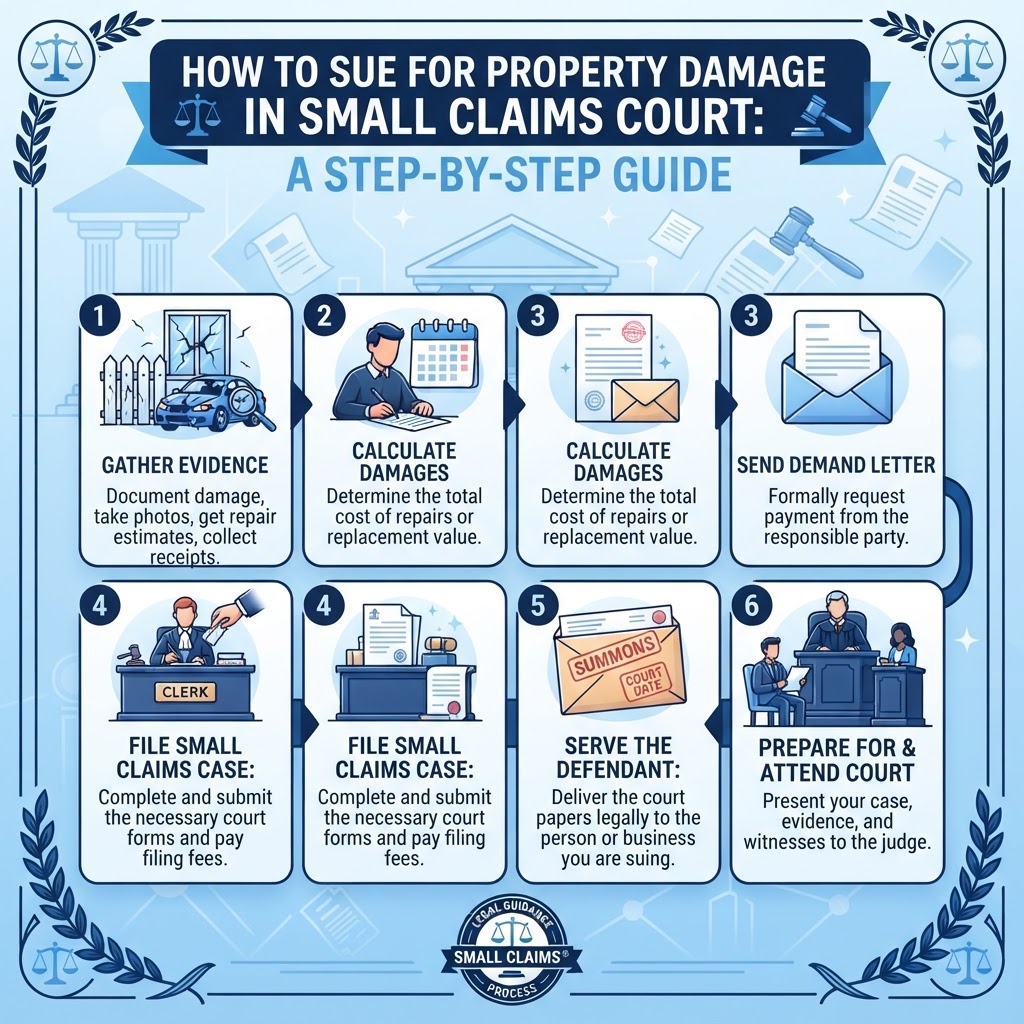
How to Sue for Property Damage in Small Claims Court: A Step-by-Step Guide
Dealing with property damage can be stressful and costly. Learn the essential steps to filing a small claims lawsuit to recover your losses and hold the responsible party accountable.
Filing a Property Damage Claim in Small Claims Court: The Comprehensive Legal Roadmap
To sue for property damage in small claims court, you must calculate your total damages, send a formal demand letter, and file a Plaintiff's Claim form at your local superior court clerk's office before the statute of limitations expires. This process allows you to recover costs for damaged assets without the prohibitive expense of hiring an attorney, as small claims courts in most jurisdictions generally prohibit legal representation during the initial hearing. Navigating this system effectively requires a thorough understanding of procedural law, local venue rules, and the evidentiary standards mandated by state statutes.
Understanding the Small Claims Framework
Small claims court is designed as a simplified forum for resolving minor civil disputes. Because the process is procedural rather than overly technical, litigants are expected to present their own evidence and arguments. Each state maintains a specific Civil Code or Code of Civil Procedure that governs how these cases proceed. In California, for example, the Code of Civil Procedure Section 116.210 governs the jurisdictional limits and procedural requirements for these actions. Across the United States, most states set monetary caps for small claims, ranging typically from $5,000 to $15,000. In certain jurisdictions, such as Tennessee, the limit is $25,000, while in others, such as Kentucky, it remains at $2,500. If your property damage exceeds these limits, you may still file in small claims court by waiving the excess amount above the jurisdictional limit, or you must pursue the case in limited or unlimited civil court. Filing in the incorrect court level can lead to a transfer fee or a total dismissal of the case. Furthermore, these courts are courts of equity, meaning the judge has the discretion to rule based on fairness in addition to strict letter of the law interpretations.
Calculating Your Damages
Before you file a small claims case, you must determine the accurate value of your claim. Property damage claims are generally based on the cost of repair or the fair market value of the item at the time it was damaged. You cannot recover for emotional distress, pain and suffering, or punitive damages in small claims court. You are strictly limited to out of pocket expenses. This includes the cost of parts, labor for professional repairs, or the replacement cost for items that cannot be salvaged. Keep all receipts and estimates from licensed professionals to substantiate these figures. If you are claiming loss of use, such as the cost of a rental car while your vehicle is repaired, ensure you have a dated rental agreement and a statement from a mechanic confirming the exact number of days the vehicle was in the shop. Do not attempt to inflate your claim with speculative costs. Judges routinely audit the reasonableness of these claims and will strike any figure that lacks a primary source document such as an invoice, a signed contract, or a bank record.
The Step-by-Step Filing Process
Successfully navigating the court system requires strict adherence to timelines and procedural requirements. If you fail to follow these steps, your case may be dismissed with prejudice, meaning you cannot file it again.
- Establish the Statute of Limitations: Every state has a legal deadline by which a lawsuit must be initiated. For property damage in many states, this is three years from the date of the incident. For example, under California Code of Civil Procedure Section 338, the period is three years for injury to real property. Research the small claims guides by state to confirm the specific window for your jurisdiction. Failure to file before this cutoff results in the defendant having a complete defense against your claim.
- Send a Formal Demand Letter: Before you can file a lawsuit, you are often required to prove that you attempted to resolve the dispute outside of court. Sending a demand letter service provides written proof of this attempt and informs the defendant that you intend to sue if restitution is not made. This letter should clearly state the amount owed, the reason for the damage, and a reasonable deadline for payment, typically 10 to 14 days. Send this via certified mail with a return receipt requested to establish a clear paper trail for the court.
- Locate the Proper Venue: You must file your claim in the county where the defendant resides, where the contract was entered into, or where the damage occurred. If you file in a county where neither the defendant lives nor the damage occurred, the defendant may file a motion to change venue. If successful, you may be required to pay the defendant's costs of transfer.
- File the Plaintiff's Claim Form: Complete the necessary forms provided by the court clerk. These forms require the names and addresses of both the plaintiff and defendant and a brief explanation of the damage claim. Filing fees vary by state and county, generally ranging from $30 to $100 depending on the amount being claimed. You must pay this fee at the time of filing or apply for a fee waiver if you meet specific low-income criteria set by the state.
- Serve the Defendant: Once the claim is filed, you are legally required to notify the defendant. You cannot serve the papers yourself. You must use a process server, a sheriff, or a neutral third party who is over the age of 18. Deadlines for service are strict, often requiring completion at least 15 to 20 days prior to the hearing date.
- File Proof of Service: After the defendant has been served, the server must provide a proof of service document, which you must file with the court prior to your hearing date. Without this document on file, the judge cannot legally proceed with the hearing.
Evidence Checklist for Property Damage
Your case will live or die based on the documentation you present to the judge. Prepare a neatly organized folder containing the following:
- Original purchase receipts or appraisal documents for the damaged property. If the item is old, be prepared to prove its current value rather than its original purchase price.
- Dated photographs or video footage showing the property before and after the damage occurred. High resolution photos are preferred.
- Written repair estimates from at least two reputable, licensed contractors or repair shops to prove the reasonableness of your claim. One estimate may be viewed as biased.
- Correspondence, including emails, text messages, or letters, between you and the defendant regarding the dispute. Do not edit these documents; they must be presented in their entirety to maintain credibility.
- Police reports if the property damage resulted from a crime or a motor vehicle accident. If the responding officer included a diagram or witness statements, ensure these are attached.
- An itemized list of all damages, including costs for parts and labor. Use a spreadsheet format to make it easy for the judge to review.
Worked Example: A Real World Scenario
Imagine a neighbor backs their truck into your custom wrought-iron fence, causing $4,200 in structural damage. You obtain two independent quotes from licensed contractors, both ranging between $4,100 and $4,300. You send a formal demand letter to the neighbor requesting $4,200, which the neighbor ignores. You file your small claims case for $4,200 plus the court filing fee of $75 and the $40 process server fee. In court, you present your photos, the two estimates, and the copy of your demand letter. The judge grants a judgment in your favor for $4,315. By keeping detailed records, you successfully recovered the full cost of the repair plus your initial costs of filing the lawsuit.
Now, consider a second scenario where a service provider damages your hardwood flooring during a home renovation. You claim $9,500 in damages. However, your state small claims limit is $8,000. You choose to waive the excess $1,500 to keep the case in small claims court to avoid the costs of a private attorney. You file for $8,000, pay the $60 filing fee, and $50 for service. At the hearing, the provider argues they only caused $3,000 in damage. Because you have a detailed, itemized report from a certified flooring inspector detailing the cost to replace the specific wood type, the judge awards you $7,500. By choosing to waive the excess, you successfully navigated the jurisdictional cap and obtained a judgment that covers the majority of your actual losses.
Common Mistakes to Avoid
- Suing the Wrong Entity: If you are suing a business, ensure you are naming the legal entity correctly. Use the Secretary of State website to find the official business name and the registered agent for service of process. Suing a trade name that is not a legal entity will result in a lost case. Always identify if the entity is an LLC, a Corporation, or a Sole Proprietorship.
- Improper Service: Failing to serve the defendant correctly is the most common reason cases are dismissed. If the court is not satisfied that the defendant received notice, they will not hear your case. Ensure you follow the specific personal service rules of your county, which may include requirements for service on Sundays or legal holidays.
- Lacking Professional Estimates: Do not rely on guesses for the cost of repairs. Judges prefer documented estimates from licensed professionals. A handwritten note or a vague verbal quote is rarely sufficient evidence. The estimate should include the license number of the contractor.
- Ignoring the Jurisdictional Limit: Attempting to sue for an amount higher than your state’s small claims limit without waiving the excess will lead to the court tossing your case. Always check your state’s maximum threshold before filing. Be aware that interest may be added to your judgment, but the principal claim amount cannot exceed the cap at the time of filing.
- Showing Up Unprepared: Small claims hearings move quickly. Judges often have dozens of cases to hear in a single session. Having your evidence organized, indexed, and ready to hand to the judge demonstrates professionalism and clarity, which can significantly influence the outcome. If you have witnesses, confirm their availability well in advance of the court date.
CourtLinked Legal Disclaimer
CourtLinked operates as a paralegal service that assists with the preparation of legal documents, is not a law firm, and does not provide legal advice or representation. You are responsible for verifying all court rules and deadlines, as these vary by jurisdiction. By preparing your case thoroughly and gathering all necessary documentation, you maximize your chances of achieving a favorable judgment. Focus on the facts, adhere to the procedural rules, and keep your evidence organized to ensure your day in court is productive and successful.
Last reviewed Nov 4, 2026 · Preparing and filing across all 50 states since 2004. Not a law firm, no legal advice. Editorial standards
Related CourtLinked services
Need help filing your small claims case?
File My CaseRelated State Guides
Related Articles
More guides from the CourtLinked Law Library on similar small claims topics.