
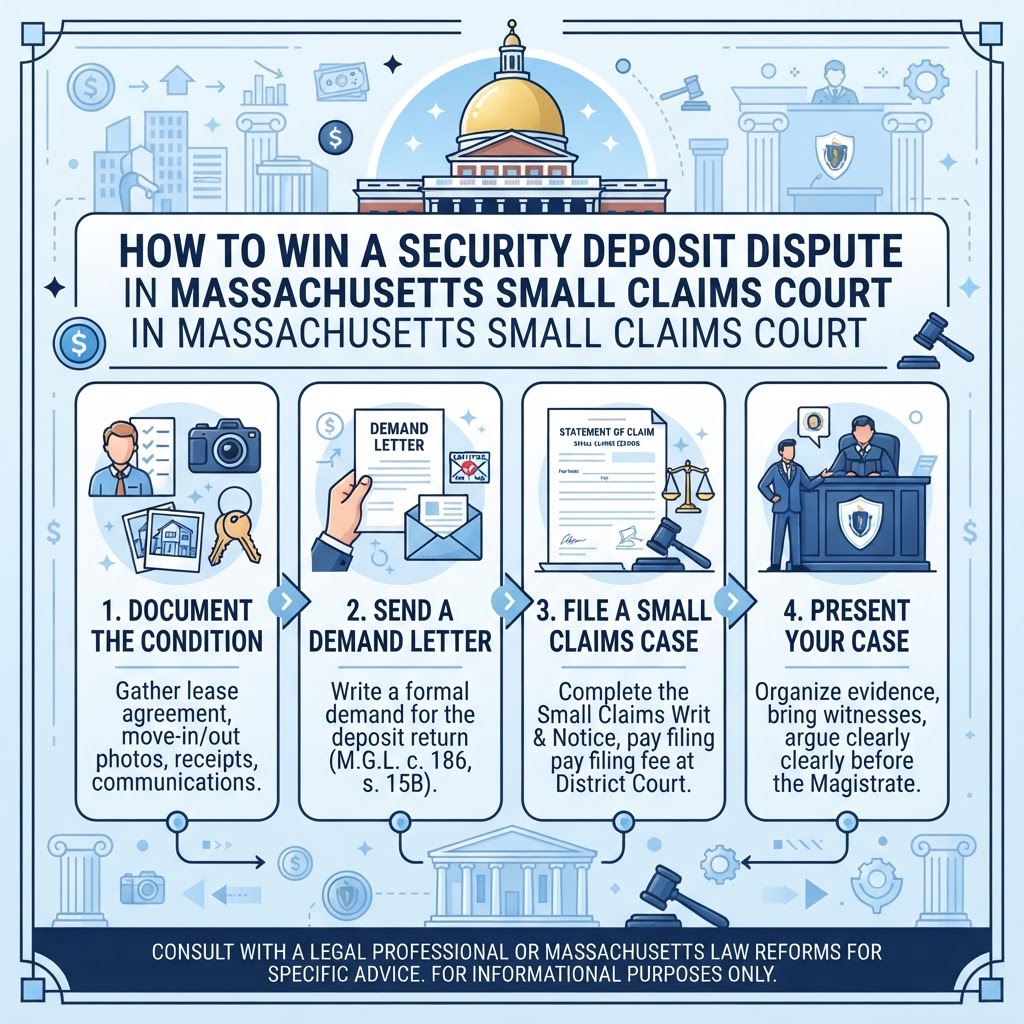
How to Win a Security Deposit Dispute in Massachusetts Small Claims Court
Facing a landlord who refuses to return your security deposit? Learn how to navigate the Massachusetts small claims process, understand your rights under the law, and recover what you are owed.
Navigating Massachusetts Security Deposit Law
To win a security deposit dispute in Massachusetts, you must prove that your landlord failed to comply with the strict requirements of Massachusetts General Laws Chapter 186, Section 15B. This section of the state code is often referred to as the security deposit statute. It is a highly protective piece of legislation designed to prevent landlords from mismanaging tenant funds. If your landlord failed to return your deposit within 30 days of your move-out date or failed to provide an itemized list of deductions supported by paid receipts, they may be liable for treble damages plus attorney fees and court costs. Winning requires meticulous documentation and strict adherence to the procedural rules of the small claims court.
Understanding Your Legal Standing
Massachusetts law is exceptionally tenant-friendly regarding security deposits. Under M.G.L. c. 186, § 15B, a landlord is required to hold your deposit in a separate, interest-bearing bank account located in Massachusetts. They must provide you with the name and location of the bank, the account number, and the amount of the deposit within 30 days of receiving it. This notice must be provided in writing. If the landlord does not provide this information or fails to move the money into a separate account, you may have grounds for a claim even before the lease ends. Specifically, a landlord cannot commingle your deposit with their personal or business funds. Failure to maintain this separation is a per se violation of the statute. If you discover the landlord has not set up this account properly, you should immediately send a written request asking for the account details. Should they fail to comply, you have established a clear paper trail of their non-compliance.
The 30-Day Rule
When your tenancy concludes, your landlord has exactly 30 days to return your full security deposit, plus any accrued interest, minus any lawful deductions. For these deductions to be valid, the landlord must provide an itemized list of damages, signed under the pains and penalties of perjury, accompanied by written evidence of the cost of repairs, such as paid receipts, invoices, or estimates. Note that the landlord cannot charge for normal wear and tear. Examples of wear and tear include faded paint, light carpet wear, or minor floor scuffs. If they fail to meet this 30-day deadline, or if their itemized list is insufficient, they lose the right to withhold any part of the deposit. Furthermore, if the landlord fails to provide the statement of condition within 10 days of receiving the deposit or within 10 days of the start of the tenancy, they forfeit their right to withhold any money for property damage. This creates a powerful defense for tenants who were not provided with the initial inspection form required by state law.
The Financial Stakes and Treble Damages
One of the most powerful tools for tenants in Massachusetts is the provision for treble damages. If a court finds that a landlord willfully withheld a deposit in violation of the statute, the landlord can be ordered to pay three times the amount of the deposit, plus court costs and interest. This makes small claims court a highly effective venue for recovering funds, as the potential financial penalty creates a strong incentive for the landlord to settle before the hearing. The court calculates interest at a rate of 5 percent per year or the amount of interest actually earned on the deposit, whichever is less, if the deposit is held for at least one year. In instances where the landlord fails to pay the interest annually or at the end of the tenancy, the tenant is entitled to the unpaid interest as part of their claim.
Worked Example: Calculating Your Claim
Imagine you paid a $2,000 security deposit. You move out, and your landlord keeps the entire amount, claiming vague charges for cleaning and carpet replacement. You verify they did not send an itemized list of damages within the 30-day window. You file a suit for the $2,000. In court, because the violation is clear, the judge grants you the original $2,000, plus another $4,000 in statutory damages (treble), bringing your judgment to $6,000. Additionally, you can request the court filing fees and costs for service of process. If your filing fee was $100 and the constable service fee was $50, you include those in your total prayer for relief. Always include the interest, even if it is small, as judges appreciate accuracy. A second example: You paid a $1,500 deposit. The landlord provides an itemized list but it is not signed under the pains and penalties of perjury. Under M.G.L. c. 186, § 15B(4), the list is invalid. You claim the $1,500 deposit plus the 5 percent annual interest ($75 for one year). The court awards you the $1,575 plus treble damages of $4,725. The total judgment becomes $6,300 plus costs. This demonstrates that even if a landlord attempts to comply, missing a procedural requirement like a perjury statement can trigger full treble liability.
Required Evidence and Documentation
Before you file a small claims case, you must gather sufficient evidence to overcome the burden of proof. Your success depends on your ability to contrast the condition of the unit at move-in versus move-out.
Checklist for Your Evidence File
- The original signed lease agreement: Highlight clauses related to the security deposit.
- The move-in checklist or condition report: This is a state-mandated form that must be given to you within 10 days of the start of your tenancy.
- Photos or videos taken on the day you moved in: Include time-stamps if possible to show the clean condition of the unit.
- Photos or videos taken on the day you moved out: Show the unit in the same condition as when you received it.
- Copies of all correspondence: Maintain a chronological log of emails, texts, and letters sent to the landlord.
- Proof of the security deposit payment: A canceled check or bank wire confirmation is the best evidence.
- A copy of the 30-day demand letter: Always send this via certified mail, return receipt requested, to prove it was delivered. This is a prerequisite to filing a lawsuit in many circumstances.
The Procedural Path to Recovery
Small claims courts in Massachusetts are designed for individuals to represent themselves without an attorney. If you feel overwhelmed by the drafting process, our demand letter service can assist in preparing professional documents to put your landlord on formal notice.
Step 1: Send a 30-Day Demand Letter
Before initiating litigation, you must send a demand letter by certified mail, return receipt requested. This letter serves as a final warning. It should detail the amount owed, the reason for the claim, and a deadline for payment. Keep a copy of the letter and the green receipt card. In Massachusetts, you should wait for the 30-day period to expire fully before walking into the clerk's office to file your suit. If you file prematurely, the judge may dismiss the case for lack of a ripened claim.
Step 2: Filing the Statement of Claim
Once the 30 days have passed, you may file your Statement of Claim at the district court or Boston Municipal Court in the county where the landlord resides or has their place of business. Filing fees generally range from $40 to $150 depending on the amount of your claim, though this varies by local court rules. If you cannot afford the fee, you may apply for a waiver of court costs by filing an Affidavit of Indigency. You must be prepared to provide the exact address for the landlord so the court can properly issue a summons. Incorrect addresses are a leading cause of delays in these cases.
Step 3: Service of Process
After filing, you must ensure your landlord is legally served. You will likely need to use a sheriff, constable, or authorized process server to deliver the court paperwork to the defendant. In most Massachusetts counties, the fee for this service is approximately $20 to $50. Once the document is served, the process server will provide you with a Return of Service form. You must file this document with the court clerk promptly. Without this proof, the judge cannot proceed, and the hearing may be postponed.
Step 4: The Hearing
On the day of your hearing, arrive at least 30 minutes early. Dress professionally to show respect for the court. Bring three copies of all your evidence: one for the judge, one for the landlord, and one for your own reference. Be prepared to explain exactly why the landlord is in violation of M.G.L. c. 186, § 15B. If the landlord does not show up, you may move for a default judgment. If the landlord does show up, listen carefully and only speak when the judge invites you to do so. Stick to the facts regarding the security deposit laws. Avoid emotional tangents like complaining about other landlord behavior or interpersonal conflicts.
Common Mistakes to Avoid
- Failing to send a formal demand letter: Courts look poorly on plaintiffs who do not attempt to resolve the issue out of court first. Many judges will require evidence of this letter to even open the case.
- Incomplete documentation: If you cannot prove the condition of the apartment at move-in, the landlord has a much easier time arguing that damages occurred during your tenancy.
- Improper filing venue: Always verify the jurisdiction. If you file in a county where neither party lives nor conducts business, your case may be dismissed, forcing you to pay additional fees to restart the process in the correct location.
- Ignoring court deadlines: Missing a filing date or failing to appear at your scheduled hearing will result in an automatic dismissal of your claim. If you have a legitimate emergency, contact the court clerk immediately to request a continuance.
- Overlooking interest: Remember that your deposit earns interest while held in the landlord’s account. Failing to include this in your total claim is essentially leaving money on the table. Always calculate the 5 percent annual interest if applicable.
- Forgetting the affidavit: Ensure any evidence you submit that relies on facts not in the lease, such as condition reports or receipts, is supported by an affidavit if required by your local court rules.
Additional Resources
For more information on the specific procedures across different jurisdictions, explore our comprehensive small claims guides by state. Understanding the local nuances of court rules can significantly improve your chances of a favorable judgment. Note that county-to-county variations exist in Massachusetts regarding how local clerks handle the intake of documents. Some courts allow for electronic filing, while others prefer hard copies. CourtLinked prepares documents as a paralegal service, is not a law firm, and does not give legal advice.
Finalizing Your Strategy
When presenting your case, focus on the statute. Judges handle many landlord-tenant disputes, but they rely on the black-letter law of M.G.L. c. 186, § 15B. Keep your arguments tethered to the 30-day timeline, the absence of receipts, or the lack of a proper bank account notice. By demonstrating that you understand the legal requirements as well as the landlord, you position yourself as a prepared and serious claimant. Remember, the law is designed to protect you from bad-faith actors. If the landlord has ignored your written communication, highlight this to the judge to show a pattern of negligence. Being organized, concise, and citing the exact law that was broken will make your case significantly more compelling.
Last reviewed Nov 4, 2026 · Preparing and filing across all 50 states since 2004. Not a law firm, no legal advice. Editorial standards
Related CourtLinked services
Need help filing your small claims case?
File My CaseRelated State Guides
Related Articles
More guides from the CourtLinked Law Library on similar small claims topics.