
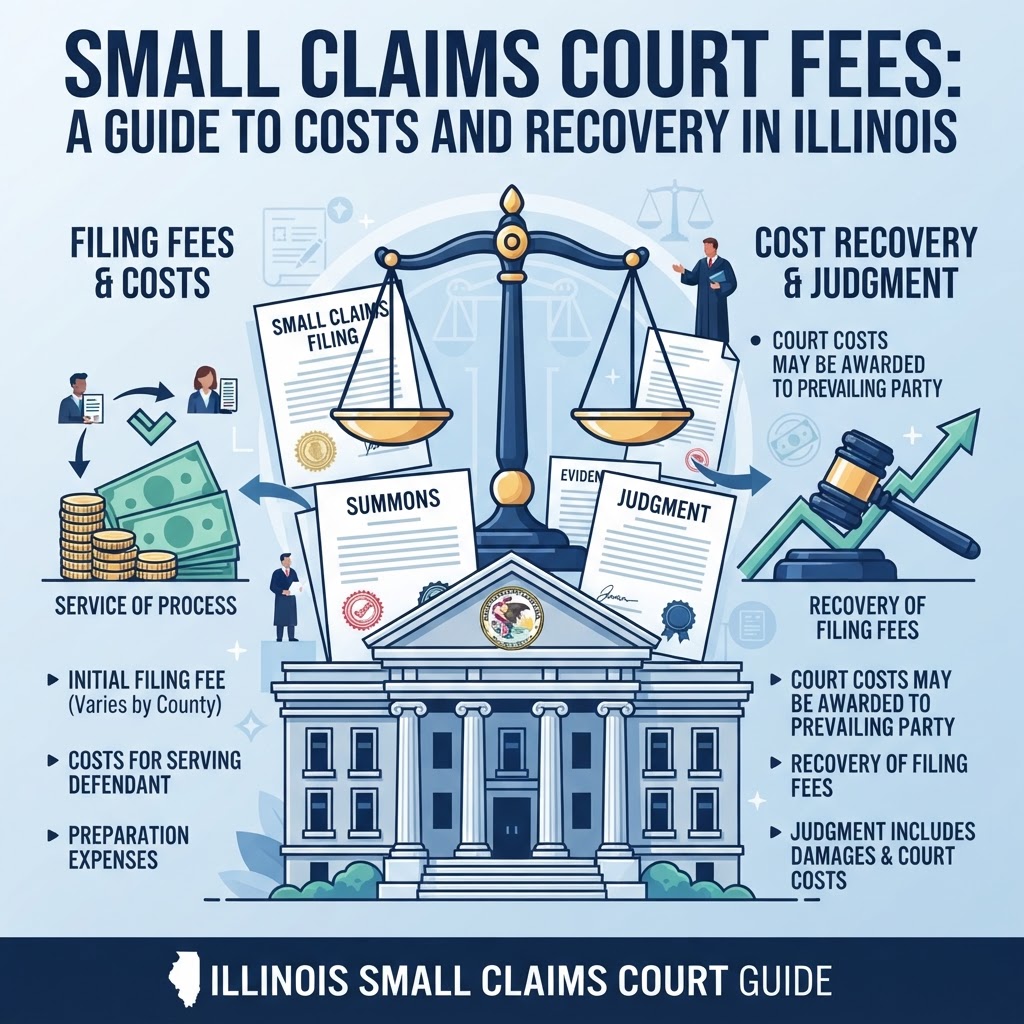
Small Claims Court Fees: A Guide to Costs and Recovery in Illinois
Navigating small claims court requires more than just a strong case; it requires a clear understanding of the financial commitment. Learn how to manage filing fees, serve process costs, and potentially recover these expenses in Illinois small claims court.
Understanding Small Claims Costs in Illinois
Filing a small claims case in Illinois typically costs between $50 and $300 depending on the amount claimed and the specific county of jurisdiction. Beyond the initial filing fee, you must also budget for service of process expenses and potential post-judgment collection costs, though many of these expenditures can be added to the judgment amount if you win your case. Navigating the Illinois court system requires an understanding of the 735 ILCS 5/2-101 code, which governs venue, and the Illinois Supreme Court Rule 282, which dictates the commencement of small claims.
The Financial Framework of Illinois Small Claims
Small claims courts in Illinois handle civil disputes involving claims of $10,000 or less, a limit set by the Illinois Supreme Court. Because these courts are designed for accessibility, the rules are simplified compared to general civil litigation. However, the financial obligations remain rigid. The Illinois Supreme Court Rules set the broad framework, but individual county circuit clerks establish specific fee schedules based on local ordinances pursuant to the Clerk of Courts Act. Unlike general civil filings, small claims typically require a simple complaint form rather than a complex pleading.
Breaking Down Initial Filing Fees
The most significant upfront cost is the filing fee paid to the Clerk of the Circuit Court. In Cook County, for example, the fee for a claim up to $2,500 is notably different than for a claim between $2,501 and $10,000. For instance, Cook County currently charges approximately $140 for claims under $2,500 and $290 for claims between $2,501 and $10,000. These fees are tiered to ensure that smaller disputes remain affordable to litigate. If you are filing your lawsuit, you can file a small claims case by visiting the local circuit clerk's office or using their e-filing portal, which is now mandatory for most litigants under Illinois Supreme Court Rule 9. If you are a pro se litigant who is unable to use the electronic system, the clerk is required by law to provide reasonable assistance at the filing desk.
The Cost of Service of Process
Once you file your complaint, you must formally notify the defendant. This is known as service of process under 735 ILCS 5/2-203. You can choose to have the Sheriff serve the papers, which incurs a fee usually ranging from $20 to $60 per service attempt depending on the county. In DuPage County, for example, the Sheriff service fee is often around $50 per defendant. Alternatively, you may utilize a private process server, which often provides faster results but at a higher premium, sometimes exceeding $100. If you require assistance ensuring your initial notice is legally sound, professional demand letter service can sometimes encourage a settlement before you incur these formal court fees. If personal service fails, you might need to seek court approval for service by publication or certified mail, the latter costing roughly $10 to $15 depending on current postal rates.
Step-by-Step Financial Process
Navigating the process requires careful planning. Follow these steps to ensure you maintain control over your legal expenses.
- Calculate your damages. Ensure your total claim is under the $10,000 limit, as exceeding this will move your case into a more expensive general civil litigation track. If you win, you cannot recover more than the jurisdictional limit even if your actual losses are higher.
- Pay the filing fee. This is a non-refundable administrative cost. If you cannot afford it, you may file an Application for Waiver of Court Fees based on your income per Illinois Supreme Court Rule 298. You must provide proof of your public benefits or financial hardship.
- Budget for service. Determine if you will use the Sheriff or a private process server. Do not forget to request a Certificate of Service which proves the defendant was legally notified under 735 ILCS 5/2-205.
- Organize your exhibits. Collect all evidence needed to prove your claim. Having your evidence ready early prevents last-minute costs associated with expedited copying or document retrieval. Prepare at least three copies: one for the judge, one for the defendant, and one for your personal records.
- Request cost recovery. During your hearing, specifically ask the judge to include your court costs, including filing fees and service fees, in the final judgment if you prevail. The judge has the discretion to award these under 735 ILCS 5/5-108.
Essential Evidence Checklist
Success in court depends on your ability to produce reliable evidence. Gather the following before your court date:
- Original copies of signed contracts or service agreements. If a contract is oral, prepare a witness affidavit.
- Dated invoices, receipts, or purchase orders. Ensure these correlate directly to the dollar amount claimed in your complaint.
- Bank statements or cancelled checks showing payment history to prove you fulfilled your side of the contract.
- Chronological logs of communication including emails, text messages, and letters. These establish the timeline of the dispute.
- Photographic documentation of damaged goods or incomplete services. Prints are generally preferred over digital images alone.
- Expert estimates for the cost of repairs or replacements. Obtain at least two written quotes to substantiate the reasonableness of your claimed damages.
- Proof of the defendant's identity and current physical address to ensure the judgment is valid against the correct party.
Worked Example: Calculating Your Total Investment
Consider a scenario where you are suing a local handyman for $4,000 in damages due to faulty work on your deck.
- Filing fee (Lake County tier for $2,500 to $10,000): $225.
- Sheriff service fee (one defendant): $50.
- Certified mail postage for pre-filing demand letter: $9.
- Photocopying for three evidence binders: $45.
- Total initial investment: $329.
If the judge rules in your favor, they may grant you the $4,000 in damages plus the $329 in documented court costs, bringing your total judgment to $4,329. If the defendant still refuses to pay after 30 days, you might choose to initiate a Citation to Discover Assets to identify their bank accounts, which carries a separate filing fee of approximately $20 to $50 depending on the county and whether it is a wage or non-wage garnishment. These post-judgment costs are also recoverable if you file the appropriate motion to add them to the judgment.
Common Mistakes to Avoid
Litigants often face avoidable setbacks that increase costs or jeopardize their claims.
- Improper Service of Process: Failing to serve the defendant according to the Illinois Code of Civil Procedure means your case will likely be dismissed, causing you to lose your filing fee entirely. If the defendant is a business, ensure you serve the registered agent on file with the Illinois Secretary of State.
- Naming the Wrong Defendant: You must sue the correct legal entity, such as the specific business owner or the registered corporation. Suing a trade name that is not a registered business often leads to an unenforceable judgment. Always check the Illinois Secretary of State Business Search database first.
- Overestimating Damages: If you claim more than $10,000, you are barred from the small claims track. Keep your claim strictly within the statutory limits to avoid being transferred to a more complex and expensive court division. If your claim is close to the limit, consider waiving the excess amount to keep the case simple.
- Ignoring Fee Waivers: If you are low-income or receive public benefits, you might qualify for a fee waiver under the Supreme Court's standardized forms. Failing to apply for this when eligible is an unnecessary loss of capital.
- Poor Documentation: Walking into court without organized evidence forces the judge to rule against you, wasting all the money you spent on fees. Always organize your evidence in a binder for both yourself and the judge. Use labeled tabs for quick reference.
Strategic Cost Recovery
Under Illinois law, the prevailing party in a civil action is generally entitled to recover court costs under 735 ILCS 5/5-108. This is not automatic, however. You must explicitly raise the issue of taxing costs to the judge at the conclusion of the trial. If you have kept receipts for every dollar spent on filing, service, and certified mail, you are in a strong position to ask the court to include those specific figures in the final judgment. It is vital to keep a master Costs Ledger throughout the duration of your case to present as a clean summary at the time of judgment. If you fail to ask for these costs at the hearing, you may lose the right to collect them later.
Understanding Jurisdiction and Venue
Many plaintiffs make the mistake of filing in the wrong county. You must generally file in the county where the transaction took place or where the defendant resides as per 735 ILCS 5/2-101. Filing in the wrong venue can lead to a motion by the defendant to transfer the case to the proper venue, which may require you to pay a transfer fee, often costing $25 to $50, and potentially restarting the service process. Always verify the venue rules for your specific county before submitting your documents. For a deeper dive into how these rules shift across different states, you can review our small claims guides by state.
Final Considerations on Legal Representation
While you are not required to hire an attorney for small claims court, the complexity of the rules can sometimes be overwhelming. If you feel that your case has complications that require a higher level of scrutiny, consider whether the time and money investment is worth the potential recovery. CourtLinked prepares documents as a paralegal service, is not a law firm, and does not give legal advice. If your opponent hires an attorney, you are still permitted to represent yourself, but you must be prepared to follow the same rules of evidence and procedure as a trained lawyer.
Always ensure that your communication with the court is professional and that your filings are completed well in advance of any deadlines. Judges have limited time, and clean, accurate documentation will always serve your interests better than disorganized submissions. By understanding the cost structure and staying diligent with your evidence, you place yourself in the best possible position to recover not just your claim, but the costs associated with seeking justice. Remember that all judgments have a life span, and in Illinois, you generally have seven years to enforce a money judgment, though it can be renewed for an additional period by filing a petition before the initial time expires.
Last reviewed Nov 4, 2026 · Preparing and filing across all 50 states since 2004. Not a law firm, no legal advice. Editorial standards
Related CourtLinked services
Need help filing your small claims case?
File My CaseRelated State Guides
Related Articles
More guides from the CourtLinked Law Library on similar small claims topics.