
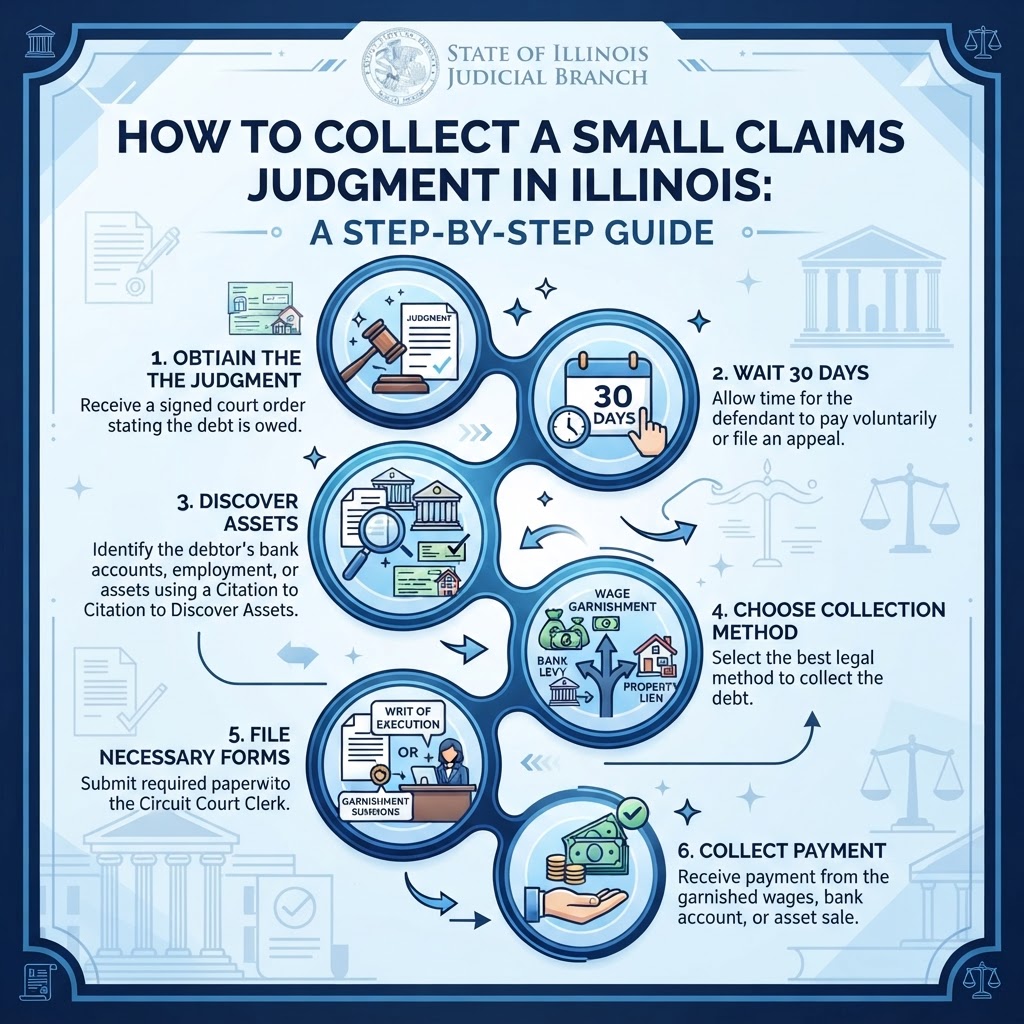
How to Collect a Small Claims Judgment in Illinois: A Step-by-Step Guide
Winning your small claims case is only the first hurdle. Learn how to navigate the post-judgment collection process in Illinois to actually get paid.
Turning Your Judgment Into Cash in Illinois
Collecting a small claims judgment in Illinois requires you to actively use the court system to locate the debtor assets and force payment through legal mechanisms like wage garnishments or bank account levies. Simply holding a court order does not guarantee payment, so you must initiate post-judgment collection proceedings, such as a Citation to Discover Assets, to legally compel the debtor to disclose their finances and allow you to seize property or income to satisfy the debt.
Understanding the Illinois Post-Judgment Legal Framework
In Illinois, the legal authority for collecting a judgment is governed by the Code of Civil Procedure, specifically the sections related to the enforcement of judgments found in 735 ILCS 5/12-101 through 735 ILCS 5/12-1007. Unlike criminal restitution, a civil judgment is essentially a court-sanctioned IOU. The court provides the legal tools to collect, but the burden remains entirely on the judgment creditor to perform the investigation and filing. If you have already managed to file a small claims case and won your trial, you now transition from a plaintiff to a judgment creditor. It is vital to note that judgments in Illinois are valid for seven years under 735 ILCS 5/12-108, and they can be revived for an additional seven years if you take specific steps before the initial period expires by filing a petition under 735 ILCS 5/2-1602. You must act diligently, as the statute of limitations for enforcement is strict.
Phase 1: Locating Assets
Before you can collect a single dollar, you need to know where the money is located. If you do not have this information, you must use the court process to extract it from the debtor.
The Citation to Discover Assets
This is the most powerful tool in your arsenal, authorized by 735 ILCS 5/2-1402. You can serve the debtor with a Citation to Discover Assets. This document requires the debtor to appear in court or provide written answers under oath regarding their bank accounts, employment, real estate ownership, and other valuable assets. When you file this with the Clerk of the Court, you create a lien on the debtor's non-exempt personal property. The citation must be served personally or via certified mail, and it includes a restraining provision that prohibits the debtor from transferring or disposing of their assets until the judgment is satisfied or the court orders otherwise. Failure to adhere to this restraining provision can result in a finding of contempt of court.
Supplemental Proceedings
If the debtor fails to appear for a citation hearing, you can request a Rule to Show Cause. This asks the judge to hold the debtor in contempt of court for ignoring a court order. While this rarely results in jail time for debt, it often provides the pressure necessary to force the debtor to start making payments. You must properly serve the Rule to Show Cause to the debtor; usually, this requires personal service by the Sheriff or a private process server, which may cost between $40 and $100 depending on the county.
Phase 2: The Step-by-Step Enforcement Process
Follow these specific steps to move from a piece of paper to actual money in your bank account. If you need assistance with the administrative requirements of these forms, CourtLinked offers small claims guides by state that simplify the terminology.
- Obtain a Certified Copy of Your Judgment: Visit the Clerk of the Court where your case was decided. A certified copy usually carries a fee of $5 to $10. You will need this to prove the debt exists when you move to seize assets.
- Record the Judgment: If the debtor owns real estate, record your judgment in the county where the property is located. This is governed by 735 ILCS 5/12-101. You must file a Memorandum of Judgment with the County Recorder of Deeds. Recording fees vary significantly by county, typically ranging from $30 to $80. This creates a lien on the property, meaning the debtor cannot sell or refinance without paying your judgment first.
- Issue a Wage Garnishment: If you know where the debtor works, file a Wage Deduction Summons under 735 ILCS 5/12-805. The employer is legally required to withhold a portion of the debtor's paycheck and send it to you. The employer must be served with the summons and a copy of the judgment. Filing fees for this action are typically $25 to $60. The employer has a statutory duty to respond to the summons within a set timeframe, usually 14 days.
- Execute a Bank Levy: If you know the bank where the debtor keeps their money, file a Non-Wage Garnishment under 735 ILCS 5/12-701. The bank will freeze the account and transfer available funds, up to the amount of the judgment, to the court. You should be prepared to pay a garnishee fee, which is often required by banks to cover their administrative costs for processing the levy, often around $50.
- Sheriff Execution: For tangible personal property, such as vehicles or business equipment, you can request an Order of Replevin or an Execution of Judgment under 735 ILCS 5/12-155. You must provide the Sheriff with a description and location of the property. The Sheriff will charge a fee for the physical seizure, which can reach $100 to $300, and they will then schedule a public auction to sell the item.
Phase 3: A Worked Example
Imagine you won a judgment for $4,500 against a former tenant for unpaid rent. You have already sent a formal demand letter service prior to the lawsuit, but they still refuse to pay. You decide to pursue a wage garnishment.
You pay a $45 filing fee to the Clerk of the Court to issue a Wage Deduction Summons. You also pay a $50 service fee to the Sheriff to deliver the summons to the employer. You add these costs to the judgment total as allowed under 735 ILCS 5/5-108, bringing the debt to $4,595. The employer confirms the debtor earns $800 in gross weekly wages. Under Illinois law, the maximum amount that can be garnished is the lesser of 15 percent of gross weekly wages or the amount by which weekly disposable earnings exceed 45 times the federal minimum wage ($7.25 as of this writing). 15 percent of $800 is $120. Weekly disposable income is roughly $720 (after mandatory taxes). 45 times the federal minimum wage is $326.25. Since $720 minus $326.25 is $393.75, the 15 percent limit applies. You will collect $120 per week. Your total judgment of $4,595 will be satisfied in approximately 39 weeks. Additionally, you are entitled to collect 9 percent annual interest, which is calculated on the remaining balance each year. If you collect $6,240 over the year, you must apply the interest first, then the principal.
Required Evidence and Documentation
To succeed, you must maintain an organized file. Keep copies of everything you submit to the court. Key documents include:
- The original signed court order granting the judgment.
- A certified copy of the judgment.
- Proof of service for the Citation to Discover Assets, usually an affidavit of service.
- Records of any voluntary payments received to date, which must be credited against the judgment amount.
- Correspondence with the debtor or their employer, including any responses to your summons.
- Documentation of any costs incurred during the collection process, such as filing fees, sheriff service fees, and certified mailing costs, all of which are recoverable as "costs of collection" under Illinois rules of civil procedure.
Common Mistakes to Avoid
- Letting the Judgment Lapse: In Illinois, you must take action to renew a judgment before the seven-year expiration. Do not assume it lasts forever. Use 735 ILCS 5/2-1602 to revive it.
- Attempting Self-Help Seizures: Never enter the debtor's property to take items yourself. This can lead to criminal charges for theft or trespassing. Always use the Sheriff.
- Ignoring Exemptions: Debtors have legal protections under 735 ILCS 5/12-1001. If you garnish money that comes from Social Security, disability, or certain public assistance, you can be forced to return those funds and face legal penalties.
- Failing to Track Interest: You are entitled to 9 percent annual interest on your judgment under 735 ILCS 5/2-1303. Many creditors forget to include this in their total, essentially leaving money on the table. You should maintain a ledger reflecting the judgment amount, payments received, and accrued interest.
- Assuming Bank Balances: If you levy a bank account, ensure it has funds. If you levy an account with a balance of $0.00, the bank will charge you a processing fee that you will not be able to recover.
Navigating County-Specific Variations
Illinois has 102 counties, and while state law provides the baseline, local court rules vary significantly. Cook County, for instance, has a highly automated e-filing system and specific requirements for service of process through the Sheriff of Cook County. In Cook County, you are often required to use a specific set of forms for garnishment that are distinct from those in smaller jurisdictions. Smaller rural counties may still rely heavily on paper filings and require you to present your documents in person to the Clerk. Some counties may require a hearing for every garnishment, while others process them primarily through affidavit. Always check the local court website or call the Clerk of the Court's office to confirm the exact filing fee, which can fluctuate between $25 and $75, and the number of copies required before traveling to the courthouse.
When to Seek Professional Assistance
If the debtor is self-employed, hides assets in offshore accounts, or has filed for bankruptcy, the standard collection process becomes significantly more complex. Bankruptcy triggers an automatic stay under the Federal Bankruptcy Code, which stops all collection activities immediately. At this stage, you may need a debt collection attorney to navigate the federal bankruptcy court system, potentially to file a proof of claim or challenge the dischargeability of the debt if there was fraud involved. For routine collections, however, a disciplined approach following the standard procedural steps is often sufficient to obtain payment. If the judgment is over $10,000, the complexity of tracking assets often justifies the fee of an attorney who works on a contingency basis, typically taking 33 to 40 percent of the recovered funds. CourtLinked prepares documents as a paralegal service, is not a law firm, and does not give legal advice. If you face complex litigation or the debtor contests your claims, consult with a licensed Illinois attorney to protect your interests. The costs of professional intervention are often outweighed by the recovery of large judgments, especially when the debtor is employed or owns real property that can be liquidated or encumbered to satisfy the debt.
Last reviewed Nov 4, 2026 · Preparing and filing across all 50 states since 2004. Not a law firm, no legal advice. Editorial standards
Related CourtLinked services
Need help filing your small claims case?
File My CaseRelated State Guides
Related Articles
More guides from the CourtLinked Law Library on similar small claims topics.