
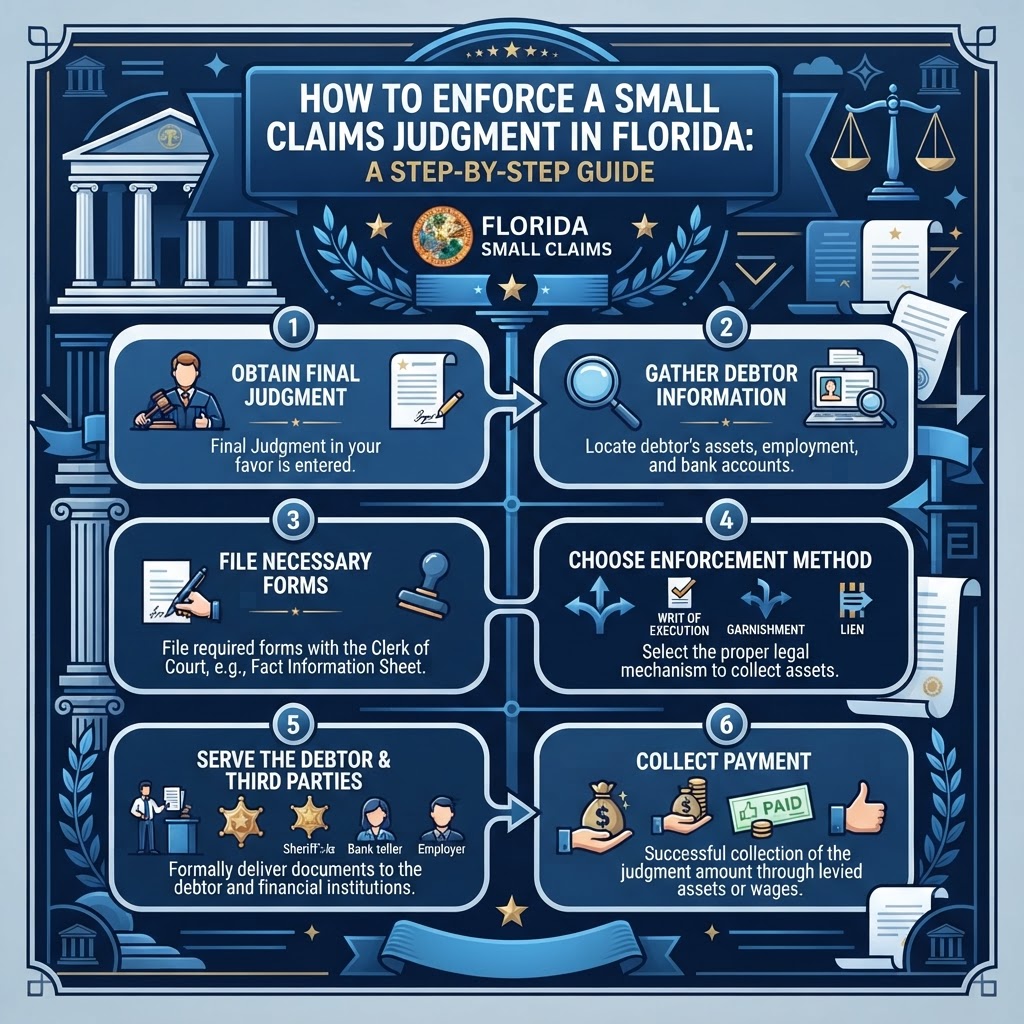
How to Enforce a Small Claims Judgment in Florida: A Step-by-Step Guide
Winning your case is only half the battle in small claims court. This guide explains the legal steps you can take to collect your money after receiving a court judgment in Florida.
Understanding the Collection Process in Florida
Enforcing a small claims judgment in Florida requires obtaining a certified copy of your judgment and conducting a thorough investigation into the debtor's assets through discovery, followed by filing for specific enforcement actions like a writ of execution, garnishment, or a lien. A court judgment is a legal order directing the defendant to pay, but it does not automatically transfer funds from the debtor’s bank account into your pocket, making the collection phase a proactive process of using Florida’s enforcement tools. Successfully navigating this process requires strict adherence to the Florida Rules of Civil Procedure and Florida Statutes Chapter 55. While the small claims court is designed for simplicity, the post judgment collection phase involves technical procedural hurdles that often require precision in document filing and service of process.
The Legal Framework for Judgment Collection
In Florida, the collection process is governed by the Florida Statutes and the Florida Small Claims Rules. Once a judge signs a final judgment, it becomes a legally binding debt. However, Florida has some of the most debtor friendly laws in the country, particularly regarding the homestead exemption and head of family wage protection. Understanding the Florida Statutes, specifically Chapter 55 which covers judgments, is critical. Chapter 55 includes provisions for the duration of judgments, interest rates, and the methodology for creating liens. If you are just starting, you may want to review our small claims guides by state to ensure you have handled your initial judgment correctly. If you have not yet reached this stage, you may need to file a small claims case to establish your legal right to payment. Note that pursuant to Florida Statute 55.03, judgments bear interest at a rate set by the Chief Financial Officer of Florida, which fluctuates annually. You must track this interest carefully to include it in your writs.
Essential Documents and Evidence
Before attempting to seize assets, you must gather proof of the debtor’s financial standing. Attempting to collect without current information is like shooting in the dark. You will need the following documentation to proceed effectively:
- Certified copy of the Final Judgment signed by the judge. The Clerk of Court usually charges a fee per page for certification, typically ranging from $1.00 to $2.00 per page, plus a $2.00 fee for the clerk's seal.
- Fact Information Sheet, which is a standardized form the debtor must fill out detailing their assets, including checking accounts, savings accounts, and physical assets.
- Motion for Contempt if the debtor ignores the Fact Information Sheet. This motion must be served via formal process to ensure the court has jurisdiction to sanction the debtor.
- Proof of income, such as pay stubs or tax documents, which may be obtained via discovery or deposition.
- Banking details, including branch location and account types, if available. Gathering these details often involves reviewing checks previously written by the debtor or online investigation.
- Real property records, searchable through the County Clerk’s property appraiser website. Recording a certified copy of the judgment in the county where the property is located creates a judgment lien against that real property.
A Step-by-Step Guide to Execution
1. Obtain and Record the Judgment
Once the judge enters the final judgment, obtain a certified copy from the Clerk of Court. You should then record a certified copy of that judgment in the Official Records of any county where the debtor owns real estate. This creates a lien on that property. Under Florida Statute 55.10, this lien remains valid for ten years and may be extended for another ten years if re recorded. The recording fee is set by the county and is usually calculated by the number of pages in the judgment, often around $10 for the first page and $8.50 for each subsequent page.
2. Fact Information Sheet
Under Florida Small Claims Rule 7.221, the plaintiff can serve a Fact Information Sheet on the defendant. The defendant has 45 days to complete it under oath. This document asks for bank account numbers, employer information, and assets. If they fail to return it, you can file a Motion for Contempt to force them before the judge. The court may issue a notice for the debtor to appear at a show cause hearing. Failure to appear at this hearing can result in the issuance of a writ of bodily attachment for the debtor, though this is a significant step that requires the judge's approval.
3. Writ of Execution
If the debtor has non exempt personal property, you can request a Writ of Execution from the Clerk. This document authorizes the Sheriff to seize and sell the debtor’s personal property to satisfy the debt. Be aware that the Sheriff will charge a service fee, and there is often a deposit required to cover storage or seizure costs, which can range from $500 to several thousand dollars depending on the nature of the property being seized. You must provide the Sheriff with a detailed list of assets to be levied.
4. Continuing Writ of Garnishment
For most individual debtors, a garnishment of wages or a bank account is the most effective method. Under Chapter 77 of the Florida Statutes, you can file a Motion for Writ of Garnishment. This freezes the money in the account or forces the employer to withhold a portion of the paycheck. To file this, you must pay a clerk's filing fee, which is often $85.00 for claims under $2,500 and higher for larger amounts. You must also pay a fee for the Sheriff or a private process server to serve the Writ on the Garnishee, usually around $40.00.
Worked Example: Collecting a Debt
Scenario A: Bank Garnishment. Assume you hold a judgment for $5,000 against a defendant. You wait 15 days to confirm the judgment is final and no motions for new trial are pending. You file a Motion for Writ of Garnishment. The clerk fee is $85.00. You pay $40.00 to a process server to serve the bank. The bank is served and freezes $2,000 from the defendant's account. The bank charges a $100.00 processing fee (deducted from the account). The defendant files no claim of exemption within 20 days. You file a Motion for Final Judgment of Garnishment. The court grants it, and the bank sends you $1,900.00. Your new remaining judgment balance is $3,225.00 ($5,000 + $85 + $40 + $100 in costs, minus $1,900 recovered).
Scenario B: Wage Garnishment. You serve the debtor's employer with a Continuing Writ of Garnishment. The employer is required to withhold the legal maximum of non exempt earnings. If the debtor is not the head of family, the employer calculates the amount based on federal guidelines (usually the lesser of 25% of disposable earnings or the amount by which weekly disposable earnings exceed 30 times the federal minimum wage). Every paycheck, the employer deducts this amount and sends it to the court registry, where it stays until you file a request to disburse the funds to you. Each disbursement request may require a small processing fee to the Clerk of Court.
Common Mistakes to Avoid
- Ignoring Exemptions: Florida law protects certain property, such as a primary home (homestead) under Article X, Section 4 of the Florida Constitution and, for heads of families, up to $750 of disposable weekly earnings per Florida Statute 222.11. Attempting to seize exempt property will result in the court rejecting your motion and potentially assessing legal costs against you.
- Failing to Serve Properly: Every motion for garnishment or execution requires proper service of process. If you do not serve the debtor according to the rules, the court will deny your request. Service of the writ must be done by the Sheriff or a certified process server, and proof of service must be filed with the clerk within 5 days of service.
- Waiting Too Long: Judgments in Florida are valid for 20 years, but they must be revived if no action is taken. Do not let your judgment sit inactive for years. Ensure that you record a certified copy of the judgment in the public records of any county where the debtor might acquire real estate to maintain the priority of your lien.
- Guessing About Assets: Filing a garnishment against a bank where the debtor does not have an account costs money in filing fees that you will likely not recover. Always do your due diligence first by checking the debtor's history of transactions or checking their credit report if you have the legal right to do so.
- Harassment: Even after winning a judgment, you must abide by the Fair Debt Collection Practices Act. Do not threaten or harass the debtor. Everything must be done through the court system. Sending unauthorized letters or making threatening phone calls can result in significant civil liability for the creditor.
Dealing with Asset Protection
Many debtors in Florida utilize the head of family exemption. If the debtor supports more than 50 percent of the support of a child or other dependent, their wages are significantly protected from garnishment. Always review the debtor’s claim of exemption carefully. If you believe they are lying about their status as head of family, you have the right to request a hearing to challenge their claim. The burden of proof to show they are the head of family rests with the debtor. If they fail to provide sufficient documentation at the hearing, the judge will likely deny their claim, and you can proceed with the garnishment. Be prepared to provide evidence at the hearing, such as utility bills or school records that might contradict their claims of support.
Costs and Filing Fees
Court costs vary by county in Florida. While the initial filing for a small claims case is standardized, supplementary proceedings for collection involve individual fees. Expect to pay a filing fee for the issuance of each writ, plus a Sheriff’s fee for service of process. Keep a running tab of these costs, as you are legally allowed to add these costs of collection to the total amount the debtor owes you, provided you file the correct motions to update the judgment. Generally, garnishment filing fees cost between $85.00 and $150.00, and service fees by a Sheriff are approximately $40.00. Private process servers may charge more, but their turnaround time is often faster. Always request an itemized receipt for every payment made to the clerk or the Sheriff, as these will be necessary to prove your total costs in a final accounting of the debt.
When to Seek Professional Assistance
If the debtor is savvy and hiding assets through complex corporate structures or transferring property to relatives, the process can quickly exceed the complexity of a standard small claims case. While you do not need to be an attorney to file these motions, the procedural requirements are strict. Ensure you are filing the exact form required by your specific county clerk, as some counties have local administrative orders that supplement the state rules. If you find the paperwork overwhelming, utilizing a paralegal service can ensure your motions are drafted correctly, preventing the court from rejecting your filings due to clerical errors. If you need initial documentation to start the cycle of collection or enforcement, remember that demand letter service options can sometimes spur a debtor to settle before you reach the stage of court ordered garnishment. For cases involving fraudulent transfers, you may need to look into filing an action under the Uniform Fraudulent Transfer Act, which is a much more complex legal procedure.
CourtLinked prepares documents as a paralegal service, is not a law firm, and does not give legal advice. By following these steps methodically and respecting the court’s procedural mandates, you maximize your chances of successfully converting your paper judgment into actual currency. Always keep copies of every filing in an organized folder, as you will need to provide a chain of documentation to the Sheriff or the bank when executing a writ. The collection process is a test of patience, and success often belongs to the creditor who is the most consistent and organized in their pursuit of the debtor's assets.
Last reviewed Nov 4, 2026 · Preparing and filing across all 50 states since 2004. Not a law firm, no legal advice. Editorial standards
Related CourtLinked services
Need help filing your small claims case?
File My CaseRelated State Guides
Related Articles
More guides from the CourtLinked Law Library on similar small claims topics.