
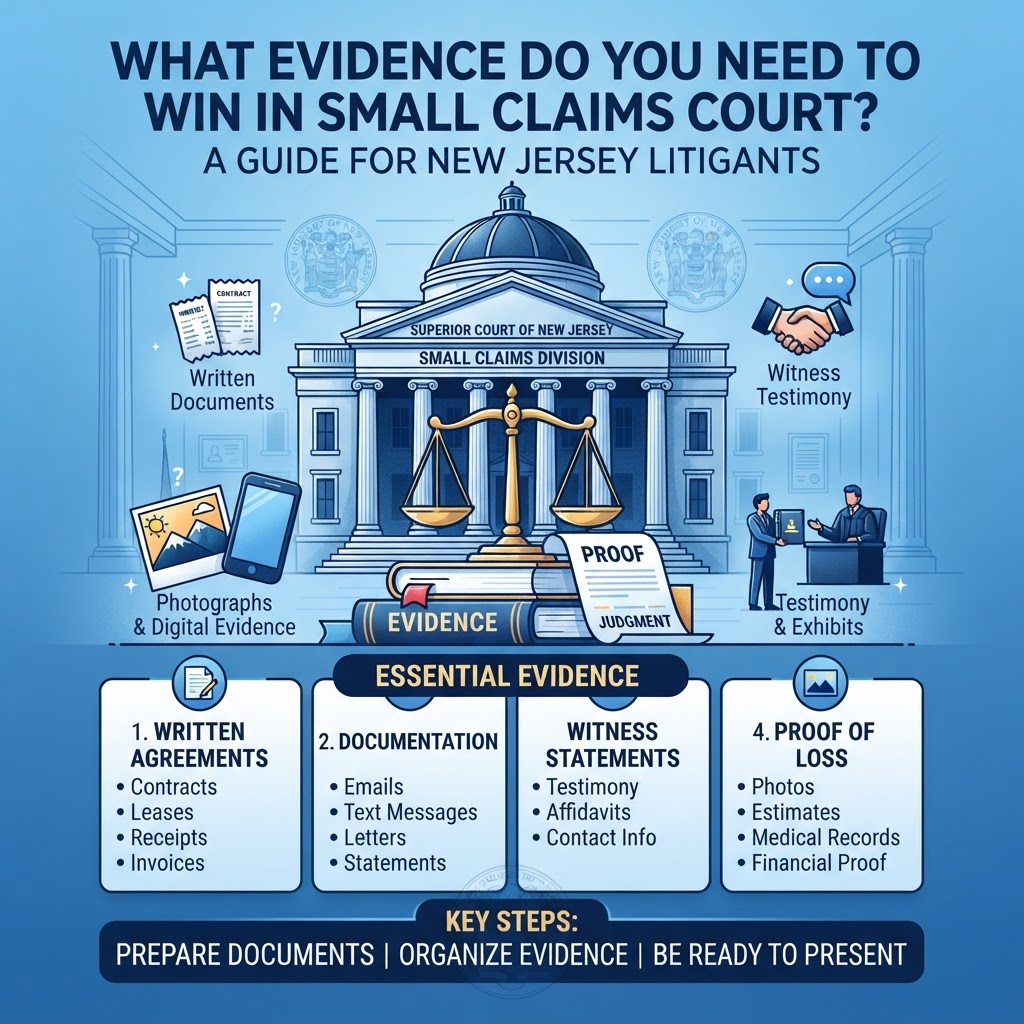
What Evidence Do You Need to Win in Small Claims Court? A Guide for New Jersey Litigants
Success in small claims court relies heavily on the quality of your evidence. This guide breaks down the essential documentation needed to build a winning case specifically for New Jersey courts.
Building Your Case: The Power of Evidence in Small Claims Court
When you enter small claims court, the burden of proof rests on you. Whether you are the plaintiff trying to recover damages or a defendant refuting a claim, the judge will not simply take your word for it. To win, you must provide tangible, credible, and organized evidence to support your version of the facts. In New Jersey, where the Special Civil Part handles small claims up to $3,000, presenting a professional and clear case file can be the difference between a judgment in your favor and a dismissal.
The Three Pillars of Evidence
Effective evidence generally falls into three categories: documentary, physical, and testimonial.
1. Documentary Evidence
This is the bedrock of most small claims cases. Judges in New Jersey value written proof above all else. This includes:
- Contracts and Agreements: Signed documents, written service agreements, or leases.
- Communication Records: Email threads, text messages, and letters sent via certified mail that demonstrate your attempts to resolve the issue before filing.
- Financial Records: Invoices, canceled checks, bank statements, receipts, and credit card statements.
- Photos and Videos: Time-stamped documentation of property damage, the state of an apartment, or the condition of goods delivered.
2. Physical Evidence
If your case involves damaged property—such as a defective product or a car part involved in a minor collision—bring it to court if it is portable. If the item is too large (like a piece of furniture or a vehicle), ensure you have high-quality, clear photographs from multiple angles.
3. Testimonial Evidence
While you will be speaking on your own behalf, you may also have witnesses. In New Jersey small claims, live testimony is preferred. If a witness cannot attend, a notarized affidavit may sometimes be accepted, but it is far less persuasive than live testimony.
New Jersey Specific Considerations
New Jersey small claims court operates under specific procedural rules. In the Special Civil Part, you are expected to be prepared to present your case concisely.
- Organize Your Exhibits: Always prepare three copies of every document you intend to introduce: one for the judge, one for the other party, and one for yourself.
- The Importance of the 'Demand Letter': Before your court date, it is vital to show the judge that you made a good-faith effort to collect the debt or resolve the dispute. Keep a copy of your demand letter.
- Admissibility: While small claims courts are less formal than the Superior Court, you must still ensure your evidence is relevant. If you are printing text messages, ensure the dates and the phone numbers of the sender are visible.
Step-by-Step Guide to Organizing Evidence
- Create an Evidence Binder: Use a three-ring binder with labeled tabs. A disorganized stack of papers can frustrate a judge and undermine your credibility.
- Chronological Order: Organize all documents by date. This helps the judge follow the "story" of your dispute.
- Identify Your Exhibits: Number your exhibits clearly. When you speak to the judge, refer to them specifically, e.g., "Exhibit A is the receipt for the initial payment."
- Review for Relevance: Do not include irrelevant information. If a document does not help prove the breach of contract or the amount owed, leave it out.
Common Pitfalls to Avoid
- Hearsay: Avoid relying solely on what someone else told you. While hearsay rules are relaxed in small claims, personal knowledge is always superior.
- Lacking Proof of Damages: You may prove the other party did something wrong, but if you don't provide receipts or estimates proving how much money you lost, the judge may award you $0.
- Poor Preparation: Arriving at court without copies of your documents shows a lack of respect for the court’s time and limits your ability to reference evidence during your testimony.
How CourtLinked Can Help
Navigating the legal requirements of small claims court can feel overwhelming, especially when you are balancing your daily life. CourtLinked provides paralegal-managed filing services to help you organize your paperwork and ensure your forms are correctly filed with the court. Please note: We are not a law firm and do not provide legal advice or representation in the courtroom. We are here to handle the administrative burdens so you can focus on preparing your evidence and presenting your case.
Final Tips for Success
Always remain calm and professional in the courtroom. Direct your comments to the judge, not the other party. If you are well-prepared, organized, and have documented your damages thoroughly, you are in the best possible position to secure a favorable outcome. For assistance with your filing process in New Jersey, contact the team at CourtLinked today.
Need help filing your small claims case?
File My Case