
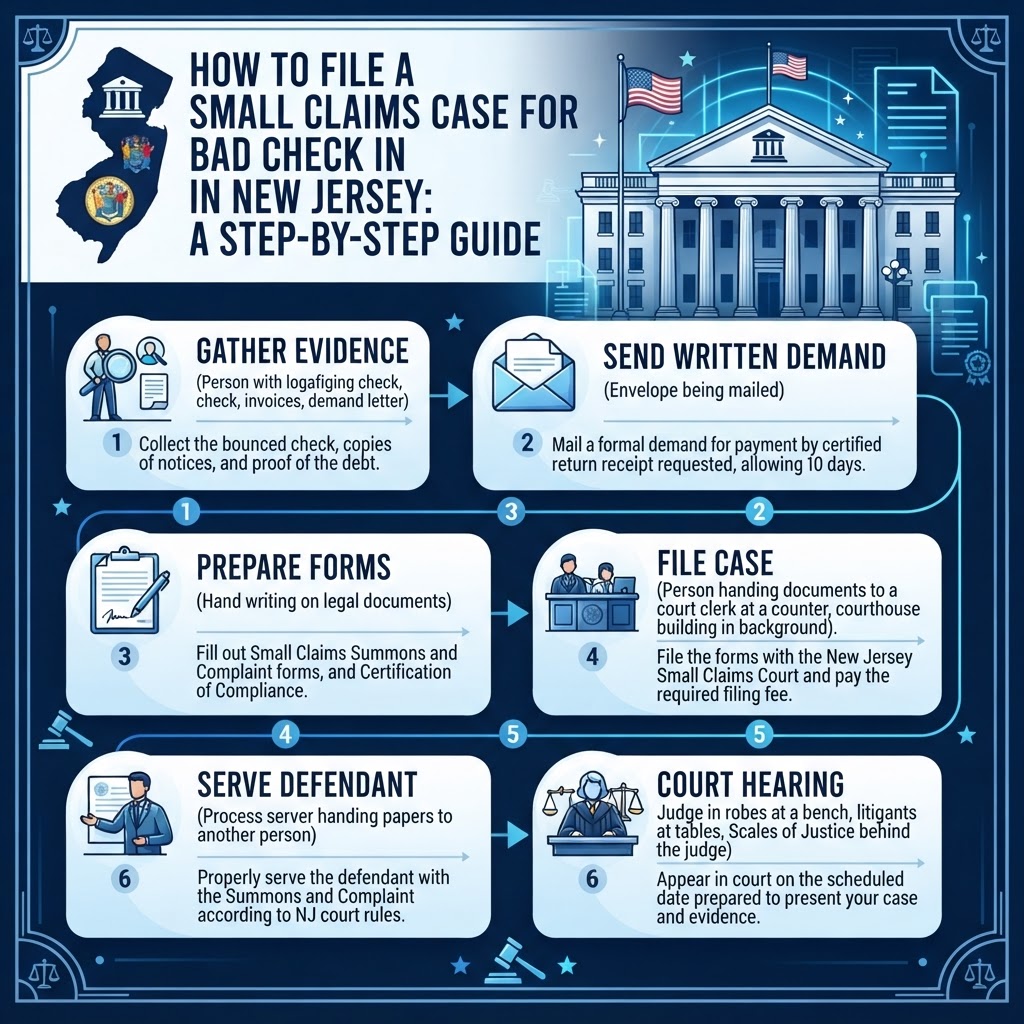
How to File a Small Claims Case for a Bad Check in New Jersey: A Step-by-Step Guide
Dealing with a bad check can be frustrating and financially draining. This comprehensive guide outlines how to navigate the New Jersey small claims court process to recover your funds effectively.
To recover funds from a bad check in New Jersey, you must send a formal demand for payment by certified mail, wait ten days for a response, and then file a complaint in the Special Civil Part of the Superior Court if the amount is $3,000 or less, or up to the $20,000 small claims limit. Successfully navigating this process requires strict adherence to the New Jersey Bad Check Statute and precise documentation of the underlying transaction. This comprehensive guide details the procedural steps, financial thresholds, and legal burdens you must satisfy to reclaim your funds. ## Understanding the New Jersey Bad Check Statute The primary legal recourse for a dishonored check is provided by New Jersey Statute 2A:32-1. This law allows a payee to recover the face value of the check along with additional damages if the issuer fails to make the check good within ten days of receiving a written notice of non-payment. If the court finds in your favor, you may be entitled to the original amount, a service fee, and potentially triple damages if the check was issued with the intent to defraud and the debtor ignored your formal notice. Under N.J.S.A. 2A:32-1, the treble damages provision is specifically designed to discourage the issuance of bad checks. The statute dictates that if the defendant fails to pay the amount due within ten days after notice, the plaintiff can recover the amount of the check plus statutory interest, court costs, and reasonable attorney fees if permitted by contract. The burden of proof shifts to the defendant once you establish that the check was presented, dishonored, notice was sent via certified mail, and the grace period elapsed. If the defendant cannot prove a legitimate defense, such as a bona fide dispute regarding the underlying debt, the court may impose the full triple damage award, capped at $1,500 above the original check amount under specific statutory interpretations of this section. ## Thresholds and Financial Limits New Jersey classifies small claims cases under the Special Civil Part of the Superior Court. You can file a claim for any amount up to $20,000. If the debt exceeds this amount, you must file in the Law Division of the Superior Court, which involves more complex rules and higher filing fees. Filing fees for Special Civil Part cases are structured based on the amount in controversy. For claims up to $3,000, the filing fee is typically $30, while claims exceeding $3,000 up to $20,000 incur a fee of approximately $50, though these figures fluctuate slightly based on mandatory surcharges assessed by the New Jersey Judiciary. County variations exist regarding local administrative procedures for service of process. For instance, in counties like Essex or Hudson, you may find that the clerk expects specific electronic filing protocols via JEFIS (the New Jersey Judiciary Electronic Filing System). Always check the local rules for your specific county clerk office, as they may impose additional fees for service by constable versus service by certified mail. Note that if you seek to combine your bad check claim with other contract damages that push the total beyond $20,000, you forfeit the right to use the streamlined Special Civil Part procedures and must instead file in the Law Division, where formal discovery and trial rules apply. ## The Mandatory Pre-filing Step: Sending the Demand Letter Before you file a small claims case, you must provide the debtor with a written notice. This is not optional. New Jersey law mandates that you send a written demand for payment via certified mail with a return receipt requested. The letter must clearly state the check number, the date it was written, the amount, and the reason it was returned, such as insufficient funds or account closed. You must provide the debtor ten days to pay the full amount due. Your letter should explicitly reference N.J.S.A. 2A:32-1 to inform the defendant that you are aware of your statutory rights to damages. Keep a copy of this letter and the post office receipt in a dedicated file. If the certified letter is returned as unclaimed, the ten-day period generally begins upon the date of the first attempted delivery. Retain the envelope if it is marked as refused or undeliverable, as this provides evidence that you fulfilled your statutory requirement despite the defendant's avoidance. If you need professional assistance drafting this, consider our demand letter service to ensure your notice meets all statutory requirements to support a future treble damages claim. ## Worked Example of a Claim Assume you sold a vintage collection of audio equipment for $5,000. The buyer provided a check for that amount, but the bank returned it marked as insufficient funds on June 1st. You sent a formal demand letter via certified mail on June 5th. Ten days passed, and the buyer did not respond or offer payment. You proceed to file a claim in the Special Civil Part. Your demand would include the $5,000 face value. Additionally, you incurred a $35 bank processing fee. Under the statute, you seek the $5,000 plus the $35. Furthermore, if you can prove the defendant acted with intent to defraud, you might petition the court for treble damages. While treble damages are often capped at $1,500 over the face value of the check in certain contexts, you should also calculate pre-judgment interest allowed under New Jersey court rules. Your total prayer for relief in your complaint would list: $5,000 (Principal) + $35 (Bank Fees) + $50 (Court Filing Fee) + $150 (Estimated Service of Process fee) + applicable interest. If the court awards the max, your total recovery could reach $6,735. ## Step-by-Step Filing Process 1. Verify the Dishonor: Contact your bank immediately. Request a formal Notice of Dishonor or a debit memo. This document is your primary exhibit. 2. Send the Notice: Mail your certified demand letter. Wait exactly ten days after the delivery date as confirmed by the USPS tracking portal before starting the court process. 3. Prepare the Complaint: Access the New Jersey Special Civil Part complaint forms (Form DC-104). You must clearly identify the plaintiff and defendant. If the defendant is a business, search the New Jersey Division of Revenue and Enterprise Services business registry to ensure you are naming the legal entity correctly. If you sue a business name that is not a registered entity, the court may dismiss your claim. 4. Filing: Submit your complaint to the Special Civil Part Clerk in the county where the defendant resides or where the business transaction was finalized. Use the New Jersey Judiciary Electronic Filing System to upload your complaint and pay the filing fee via credit card or e-check. 5. Service of Process: The clerk will issue the summons. In New Jersey, you must ensure the defendant is served. The Special Civil Part often uses the court officer to serve the defendant, for which you must pay a service fee, typically ranging from $25 to $75 depending on the complexity of locating the defendant. 6. The Hearing: Attend the hearing with all your evidence. The judge will listen to your case and the defendant's response. If the defendant fails to appear, you may request a default judgment, which requires providing proof of the debt and the service of process. For more details on varying procedures across different jurisdictions, review our small claims guides by state. ## Essential Evidence List To win your case, you must present a well-organized file to the judge. Include the following: * The original check or a high-quality physical or digital copy obtained from your bank. * A copy of the bank notice stating the reason for the check rejection. * A copy of your initial demand letter sent via certified mail. * The certified mail receipt showing the date it was delivered, known as the green card or the digital proof of delivery. * The original contract, purchase order, or signed invoice that explains the goods or services provided. * A ledger or list showing the transaction date, the check date, and any partial payments if applicable. * A statement of total losses, clearly breaking down the check amount, the bank fees, and court costs. ## Common Mistakes to Avoid 1. Suing the Wrong Entity: If you are dealing with a business, do not just name the manager or the person who signed the check. You must name the legal entity. Failure to name the correct party is a fatal error that requires you to restart the entire process. 2. Forgetting the Certified Mail Requirement: If you try to sue without sending the mandatory notice, the judge may dismiss your case immediately for failure to follow statutory procedure under 2A:32-1. 3. Missing the Statute of Limitations: In New Jersey, the statute of limitations for a contract claim or a dishonored check is six years from the date of the breach. Waiting too long makes evidence harder to verify and witnesses harder to locate. 4. Incomplete Documentation: Showing up with just the check is rarely enough. Always bring the underlying proof of what the check was for, such as an invoice or signed agreement. 5. Failing to Calculate Costs: Do not forget to include the bank fees and court costs in your total prayer for relief. If you do not ask for these specifically, the judge is unlikely to award them automatically. ## Preparing for Your Day in Court Small claims court is designed to be accessible to the average person, but it remains a formal proceeding. Dress professionally and arrive at least 30 minutes early to check in with the clerk. When you speak to the judge, keep your explanation concise. Stick to the timeline of events. Start by explaining the contract for goods or services, then show the check, then the bank rejection notice, and finally your demand letter with the proof of delivery. If the defendant claims they did not receive your demand letter, point to the return receipt card as proof of delivery. Stay calm if the defendant disputes the claim. If they have no valid reason for the check failing to clear, such as a prior agreement to hold the check, the judge will prioritize your documented evidence over their verbal excuses. Note that if you receive a settlement offer before the court date, you may withdraw your complaint, but ensure any settlement payment is cleared by the bank before filing a notice of dismissal with the court. CourtLinked provides document preparation as a paralegal service, is not a law firm, and does not provide legal advice. By following these steps and maintaining meticulous records, you significantly increase your chances of recovering the money owed to you under New Jersey law.
Last reviewed Nov 4, 2026 · Preparing and filing across all 50 states since 2004. Not a law firm, no legal advice. Editorial standards
Related CourtLinked services
Need help filing your small claims case?
File My CaseRelated State Guides
Related Articles
More guides from the CourtLinked Law Library on similar small claims topics.