
Filing GuideBy CourtLinked Published Oct 28, 2026 9 min read
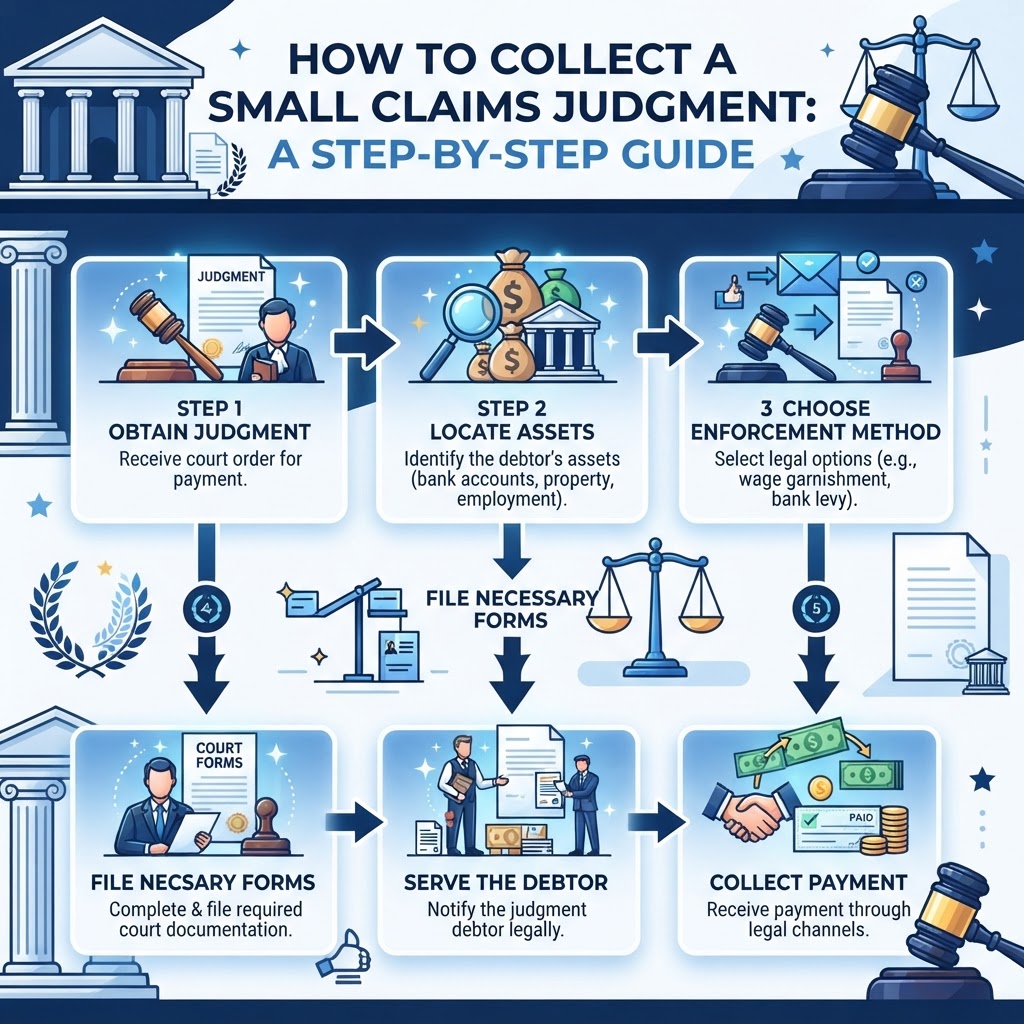
How to Collect a Small Claims Judgment: A Step-by-Step Guide
Winning a small claims case is only half the battle. Learn the essential steps to enforcing your judgment and actually getting paid, including specific procedures for New Jersey residents.
Turning Your Court Judgment Into Actual Payment. Winning your small claims case is only the beginning because the court does not automatically collect the money for you. You must take active steps to enforce the judgment by locating the debtor assets and using legal tools like wage garnishment or bank levies to satisfy the debt. Once the judge enters a final judgment in your favor, you become the judgment creditor, and the person who owes you money becomes the judgment debtor. In New Jersey, small claims cases are governed by the Rules Governing the Courts of the State of New Jersey, specifically Part VI, which addresses Special Civil Part procedures. Under these rules, once a judgment is entered, you have the right to seek satisfaction through various post-judgment discovery and collection mechanisms. If you are just starting the process, you may need to file a small claims case or consider our demand letter service to establish a formal record before going to trial. For those in other jurisdictions, we maintain comprehensive small claims guides by state to assist with local procedural nuances. ## The Reality of Judgment Enforcement. Many creditors mistakenly believe that the court clerk will send them a check on behalf of the debtor. This is never the case. The court provides the authority to collect, but you provide the legwork. In New Jersey, a money judgment is valid for 20 years under the statute of limitations. This gives you a significant window of time to identify assets, though it is best to act quickly while the debt is fresh and the debtor is still in the same jurisdiction. Before initiating formal collection, ensure you have a certified copy of the judgment issued by the Special Civil Part clerk. You must obtain this certified copy, often requiring a nominal fee of $5 to $10 depending on the county, to serve as official evidence of your right to collect. Once obtained, keep the original in a safe place, as this document is the foundation of every subsequent writ or order you file. ## Step-by-Step Collection Process. 1. Docket the Judgment: If the judgment amount exceeds the small claims limit or you need to place a lien on real estate, you may need to docket the judgment with the Clerk of the Superior Court in Trenton. Under New Jersey law, the Special Civil Part limit is $20,000. If you seek to attach the judgment to real property, you must pay a docketing fee, which is currently $50 per statute N.J.S.A. 2A:16-11. This creates a lien on any real estate the debtor owns within the state. This is a critical strategic move, as the lien remains for 20 years and effectively prevents the debtor from refinancing or selling their home without paying your judgment first. 2. Conduct Post-Judgment Discovery: You cannot seize assets if you do not know where they are. You may serve the debtor with a Fact Sheet, specifically the form approved under Rule 6:7-2. This document requires the debtor to disclose employment details, bank account numbers, and owned assets under oath. Service should be by certified mail, return receipt requested. If the debtor fails to answer the Fact Sheet within 14 days of service, you are permitted to file a motion to enforce the litigant’s rights. If the court grants this, the debtor may be ordered to appear at a supplementary proceeding. If they fail to appear, the court can issue a bench warrant for their arrest, though this is a measure of last resort. 3. Request a Writ of Execution: This is the primary document used to seize assets. You must file a request for a Writ of Execution with the Special Civil Part office in the county where the debtor lives or where their bank account is held. The filing fee is typically $50, but verify this with your local county clerk as fees vary slightly by location. For example, some counties require payment via money order or certified check rather than personal check. You must provide the clerk with a self-addressed stamped envelope to receive the issued Writ back. Once issued, you must forward this Writ to the court officer or sheriff in the relevant county. 4. Levy on Bank Accounts: Once you have a Writ of Execution, you can deliver it to the debtor's bank. The sheriff or a court officer will serve the writ, and the bank must freeze the funds in the debtor account up to the amount of the judgment plus interest and costs. Be aware that the bank is legally required to freeze the account for a specific period, usually 10 days, to allow the debtor to claim exemptions under N.J.S.A. 2A:17-50 through 2A:17-57. If the debtor does not contest the levy, the bank will transfer the funds to the court officer. 5. Garnish Wages: If the debtor is employed, you may file for a wage execution under Rule 6:7-3. This requires the employer to withhold a portion of the debtor's paycheck. The amount is governed by federal law, specifically the Consumer Credit Protection Act, which limits garnishment to the lesser of 25 percent of disposable earnings or the amount by which weekly earnings exceed 30 times the federal minimum wage. You must first provide the debtor with a notice of the intent to garnish wages, and they have 10 days to file an objection before you can proceed with the formal application to the court. ## Evidence and Documentation You Need. To successfully navigate the collection process, you must maintain an organized file. Keep the following documents ready at all times: - A certified copy of the Final Judgment signed by the judge. - Records of all communication with the debtor regarding payment, including emails and copies of letters sent via certified mail. - A log of interest accrued on the judgment. In New Jersey, post-judgment interest is calculated annually according to the rates set by the New Jersey Court Rules, Rule 4:42-11. This rate is determined by the Cash Management Fund rate plus two percent. - Copies of the Fact Sheet or any discovery responses provided by the debtor, which are vital for proving the debtor's assets in court. - Proof of the debtor’s current employer or primary banking institution. This information can often be gleaned from previous checks written by the debtor or their credit report if you have a permissible purpose. - Receipts for all filing fees paid during the collection phase, including clerk fees, court officer service fees, and postage. Under Rule 6:7-1, these costs are recoverable and should be added to the total judgment amount every time you execute a new phase of collection. ## Worked Example of a Collection Scenario. Imagine you won a judgment for $2,000 for unpaid renovation work on May 1st. You send a letter requesting payment, but the debtor ignores your letters for 60 days. You decide to initiate collection. First, you perform a search and identify the debtor's bank. You pay a $50 fee to the Special Civil Part clerk to file a Writ of Execution. The clerk stamps the document and sends it back to you. You then contact a court officer in the county where the bank branch is located, paying them a $75 service fee plus a $50 levy execution fee. The court officer serves the writ on the bank on August 1st. The bank identifies an account with $2,200. They freeze the account. After a 10-day waiting period mandated by N.J.S.A. 2A:17-52, to allow the debtor to contest the levy, the bank releases the funds. Your total judgment is $2,000, plus $175 in court costs, plus approximately $25 in accrued interest for the three months since the judgment was entered. The bank releases $2,200 total to the court officer. The court officer takes a commission of approximately 10 percent on the first $1,000 and 4 percent on the remainder, totaling $148. The court officer subtracts this commission and sends the remaining $2,052 to you. In this scenario, your total recovery is the full $2,000 plus the costs associated with the enforcement. ## Common Mistakes to Avoid. 1. Ignoring the Statute of Limitations. While the judgment itself is valid for 20 years, you must ensure that you file for renewal or extension if you haven't collected within that timeframe. Do not wait years to start the process, as assets can disappear or be spent, and employers often change. 2. Harassing the Debtor. While you are a creditor, you must still follow the Fair Debt Collection Practices Act (FDCPA). Even if you are a private individual, state-level consumer protection laws, such as the New Jersey Consumer Fraud Act, may apply to your conduct. Avoid threatening the debtor, calling them at unreasonable hours before 8 a.m. or after 9 p.m., or using abusive language. Keep all interactions professional and strictly business. 3. Failing to Update the Clerk. Every time you collect money, whether in a lump sum or through installments, you are legally required under Rule 6:7-1(b) to notify the clerk so the judgment balance can be credited. If you fail to do this, you risk being accused of trying to collect more than is owed, which can lead to sanctions, fines, or a court-ordered dismissal of your remaining judgment. 4. Trying to Seize Exempt Assets. Certain income sources, such as Social Security, Supplemental Security Income (SSI), disability benefits, and specific retirement accounts like 401(k) or IRA funds, are exempt from levy under both federal and state law. Attempting to seize these can result in a judge holding you in contempt or ordering you to pay the debtor's attorney fees. 5. Giving Up Too Soon. Debtors often ignore the first or second attempt at collection. Persistence, such as periodically checking for new employment or bank accounts, often pays off when the debtor eventually deposits a large sum or starts a new job. Setting a reminder to check public records every six months is a prudent strategy. ## Strategic Advice for Small Claims. One of the most effective ways to encourage payment is through a structured settlement offer. Many debtors will pay immediately if you offer a 10 percent discount for a lump-sum payment within 48 hours. This saves you the time and risk associated with bank levies. If you are struggling with the paperwork or the specific forms required for a levy, remember that CourtLinked prepares documents as a paralegal service, is not a law firm, and does not give legal advice. Utilizing professional document preparation ensures that your filings are accurate and compliant with the procedural requirements of the Special Civil Part. Always double-check your local county's website for specific local rules, as clerks in Bergen County may have slightly different administrative requirements than those in Camden County or Essex County. For instance, some counties require you to include a cover letter with your writs, while others have a specific local form for requesting a court officer service. Maintaining clear communication with the court clerk is the best way to ensure your collection process moves forward without unnecessary delays.
C
CourtLinked
Last reviewed Nov 4, 2026 · Preparing and filing across all 50 states since 2004. Not a law firm, no legal advice. Editorial standards
Related CourtLinked services
Need help filing your small claims case?
File My CaseRelated State Guides
Related Articles
More guides from the CourtLinked Law Library on similar small claims topics.
Filing GuideMissouri Small Claims Dollar Limit: What to Do When Your Claim Exceeds $5,000Read article →Filing GuideMinnesota Small Claims Dollar Limit: What to Do When Your Claim Exceeds $15,000Read article →Filing GuideHow to Enforce a Small Claims Judgment in Michigan: A Step-by-Step GuideRead article →Filing GuideHow to Collect a Small Claims Judgment in Texas: A Practical GuideRead article →Winning StrategiesHow to File a Small Claims Case for a Bad Check in New Jersey: A Step-by-Step GuideRead article →GeneralHow to File a Small Claims Case for a Bad Check in New JerseyRead article →