
Filing GuideBy CourtLinked Published Oct 16, 2026 12 min read
How to Enforce a Small Claims Judgment in Michigan: A Step-by-Step Guide
Winning your small claims case is only half the battle. Discover the essential steps to enforcing your judgment and collecting your money in Michigan.
Mastering the Michigan Post-Judgment Collection Process. Winning a small claims case is only the beginning of your journey to recovering your money. To enforce a judgment in Michigan, you must actively track the debtor's assets and use court-ordered discovery or collection remedies to compel payment, as the court does not automatically collect funds on your behalf. Under Michigan Court Rule 2.621, you possess the legal authority to use specific procedural tools to identify assets and satisfy the judgment debt. Enforcement is a strategic process that requires the judgment creditor to be the primary driver of all post-judgment activity, shifting from the role of a plaintiff to that of an enforcement agent.
Understanding the Legal Framework and Timelines. In Michigan, a small claims judgment remains valid for ten years from the date it was entered. This period is governed by the Michigan Revised Judicature Act, specifically MCL 600.5809. During this window, interest accrues on the judgment balance at a statutory rate defined in MCL 600.6013. For most small claims cases, the annual interest rate is calculated based on the average prime rate plus one percent, compounded annually. Because the burden rests on the creditor to initiate enforcement, patience and persistence are required. If you have not yet reached the stage of enforcement, you may need to review the initial steps to file a small claims case to ensure your judgment was recorded correctly. Remember that while the judgment itself lasts ten years, it can be renewed for an additional ten-year period if the proper steps are taken before the initial expiration, ensuring your right to collect does not vanish due to administrative neglect.
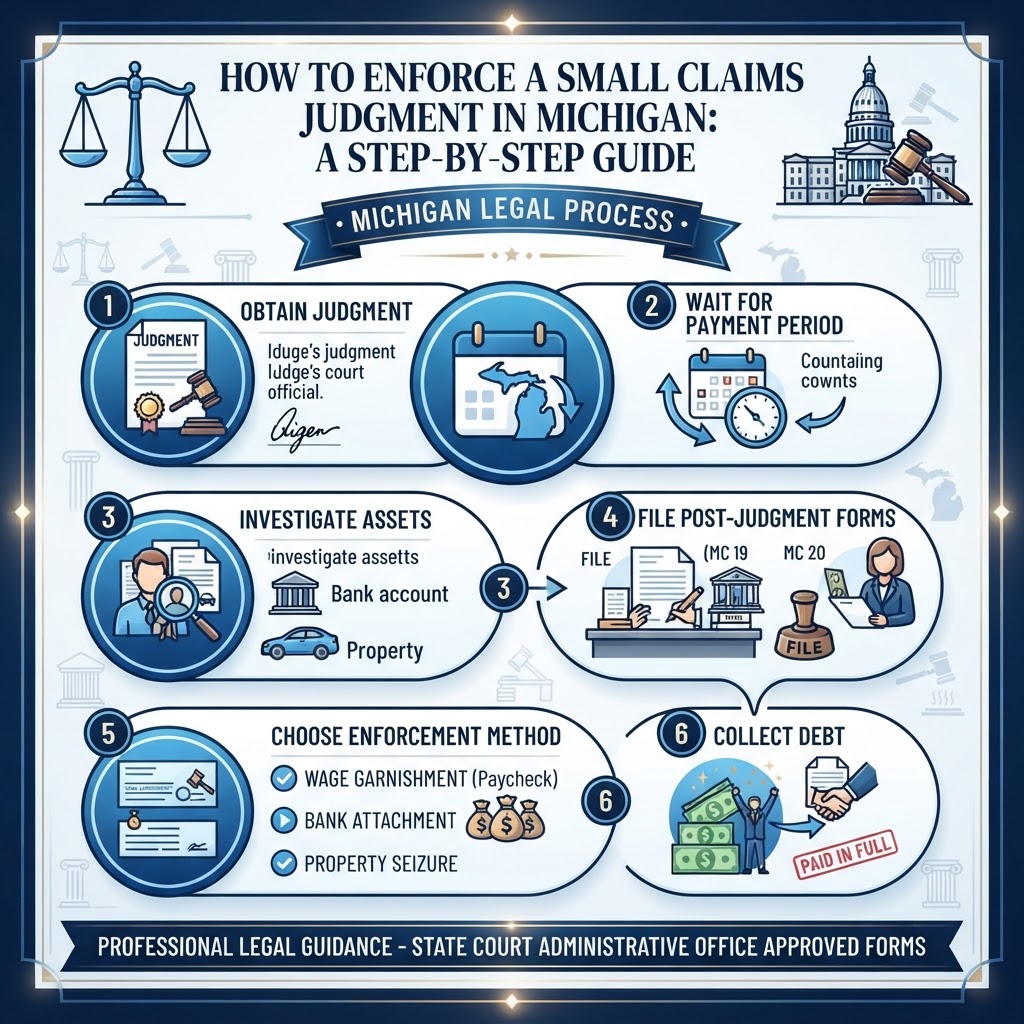
The Step-by-Step Collection Process. Collecting a debt is a procedural exercise that requires filing the correct forms with the same district court that issued your judgment. Follow this sequence to maximize your chances of recovery.
- Wait for the Statutory Period to Expire: You must wait 21 days after the judgment is entered before you can begin enforcement proceedings, pursuant to MCR 2.614. This provides the debtor a window to pay voluntarily, satisfy the judgment through other means, or file a motion to set aside the judgment or file an appeal.
- Obtain a Certified Copy of the Judgment: Visit the clerk of the district court. You will need a certified copy to prove your legal right to collect. This document serves as the foundation for all subsequent actions. The fee for a certified copy is typically $10 to $15 depending on the specific county local administrative order.
- Discovery of Assets: If you do not know where the debtor works or banks, file a Motion and Order for Discovery (Form MC 253). This compels the debtor to appear in court to answer questions under oath regarding their income, bank accounts, and real property. If the debtor fails to appear, the court may issue a bench warrant for contempt. This process is governed by MCR 2.621, which allows for the examination of the debtor to uncover hidden assets or income streams.
- Requesting a Writ of Execution: Once you have identified specific personal property, file for a Writ of Execution (Form MC 19). This authorizes a sheriff or court officer to seize the debtor's non-exempt personal property to sell at a public auction. Note that Michigan law protects certain household goods, tools of the trade, and a portion of wages from seizure under the personal property exemptions listed in MCL 600.6023.
- Garnishment of Wages or Bank Accounts: This is often the most effective tool. File a Request and Writ for Garnishment (Form MC 12). You must serve the garnishee, such as the debtor's employer or bank, which then creates a legal hold on the funds. The garnishee must respond to the court within 14 days of service. You must also serve the debtor with a copy of the request within seven days of serving the garnishee.
Essential Evidence and Documentation. To successfully navigate enforcement, keep a meticulous file of all communications and legal filings. You will need the following items readily available:
- A certified copy of the Judgment and Order.
- A current statement showing the remaining balance, including principal, interest, and any court-ordered costs such as filing fees or service fees.
- Proof of the debtor's employment, such as a recent pay stub, or bank account information acquired during discovery.
- Copies of the Proof of Service (Form MC 01) for every document mailed or hand-delivered to the debtor.
- Correspondence records, including any demand letter service documents sent prior to the initial filing.
- Documentation of all costs incurred during the collection process, as these are generally taxable costs that can be added to the judgment amount if the court approves a Bill of Costs.
A Worked Example of Asset Recovery. Assume you won a judgment for $3,000 against a debtor. You waited the mandatory 21 days, but the debtor failed to pay. You perform a search and find the debtor is employed at a local firm. You file a Request and Writ for Garnishment of Periodic Payments. Your filing fee is approximately $45, depending on the county requirements. The court clerk issues the writ, and you have it served on the employer. The employer is legally required to withhold a portion of the debtor's non-exempt disposable earnings and send those funds to the court, as regulated by the Consumer Credit Protection Act. Over the course of six months, the employer forwards $500 per month until the $3,000 judgment, plus statutory interest and your $45 filing fee, is paid in full. If the interest calculated at 4.5 percent per annum adds $65 over this period, your final recovery total would be $3,110. The court then issues a Satisfaction of Judgment (Form MC 17), which you must file to formally close the case and notify the debtor.
A Second Worked Example: Bank Garnishment. Imagine you have a judgment for $1,200. You locate the debtor's primary checking account through a credit report or previous discovery session. You file a Request and Writ for Garnishment (Non-Periodic), Form MC 13. You pay the $45 filing fee and a $10 service fee for the deputy sheriff or process server. The bank receives the writ and puts a hold on the account balance. If the account contains $800, the bank is legally obligated to freeze those funds. After the 28-day waiting period, if no objection is filed by the debtor, the bank sends the $800 to the court. You then file a motion to apply these funds toward your judgment. The total amount recovered is $800, leaving a remaining balance of $400 plus the $55 in collection costs. You then begin the process again for the remaining amount when you believe the account balance has replenished.
Common Mistakes to Avoid. Even experienced creditors can stumble during the enforcement phase. Avoid these five costly errors:
- Failing to update the judgment amount: Many creditors forget to add interest and taxable costs. Use an online calculator or contact the court clerk to ensure you are requesting the correct current total. Under MCL 600.6013, you are entitled to simple interest unless the judgment specifies compounding.
- Ignoring exemptions: Michigan law exempts specific amounts of household goods, tools of the trade, and portions of a head-of-household's wages under MCL 600.6023. Attempting to seize exempt property can lead to court sanctions against you or an immediate motion to dissolve the garnishment.
- Improper service: Every motion for garnishment or discovery must be served according to Michigan Court Rules. If you serve the documents incorrectly, such as failing to provide the debtor with the required disclosure forms, the judge will dismiss your motion, and you will lose your filing fee.
- Misidentifying the garnishee: Ensure you have the exact legal name and registered agent address for the bank or employer you are garnishing. If the name is slightly off, the bank may reject the writ. You can verify this by checking the Michigan Department of Licensing and Regulatory Affairs (LARA) database for registered agents.
- Giving up too soon: Judgments are valid for ten years. If the debtor is currently unemployed, the debt does not vanish. Periodic check-ins or re-filing for garnishment after the debtor finds a new job is a standard practice for successful collection. Persistence often wears down a debtor who would otherwise wait for the judgment to become stale.
Frequently Asked Questions. Where can you find additional resources? If you are navigating multiple jurisdictions, look into small claims guides by state for comparative insights into debt collection laws. Can you hire a collection agency? Yes, but they will take a percentage of the recovered funds as a commission, often ranging from 30 to 50 percent. Is it worth the cost? If the debt is significant, hiring a professional can save you the time and frustration of navigating the complex procedural filings required by the district court. Are there limits to garnishment? Yes, federal and state law sets specific caps on the percentage of disposable earnings that can be withheld, typically 25 percent of weekly disposable earnings or the amount by which disposable earnings exceed 30 times the federal minimum wage, whichever is less.
Final Procedural Notes. Always remember that the court clerk cannot provide legal strategy or dictate which collection method will work best for your specific case. They can only explain the forms and the fees. If you find the paperwork overwhelming, consider using an outside document preparation service to ensure your filings meet local court requirements. CourtLinked prepares documents as a paralegal service, is not a law firm, and does not give legal advice. Ensure all forms are signed, notarized where required, and filed in duplicate to keep a copy for your personal records. Always keep a calendar of your filing deadlines, as missing a 14-day window for a garnishee response or a 28-day window for a garnishment objection can force you to restart the entire enforcement process, resulting in further wasted filing fees and increased time delay. Persistence is your best asset when dealing with resistant debtors.
C
CourtLinked
Last reviewed Nov 4, 2026 · Preparing and filing across all 50 states since 2004. Not a law firm, no legal advice. Editorial standards
Related CourtLinked services
Need help filing your small claims case?
File My CaseRelated State Guides
Related Articles
More guides from the CourtLinked Law Library on similar small claims topics.
Filing GuideMissouri Small Claims Dollar Limit: What to Do When Your Claim Exceeds $5,000Read article →Filing GuideMinnesota Small Claims Dollar Limit: What to Do When Your Claim Exceeds $15,000Read article →Filing GuideHow to Collect a Small Claims Judgment: A Step-by-Step GuideRead article →Filing GuideHow to Collect a Small Claims Judgment in Texas: A Practical GuideRead article →GeneralHow to Win a Security Deposit Dispute in Michigan Small Claims CourtRead article →GeneralHow to Appeal a Small Claims Court Decision: A Comprehensive GuideRead article →