
How to Collect a Small Claims Judgment in Washington State
Winning your small claims case is only half the battle; collecting your money is the next step. Learn the legal methods available to recover your judgment in Washington State.
Understanding the Reality of Judgment Collection in Washington
Winning a judgment in Washington Small Claims Court signifies that the judge has formally recognized your right to be paid, but it does not automatically move money from the defendant's bank account to yours. In Washington, the burden of collection rests entirely on the judgment creditor, requiring you to navigate specific legal procedures under the Revised Code of Washington (RCW) Title 6, which governs enforcement of judgments, to compel payment or seize assets. Many creditors mistakenly believe the court acts as a debt collector. In reality, the court acts only as an adjudicator. If you are successful, the clerk will record the judgment in the court's ledger, but you are the one responsible for the logistics of extraction.
The Legal Framework for Collection
When a judge enters a judgment in your favor, it becomes a legal debt. Under Washington law, this judgment is valid for ten years and can be renewed for an additional ten-year period if you file a renewal of judgment before the initial expiration date, as stipulated in RCW 6.17.020. You must obtain a certified copy of the judgment from the court clerk to initiate any formal collection process. This document, officially stamped and sealed, serves as the legal authorization to trigger post-judgment remedies. Without this physical proof of debt, you cannot issue writs of garnishment or liens against property. If you are still in the preliminary stages of your dispute, you can file a small claims case through proper court channels to establish this foundation. Should you need professional assistance in drafting the necessary notices before reaching the collection phase, our demand letter service provides a structured approach to notifying the debtor before filing.
It is critical to note that the judgment is a public record. Once entered, credit bureaus may eventually pick up this information, which creates a powerful incentive for debtors to pay. However, your role is to facilitate this by having the proper paperwork in hand. Fees for obtaining a certified copy are typically minimal, usually ranging between $5 and $10 depending on the specific county clerk’s fee schedule.
Step-by-Step Collection Process
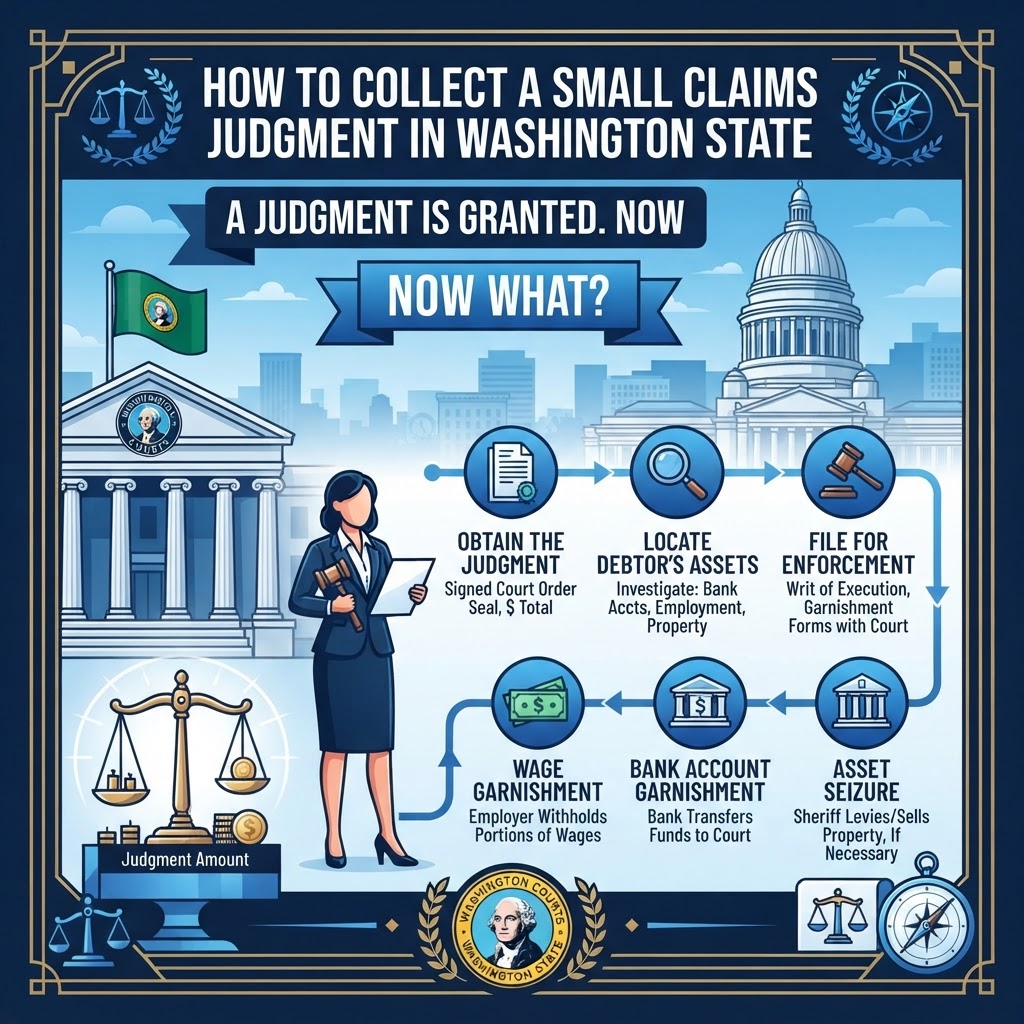
Collecting a judgment is a methodical process. You cannot simply demand cash from a reluctant debtor. You must follow the statutory path to locate assets and legally seize them.
- Obtain a Certified Copy of the Judgment: Visit the clerk of the court where your case was decided. You will need to pay a small statutory fee for a certified copy. This document is your key to all subsequent collection actions. Ensure you request at least three certified copies to keep one for your records and provide others to banks or the sheriff.
- Conduct a Debtor’s Examination: If you do not know where the debtor works or banks, you can file for a Supplemental Proceeding under RCW 6.32. This forces the debtor to appear in court under oath to answer questions about their assets, income, and liabilities. You will file an Application for Order Requiring Appearance of Judgment Debtor. If the judge grants this, the debtor is served with an order to appear. Failure to appear can result in a bench warrant for the debtor's arrest.
- Verify Asset Locations: Using the information from the debtor's exam, identify liquid assets. If they are employed, you look for payroll information. If they own a home, look for the county records to see if a lien is feasible. You can access the County Auditor’s website to search for property deeds associated with the debtor's name.
- Apply for a Writ of Garnishment: Once you identify a bank account or employer, file for a Writ of Garnishment. You must submit the application and the required fee to the court. The clerk issues the writ, which you must serve on the bank or employer, known as the garnishee. Note that in many counties, the clerk charges an additional administrative fee for processing the writ, separate from any service fees.
- Wait for the Answer: The bank or employer is legally required to answer the writ within 20 days. They must state whether they hold any of the debtor's funds. Under RCW 6.27.190, the garnishee must provide this answer in writing.
- Receive Payment: If funds are identified, the garnishee will forward them to the court, which will then distribute the funds to you, less any applicable court administrative costs. Be aware that the court registry process can take several weeks after the funds are deposited by the employer or bank.
Worked Example: Garnishing Wages and Bank Accounts
Consider two scenarios. Scenario A: You won a $4,000 judgment against a contractor. They earn $800 in disposable weekly earnings. Per RCW 6.27.150, the amount subject to garnishment is the lesser of 25% of disposable earnings or the amount by which disposable earnings exceed 35 times the federal minimum wage. If the weekly earnings are $800, 25% is $200. This is the weekly deduction. Over 20 weeks, your $4,000 debt is satisfied.
Scenario B: You have a judgment for $1,200 and you find a bank account containing $1,500. You serve a Writ of Garnishment on the bank. The bank must freeze the funds up to the amount of the judgment plus estimated interest and costs. If your total judgment with interest is $1,250, the bank will freeze $1,250. They will hold it for the statutory period, and if no claim of exemption is filed by the debtor, they will remit the $1,250 to the court. Your total recovery includes the original $1,200 plus the statutory interest accrued from the date of judgment until the date of payment.
Evidence Required for Successful Collection
To succeed, you must maintain a file of specific evidence. Keeping these documents organized is critical for court hearings:
- Certified Copy of the Judgment: The primary proof of the debt.
- Proof of Service: If you serve documents on a garnishee, ensure you have a sworn statement that the documents were delivered according to civil procedure rules. This often involves a process server’s affidavit or a declaration of service.
- Asset Search Results: Bank names, branch addresses, and employer contact information. Documentation here helps you target the correct financial institution.
- Interest Calculation Sheet: A precise log of the judgment amount, interest accrued, and any costs incurred during the collection phase. Washington allows for post-judgment interest, typically at the rate of 12% per annum, or the prime rate plus 4%, whichever is higher, under RCW 4.56.110.
- Correspondence Log: Records of any communications with the debtor regarding payment plans.
For those needing context on how other states handle these processes, you can review our comprehensive small claims guides by state for comparative insights.
Common Mistakes to Avoid
Many creditors fail because they assume the court system will track the money for them. Here are five costly errors:
- Failure to Renew the Judgment: Many creditors wait too long. If your judgment expires after ten years, you lose the ability to collect. Set a digital calendar alert for eight years after the judgment date to prepare for renewal. Per RCW 6.17.020, you must file the renewal with the clerk before the expiration date.
- Ignoring Exemptions: Washington law protects certain assets, such as specific household goods, a portion of wages, and social security payments. Attempting to garnish exempt funds leads to court sanctions and waste of your filing fees. Review RCW 6.15.010 to understand what is protected, such as a motor vehicle up to a certain dollar value or basic personal household goods.
- Giving Up Too Soon: Debtors often move or change jobs. If a garnishment fails today, it does not mean it will fail in six months. Periodically re-check public records to see if the debtor has opened new bank accounts or started a new job.
- Not Calculating Costs: You are allowed to add the cost of filing fees and service fees to the total judgment amount. Failing to do this means you lose money out of your own pocket for every step you take. Keep every receipt for your filing fees and process service, and file a Cost Bill with the court.
- Harassment: Never threaten, intimidate, or harass the debtor. Washington has strict consumer protection laws. If you cross the line into harassment, the debtor can countersue you, effectively canceling out your victory. Do not contact the debtor's workplace for reasons other than serving legal process.
Assessing the Cost of Collection
Collection is not free. You will face filing fees for writs, which generally range between $20 and $50 depending on the county. King County, for example, has its own fee schedule which may differ from smaller counties like Spokane or Pierce. Additionally, you may pay a private process server to deliver the writs, usually costing between $50 and $150. Always weigh these sunk costs against the likelihood of recovery. If the debtor is truly judgment proof, meaning they have no income or assets, spending more money to chase them is illogical. Before spending on professional servers, check if the local sheriff is a cheaper alternative for serving garnishments in your jurisdiction.
Understanding Liens on Real Property
If the debtor owns real estate in Washington, you can create a lien on that property. This does not result in an immediate payment, but it prevents the debtor from selling or refinancing the property without paying your judgment first. To do this, you must file an Abstract of Judgment with the county auditor in the county where the property is located. This lien attaches to the real property and earns interest until the debt is satisfied or the property is sold. This is a low-maintenance way to secure your debt. If the debtor ever decides to sell their home, your judgment will appear in the title search, and the escrow company will require payment to you to clear the title.
Finalizing the Debt
Once you receive payment in full, you are legally required to file a Satisfaction of Judgment with the court clerk. This document informs the court that the debt has been paid and removes the cloud from the debtor's credit and property records. Failure to file this notice within 60 days of receiving payment can result in penalties against you, including potential statutory damages for refusing to acknowledge a paid debt. It is a simple form available at the clerk's office, but it carries significant legal weight for the debtor's financial future.
CourtLinked prepares documents as a paralegal service, is not a law firm, and does not give legal advice. If your collection attempt involves complex bankruptcy issues or significant asset transfers, consult with an attorney to ensure your rights are protected under Washington law. When navigating the complexities of post-judgment collection, the more prepared you are with your documentation and statutory knowledge, the higher the probability of successful recovery.
Last reviewed Nov 4, 2026 · Preparing and filing across all 50 states since 2004. Not a law firm, no legal advice. Editorial standards
Related CourtLinked services
Need help filing your small claims case?
File My CaseRelated State Guides
Related Articles
More guides from the CourtLinked Law Library on similar small claims topics.