
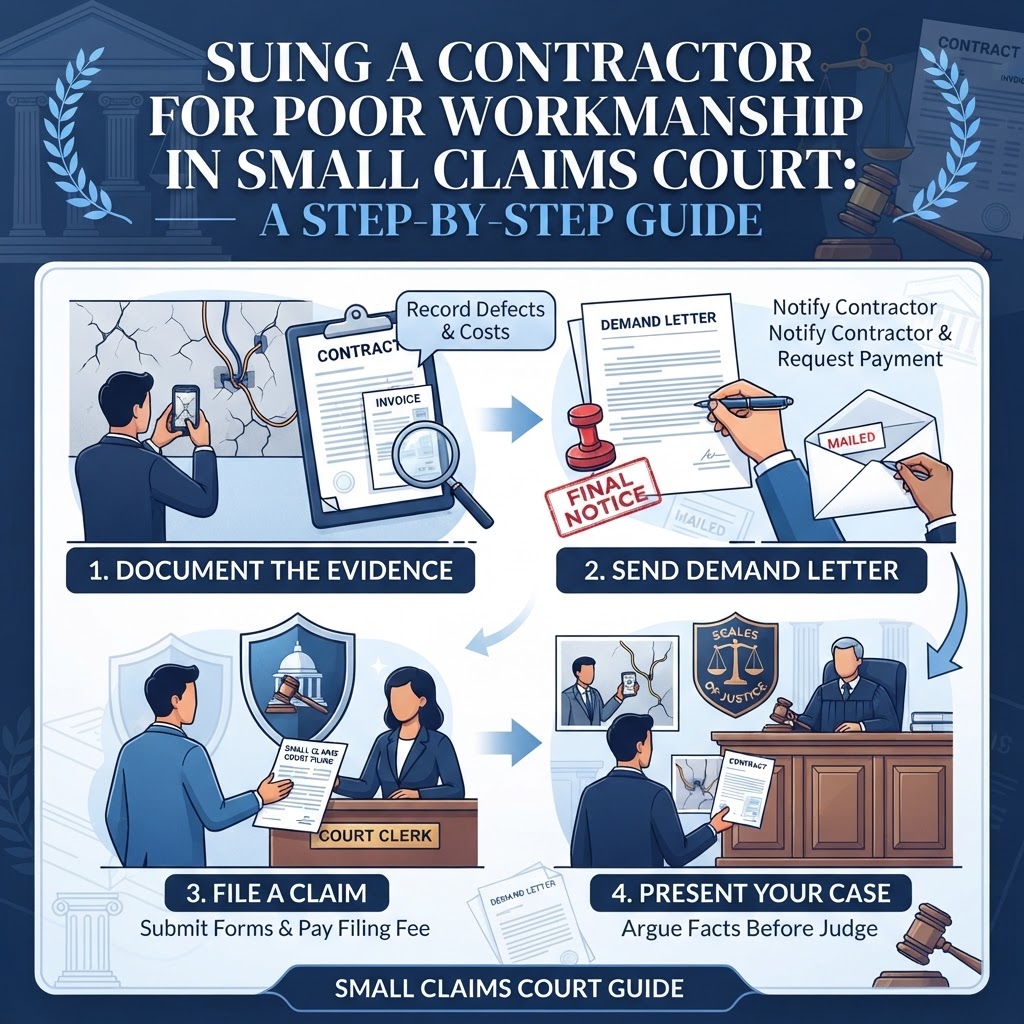
Suing a Contractor for Poor Workmanship in Small Claims Court: A Step-by-Step Guide
Discover how to hold a contractor accountable for substandard work in small claims court. This guide covers essential evidence collection, New York-specific filing procedures, and how to build a winning case.
Navigating Contractor Disputes in New York Small Claims Court
To sue a contractor for poor workmanship in New York, you must first prove that the contractor breached their contractual obligations by failing to meet industry standards or the specific terms of your agreement. Small claims court provides a streamlined, low-cost venue for recovering damages up to $5,000 in town and village courts, or up to $10,000 in city courts, provided the dispute centers on money damages rather than performance mandates. When seeking damages, plaintiffs should note that these limits are based on the principal amount sought, not including interest or court costs, which may be added at the court's discretion.
Establishing the Legal Foundation
Under New York law, contractors are generally held to a standard of workmanlike performance. This is often implied in every home improvement contract, even if it is not explicitly stated in writing. When a contractor performs work that deviates from the building code or the agreed-upon specifications, they have breached the contract. New York General Business Law Article 36-A regulates home improvement contracts, requiring that agreements over $500 be in writing and contain specific disclosures. If your contractor failed to provide a written contract, they may be in violation of these regulations, which significantly strengthens your position. These regulations mandate that the contract includes the contractor's name, address, and registration number, as well as a approximate start and completion date. Failure to include these elements may constitute a violation of GBL Section 771. In addition to GBL Article 36-A, contractors must comply with the New York State Uniform Fire Prevention and Building Code. Deviating from these codes is a powerful argument for a breach of contract claim, as it establishes that the work failed to meet basic legal safety requirements.
Documenting the Defective Work
Evidence is the pivot point of your case. Because the judge relies exclusively on the documentation provided during the hearing, you must create a narrative that is impossible to ignore. Begin by assembling a comprehensive file that illustrates the timeline of the project from inception to the final, unsatisfactory result.
- The original signed contract and any subsequent change orders. Ensure every change order is dated and signed by both parties.
- Dated photographs capturing the specific areas of poor workmanship from multiple angles. Include a tape measure or a reference object to show scale, especially for spacing or depth issues.
- Detailed logs of all communications, including emails, text messages, and call records. Create a chronological spreadsheet that lists the date, the medium of communication, and a brief summary of what was said.
- A copy of the formal demand letter service notice sent to the contractor. This must be sent via certified mail, return receipt requested, to ensure there is a legal record of delivery.
- Itemized estimates from a licensed, reputable third-party contractor detailing the cost to repair the specific damage. These should be on professional letterhead with the contractor’s license number listed.
- Proof of all payments made to the contractor, including cancelled checks, bank statements, or digital payment transfer logs like Zelle or Venmo transactions.
- Any building permits or inspection reports from the local municipality if the work required a Certificate of Occupancy or specific sign-offs. If the contractor promised to obtain a permit but failed to do so, document the local town code requiring that permit.
The Step-by-Step Filing Process
- Calculate your damages. Ensure you are only seeking money. Small claims courts cannot order a contractor to finish a job; they can only order them to pay for damages or repairs. Total damages include the cost of repair, the cost of permits for the remedial work, and any storage or temporary housing costs directly caused by the breach.
- Attempt to resolve the dispute. Send a formal demand letter via certified mail with a return receipt. This serves as your final notice and is a prerequisite for showing the judge that you acted in good faith. Allow at least 15 days for a response before proceeding to filing.
- Locate the correct court. You must file in the county where the contractor resides, has a place of business, or where the work was performed. If filing in a City Court, consult the Uniform City Court Act (UCCA) jurisdictional rules. Filing fees range from $15 to $20 depending on the amount of your claim. In NYC, the fee is $15 for claims up to $1,000 and $20 for claims over $1,000.
- File the claim. Visit the clerk of the court to file a small claims case. You will need to provide the exact legal name of the contractor or their business entity. If the business is an LLC, search the New York Department of State database to find the registered agent for service of process. Do not use a DBA name if the business is registered as an LLC or Corp.
- Serve the defendant. Once the clerk issues a notice of trial, you must ensure the defendant is served according to New York Uniform City Court Act or the relevant local act. This usually involves personal delivery or delivery to a person of suitable age and discretion at the contractor's business address, followed by a mailing. Service must be completed within 120 days of filing the summons in many jurisdictions, but local rules vary, so verify with your specific court clerk.
- Prepare for the hearing. Organize your evidence in a binder with an index. You will only have a few minutes to present your case, so keep your arguments focused on the contract breach and the dollar value of the damages. Expect to provide a brief opening statement of 60 seconds that summarizes the contract, the breach, and the cost to repair.
Worked Example: Calculating Your Claim
Scenario 1: You hire a contractor for a kitchen renovation for $15,000. You pay an $8,000 deposit. The contractor installs cabinets unevenly and leaves wiring exposed, failing municipal inspections. A second professional provides a written estimate: $4,500 for removal/repair and $500 for a new building permit. Your total claim is $5,000.
Scenario 2: Consider a flooring installation. The contract was $6,000. You paid $4,000 upfront. The contractor installed the wrong grade of wood, violating the contract specifications. The cost to remove the bad floor is $1,200, and the cost for the correct material and labor to reinstall is $5,500. Total repair cost is $6,700. Since you only paid $4,000, your net loss is $2,700, plus you should demand the return of the $4,000 paid for the unusable work. Your total claim would be $6,700 (the cost to get the job you originally contracted for). Always be prepared to prove that the work done has zero residual value if you are seeking a full refund.
Common Mistakes to Avoid
- Suing the wrong entity: If you sue "John Smith" but the business is "John Smith Contracting LLC," the court may dismiss your case. Always check the entity status through the New York Secretary of State to identify the correct defendant. If you sue the wrong entity, the judgment may be unenforceable against the correct corporate assets.
- Lacking expert testimony: Photographs are rarely enough for structural defects. A written estimate from another licensed contractor acts as your expert witness. Without it, you are asking a judge to guess the value of the repairs. Ensure the estimate specifies that the repair is necessary to meet industry standards.
- Failing to send a demand letter: Judges look unfavorably on litigants who rush to court without giving the contractor a formal opportunity to rectify the work. This letter is your primary evidence of an attempted settlement and serves as your notice of intent to sue.
- Seeking non-monetary relief: You cannot use small claims court to force a contractor to return to your house to fix the work. If you ask for the work to be completed, the judge may dismiss the claim because they lack the authority to grant that remedy under the UCCA or uniform acts for local courts.
- Missing the service deadline: New York law requires specific time frames for serving the defendant. In some jurisdictions, the defendant must be served at least 10 to 15 days before the trial date. If you fail to file your Affidavit of Service with the court clerk before the deadline, the judge will reschedule or dismiss the case.
Expert Tips for Success
Dress professionally and treat the court clerk and the judge with respect. Bring three copies of every document: one for the judge, one for the defendant, and one for your personal records. If you are appearing in a crowded municipal court, anticipate that the judge may see dozens of cases in one day. Brevity is your best friend. Stay calm if the contractor lies or attempts to shift blame; simply present your evidence as a neutral, factual account of the contract breach. If the contractor does not show up, you may be granted a default judgment, but you must still be prepared to prove your damages to the judge to ensure the amount awarded is accurate. When presenting your binder, label tabs clearly (e.g., Tab 1: Contract, Tab 2: Photos, Tab 3: Estimates). Mentioning the specific section of your contract that was breached helps the judge identify the legal core of your dispute immediately. If you have any doubts about your case's timeline, remember that New York has a six-year statute of limitations for contract breaches under CPLR Section 213, though you should file as soon as the dispute remains unresolved.
CourtLinked prepares documents as a paralegal service, is not a law firm, and does not give legal advice.
Frequently Asked Questions
Can I recover interest on the money?
Yes, in many cases, you can request statutory interest at the rate of 9% per year from the date the breach occurred, provided you clearly document the date the contract was violated. You must explicitly ask the judge to include this interest in the final judgment during the hearing.
What if the contractor ignores the judgment?
If the contractor does not pay, you can use the judgment to pursue collection actions such as garnishing their business bank account or placing a lien on property they own, though these processes require additional filings. You may need to obtain an Information Subpoena from the court clerk to locate their banking details.
Is mediation required?
Many small claims courts offer mediation before the hearing. It is often a wise choice because it allows for a negotiated settlement that is guaranteed by a written agreement, saving you the risk of a judge's final decision. If the mediation results in a settlement, ensure it is signed by both parties and the mediator, then filed with the court to become a binding, enforceable judgment.
Last reviewed Nov 4, 2026 · Preparing and filing across all 50 states since 2004. Not a law firm, no legal advice. Editorial standards
Related CourtLinked services
Need help filing your small claims case?
File My CaseRelated State Guides
Related Articles
More guides from the CourtLinked Law Library on similar small claims topics.