
EvidenceBy CourtLinked Published Sep 25, 2026 9 min read
How to Collect a Small Claims Judgment in New Jersey: A Step-by-Step Guide
Winning your small claims case is only half the battle. Learn the essential steps to enforcing your judgment and collecting what you are owed in the state of New Jersey.
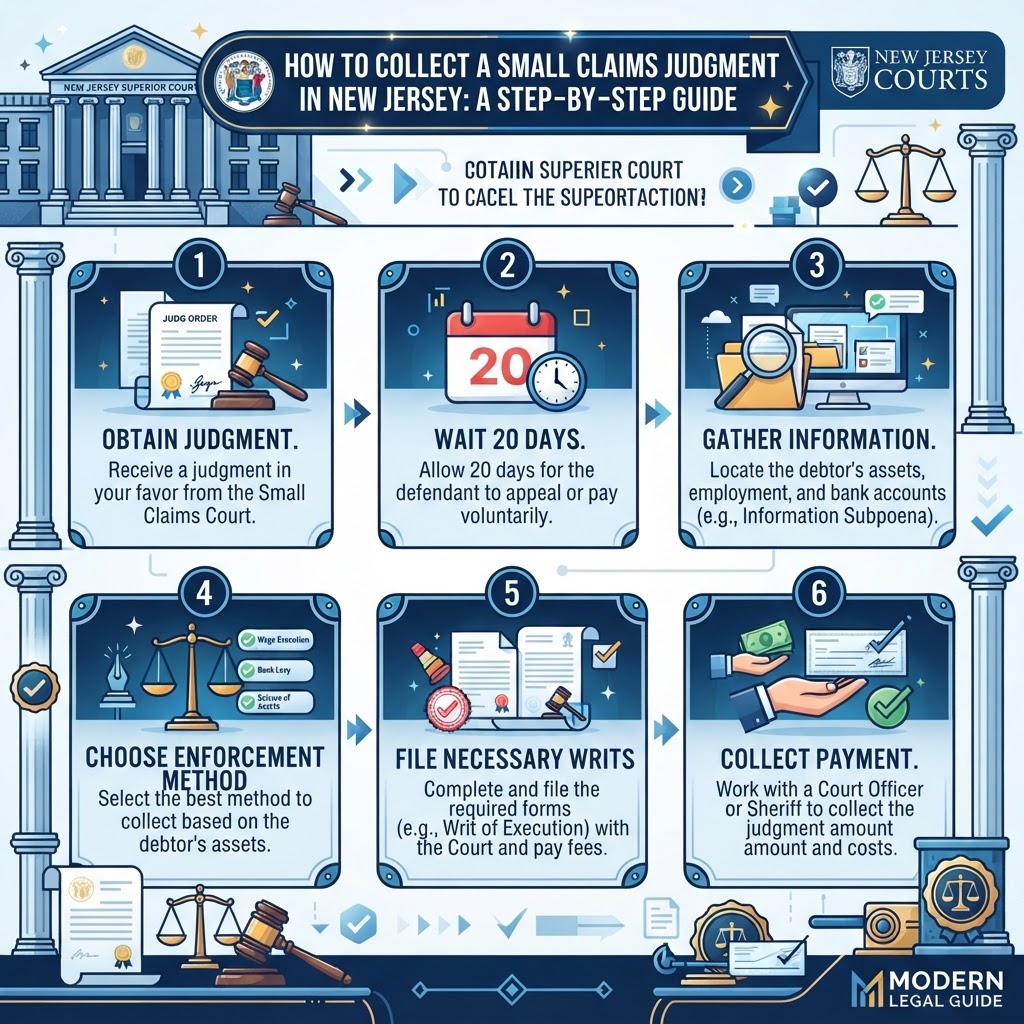
Understanding the Collection Process in New Jersey. Winning a judgment in New Jersey Small Claims Court is a legal victory, but it does not automatically result in cash in your pocket. The court grants you the right to collect, but the responsibility to locate assets and initiate enforcement mechanisms rests entirely with you as the judgment creditor. Under the New Jersey Rules of Court, specifically Rule 6:7 regarding process to enforce judgments, you must actively track down the debtor's income or property to satisfy the debt. ### The Legal Reality of Your Judgment. When a judge enters a judgment in your favor, the clerk records it in the court's judgment docket. In New Jersey, a small claims judgment remains valid for twenty years under N.J.S.A. 2A:14-5. You have significant time to collect, but interest accrues on the unpaid balance at the annual rate set by the New Jersey Rules of Court, Rule 4:42-11. This interest can be added to the total amount owed, making it vital to keep precise records of all payments received and expenses incurred during the collection process. If the debtor refuses to pay voluntarily, you must move from the role of a litigant to an investigator and enforcer. The interest rate is a variable figure that changes annually based on the average rate of return of the State of New Jersey Cash Management Fund. For example, if you obtained a judgment for $3,000, you are entitled to add the accrued interest to the principal when calculating your final collection total. Keeping this figure updated is essential because debtors often wait for you to provide the total payoff amount before they are willing to settle the debt. ## Phase One: Information Gathering. Before you can collect, you must find where the debtor keeps their money. If you do not know the debtor's place of employment or banking details, you should utilize the Information Subpoena process. This is the most powerful tool for a self-represented creditor. You request that the court clerk issue an Information Subpoena, which is a formal document requiring the debtor to answer questions under oath about their assets, employment, and bank accounts. ### The Information Subpoena Process. Once you receive the subpoena from the court, you must serve it on the debtor via certified mail, return receipt requested, or personal service as permitted by Rule 1:9-3. The clerk will usually charge a nominal fee, typically around $5 to $10, for the issuance of the subpoena depending on the county. The debtor has ten days to complete the form and return it to you. If the debtor fails to respond or provides incomplete information, you can file a motion with the court to hold them in contempt of court under Rule 1:10-3. This motion requires a $30 filing fee in most counties. Contempt proceedings can lead to sanctions, which may provide the leverage needed to force payment. A judge may order the debtor to pay your costs associated with the motion, which often includes the filing fee and service costs. If you require professional assistance in drafting these requests, you may consider utilizing resources for [small claims guides by state] to ensure your filings are procedurally accurate. ## Phase Two: Legal Enforcement Mechanisms. Once you identify assets, you must select the correct enforcement method. Each method involves different filing fees, which are generally added to the judgment amount, but you must pay them upfront. These fees can vary by county, but they are regulated statewide. ### Wage Garnishment. Wage garnishment is effective if the debtor is employed. You must file a Wage Execution form with the Clerk of the Special Civil Part. New Jersey law limits the amount that can be garnished. Generally, the amount cannot exceed 25 percent of the debtor's disposable earnings or the amount by which their disposable earnings exceed 40 times the federal minimum hourly wage, whichever is lower. The federal minimum wage currently sits at $7.25 per hour, though New Jersey state minimum wage laws may provide higher protections for the debtor. You must have a current address for the employer to initiate this process. The process involves sending the wage execution to the employer, who is then required by law to withhold the specific amount from the employee's paycheck until the judgment, plus the court officer's fees, is fully satisfied. ### Bank Levy. If you know where the debtor keeps their money, a bank levy is often the fastest way to collect. You must file a Writ of Execution with the court clerk. Once issued, you provide this to a court officer or a private process server, who will serve the bank. The bank is then legally obligated to freeze the debtor's account up to the amount of the judgment plus interest and costs. You must serve the bank with the Writ of Execution and a copy of the original judgment. The bank is required to hold the funds for a period of time, usually 15 to 30 days, to allow the debtor an opportunity to file a claim for exemptions. If no claim is filed, the bank will release the funds to the court officer. ## A Worked Example of Collection. Suppose you won a judgment for $2,500. After six months, the debtor has paid nothing. You filed an Information Subpoena, which cost $5 in fees, and discovered the debtor is employed at a local firm. You then paid a $75 fee to file for a Wage Execution. The total debt is now $2,580 plus statutory interest. Let us calculate the interest on the original $2,500 at an assumed rate of 0.5 percent per annum for six months, which adds $6.25, bringing your total to $2,586.25. If the debtor earns $800 in disposable income weekly, the court may authorize a garnishment of approximately $200 per week. Over time, this satisfies the debt. You must keep a ledger of every dollar received and notify the court when the debt is fully satisfied so that the judgment can be marked as satisfied on the record. For a second example, imagine you have a $5,000 judgment. You discover a bank account with $2,000 in it. You pay a $50 filing fee for the Writ of Execution and $100 for the court officer fee. You are now authorized to collect $5,150. If the levy is successful, the bank freezes the $2,000. After the waiting period, the bank sends $2,000 to the court officer. The officer keeps their commission, typically 10 percent on the first $1,000 and 4 percent thereafter, and sends the remainder to you. You then credit the $5,000 judgment with the net amount received. ## Evidence Checklist for Collections. To effectively navigate the collection process, you must maintain a comprehensive folder containing the following items: * Certified copy of the original court judgment obtained from the Special Civil Part clerk. * A detailed ledger showing the principal amount, interest calculations, and any partial payments made. * Copies of all returned Information Subpoenas signed by the debtor under penalty of perjury. * Proof of service documents for all enforcement motions, including certified mail green cards and affidavit of service forms. * Documentation of the debtor's employer or banking institution names and addresses as revealed through discovery. * Receipts for all court filing fees paid during the enforcement phase, as these are reimbursable by the debtor upon collection. If you are just starting your journey or need to revisit earlier steps, you can [file a small claims case] or use a [demand letter service] to ensure you have exhausted all pre-judgment options. ## Common Mistakes to Avoid. 1. Ignoring Exempt Assets: Attempting to levy assets that are exempt under New Jersey law, such as certain social security benefits, unemployment benefits, or workers compensation, is a waste of time and money. Familiarize yourself with the list of exempt property under N.J.S.A. 2A:17-19. 2. Failing to Update the Court: Every time you receive a payment, you are legally required to credit the debtor. Failing to do so can lead to accusations of fraud or bad faith, which can jeopardize your entire judgment. 3. Assuming the Court Collects for You: Many creditors believe the court clerk will chase the money. The clerk facilitates the paperwork, but you are the collection agent. If you do nothing, you get nothing. 4. Letting the Judgment Lapse: While judgments last 20 years, they should be renewed or tracked carefully. If you reach the end of the term without enforcement, the judgment becomes uncollectible under the statute of limitations. 5. Using Self-Help Harassment: You cannot call the debtor at work repeatedly or threaten them. These actions can violate the Fair Debt Collection Practices Act and lead to counter-suits against you, even if they owe you money. 6. Miscalculating Costs: Always verify current filing fees with the specific county office, as fees in Bergen County may differ from those in Salem County due to local administrative charges. ## Procedural Step-by-Step. 1. Secure the Judgment: Obtain a certified copy of the judgment from the Special Civil Part Clerk's office. This will cost approximately $5 to $10. 2. Asset Search: Send the Information Subpoena to the debtor. If they refuse to cooperate, file a motion to enforce the litigant's rights, which usually requires a motion fee of $30. 3. Selection: Choose between a Wage Execution for employed debtors or a Writ of Execution for bank accounts. 4. Filing: Submit the appropriate application to the Clerk of the Special Civil Part, paying the required filing fees. 5. Service: Coordinate with a court officer to serve the Wage Execution on the employer or the Writ of Execution on the bank. 6. Distribution: The court officer collects the funds, deducts their statutory service fee, and forwards the balance to you. 7. Satisfaction: Once paid in full, notify the Clerk of the Special Civil Part immediately so the judgment can be marked as satisfied and closed. Failure to file a warrant of satisfaction can lead to legal penalties. CourtLinked prepares documents as a paralegal service, is not a law firm, and does not give legal advice. Navigating the legal system requires attention to detail. If you are ever in doubt regarding a specific procedural hurdle, consult the local rules of your specific county court, as filing fees and local requirements can differ slightly across the state of New Jersey.
C
CourtLinked
Last reviewed Nov 4, 2026 · Preparing and filing across all 50 states since 2004. Not a law firm, no legal advice. Editorial standards
Related CourtLinked services
Need help filing your small claims case?
File My CaseRelated State Guides
Related Articles
More guides from the CourtLinked Law Library on similar small claims topics.
EvidenceHow to Win Your Small Claims Case: A Strategic Guide for New Jersey PlaintiffsRead article →EvidenceSuing a Contractor for Poor Workmanship in Small Claims Court: A Step-by-Step GuideRead article →EvidenceHow to Sue for Breach of Contract in Small Claims Court: A Complete GuideRead article →Winning StrategiesHow to File a Small Claims Case for a Bad Check in New Jersey: A Step-by-Step GuideRead article →Filing GuideHow to Collect a Small Claims Judgment: A Step-by-Step GuideRead article →GeneralHow to File a Small Claims Case for a Bad Check in New JerseyRead article →