
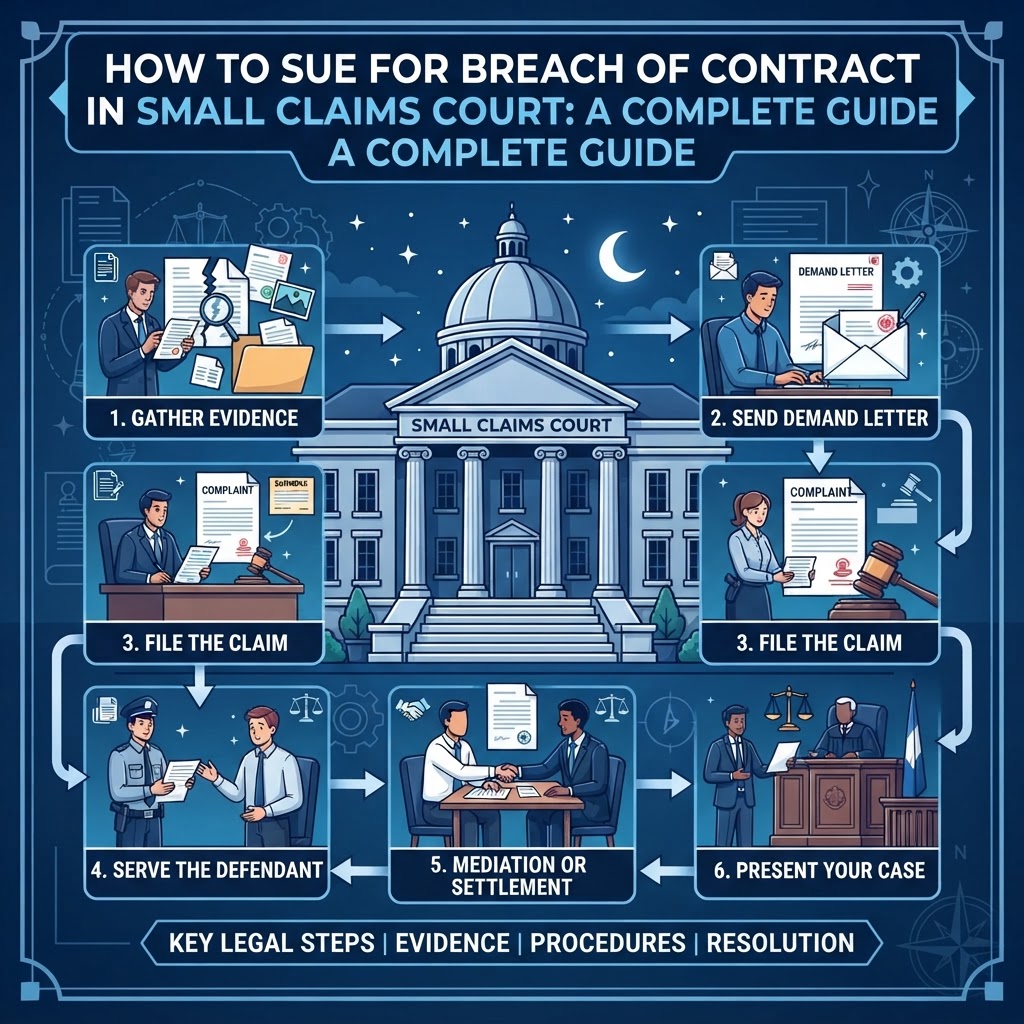
How to Sue for Breach of Contract in Small Claims Court: A Complete Guide
Facing a broken agreement? Learn how to prepare, file, and win a breach of contract case in small claims court with our step-by-step guide. Discover essential evidence-gathering tips and navigate the Virginia legal process with confidence.
Understanding Breach of Contract in Virginia Small Claims
To successfully sue for breach of contract in Virginia Small Claims court, you must demonstrate the existence of a valid agreement, your own performance, the defendant’s failure to perform, and resulting monetary damages. This process occurs in the General District Court, where the jurisdictional limit for small claims cases is $5,000. It is critical to recognize that the small claims division is a specialized part of the General District Court, established under the authority of the Code of Virginia. While the court is designed to be accessible to pro se litigants, it still adheres to strict procedural requirements regarding notice, service, and evidence. The $5,000 limit represents the maximum principal amount you can claim. If you have accrued interest as part of your contract, that amount may be added to the claim, but the principal itself must not exceed the jurisdictional cap. If your actual damages exceed $5,000, you must either waive the excess amount to remain in small claims or file your lawsuit in the regular civil division of the General District Court or Circuit Court, both of which involve more complex rules of evidence and procedure.
The Legal Framework of Contracts in Virginia
Virginia law recognizes both written and oral contracts, provided they meet three essential elements: an offer, an acceptance, and consideration. Consideration is the value exchanged between parties, such as payment for services or goods. When one party fails to fulfill their obligations under these terms, the agreement is considered breached. In Virginia, the statute of limitations for bringing a claim on a written contract is five years as defined in Section 8.01-246 of the Code of Virginia, while an oral contract must be sued upon within three years under the same statutory framework. Failing to file within these windows permanently waives your right to seek legal recourse. A written contract does not necessarily need to be a formal document; it can be established through a series of emails, signed work orders, or a standard purchase agreement. Conversely, oral contracts, while legally binding, present higher evidentiary hurdles because their existence must be proven through testimony and circumstantial evidence rather than a signature. Always note the date of the breach, as this is the exact moment the statute of limitations clock begins to tick.
Step-by-Step Procedure for Filing Your Claim
-
Confirm Eligibility and Jurisdiction: Ensure your claim does not exceed $5,000. If your damages are slightly higher, you may waive the excess to stay within small claims limits. You must file in the county where the defendant resides, is employed, or where the contract was signed. This is governed by venue rules found in Section 8.01-262 of the Code of Virginia. If you file in the wrong county, the defendant may file a motion to transfer venue, which could cause significant delays or lead to a dismissal.
-
Issue a Formal Demand: Before heading to the courthouse, send a certified letter to the defendant outlining the amount owed and providing a final deadline for payment. If you require assistance drafting this, consider our demand letter service. Sending this letter via certified mail with a return receipt requested provides you with a physical document confirming the defendant received notice of your intent to sue, which judges often view as a sign of your good faith effort to resolve the dispute outside of court.
-
File the Warrant in Debt: Visit the clerk of the General District Court in the appropriate county. You will complete a Warrant in Debt form. This serves as the formal summons for the defendant. You will pay a filing fee, which typically ranges from $40 to $70 depending on the court jurisdiction and the need for sheriff service. For instance, in larger counties like Fairfax or Henrico, the costs may be higher due to additional processing fees associated with local ordinances. You must be prepared to pay these fees via cash, check, or money order at the time of filing, as many local courts do not accept credit card payments at the filing counter.
-
Service of Process: The court clerk will arrange for the sheriff to serve the defendant. You must pay the service fee at the time of filing. The defendant must be served at least 10 days before the hearing date. If the sheriff is unable to serve the defendant, you may need to request an alias summons for an additional fee to try service at a different address or via a private process server if the court permits.
-
Prepare Your Evidence: Organize all documentation that proves the agreement exists and that the defendant defaulted. If you are uncertain about the specific filings for your area, review our small claims guides by state. Ensure that you have three copies of every document: one for the judge, one for yourself, and one for the defendant.
-
The Hearing: Present your case to the judge. You will have a limited amount of time to present documents, explain the breach, and demand judgment. Small claims hearings are usually short, often lasting between 10 to 20 minutes. Be concise and rely on your documents rather than long-winded narratives.
-
Enforcement: If you win, the court issues a judgment. If the defendant does not pay voluntarily, you may need to pursue garnishment or liens. This is often the most difficult step. You may need to file a suggestion for summons in garnishment to seize funds from the defendant’s bank account or wages. This process requires additional fees and paperwork, and you must have accurate information regarding the defendant’s employer or financial institution.
Essential Evidence Checklist
Winning in court requires more than just your word. You must present tangible proof to substantiate your claims. Gather the following documentation before you file a small claims case:
- The Original Contract: A signed copy of any written agreement, invoice, or purchase order. If the agreement is electronic, print out the entire digital trail.
- Proof of Payment: Bank statements, canceled checks, or digital receipts showing you performed your side of the bargain. Ensure these documents show the payee clearly.
- Written Correspondence: Copies of emails, text messages, or letters between you and the defendant that acknowledge the agreement or the dispute. Organize these chronologically to show the progression of the dispute.
- Witness Statements: A signed, written statement from anyone who saw the contract being signed or witnessed the breach. Note that a written statement is hearsay unless the witness is physically present to testify in court.
- Logs and Calendars: A detailed chronological record of dates, times, and phone calls relating to the contract performance. This is particularly important for service-based breaches.
- Photos or Videos: Visual evidence of damaged or missing goods if the breach involved physical property. High-quality prints are better than showing photos on a phone screen.
- Estimates: If you had to hire someone else to fix the defendant's mistake, provide the invoice for that corrective work. This proves your actual out-of-pocket loss, which is essential for damage calculations.
A Worked Scenario
Scenario A: You hired a contractor to install a custom fence for $4,500. You paid a $1,500 deposit. The contractor never showed up on the scheduled date and has stopped responding to calls. You eventually had to hire a second company for $5,000 to complete the exact same project. In small claims court, you can sue the original contractor for the $1,500 deposit plus the $500 difference in cost between the first and second contractor, totaling $2,000 in damages. You would present the signed contract, the $1,500 proof of payment, and the contract from the second vendor as evidence of your financial loss.
Scenario B: Imagine you purchased a used appliance from a private seller for $800, which was advertised as being in working condition. You paid the full $800 in cash. Upon delivery, the unit was completely non-functional. The seller refused to refund your money or repair the unit. You then hired a repair technician to inspect the item, who provided a written report stating the appliance had a failed motor, which would cost $300 to fix. In small claims court, you would sue the seller for the $300 repair cost. You would bring the original advertisement listing, the receipt for the $800 payment, and the technician's invoice for $300. Because you are essentially keeping the appliance and simply asking for the cost to make it perform as promised, the $300 represents your actual compensatory damages. You must also bring the technician to court or ensure their report is notarized if the judge requires live testimony to authenticate the repair estimate.
Common Mistakes to Avoid
-
Suing the Wrong Entity: Many plaintiffs sue an individual instead of the business entity. Check the State Corporation Commission website to confirm the legal name of the business and its registered agent. If you sue the owner personally when the contract was with an LLC, your case may be dismissed.
-
Missing the Statute of Limitations: Waiting too long to file is the most common reason for immediate dismissal. Start the clock as soon as the breach occurs. If your breach happened three years and one day ago for an oral contract, your case is barred by law.
-
Failing to Quantify Damages: The judge cannot guess what you lost. You must have a clear, documented dollar amount that accounts for every cent claimed in the suit. Do not include claims for pain and suffering or emotional distress, as Virginia small claims generally only allow for actual economic damages.
-
Lack of Organization: Judges hear dozens of cases per day. If you arrive with a disorganized pile of papers, you may lose your window to present your case clearly. Use folders and tabs for every document. Label them as Exhibit A, Exhibit B, and so on.
-
Being Unprepared for Counterclaims: Expect the defendant to blame you for the breach. Be ready to prove you performed your duties exactly as specified in the contract. If they file a counterclaim, you will need to prepare a defense against their version of events.
The Role of the Court in Virginia
Small claims in Virginia are designed to be user-friendly, but the rules are strict. You represent yourself without an attorney. The judge acts as the arbiter of facts. If the defendant appears and contests the claim, the judge will evaluate the evidence and issue a ruling. If the defendant does not show up, you may be granted a default judgment, but you must still be prepared to explain the nature of your claim to the judge to justify the requested amount. The judge has the discretion to reduce your claim if they believe the evidence does not fully support the requested amount, even in default situations. If the defendant loses, they have 10 days to appeal the decision to the Circuit Court under Section 16.1-106 of the Code of Virginia, which allows for a full new trial (trial de novo). Note that if the amount in controversy is less than $50, the judgment is final and cannot be appealed.
Final Preparation Tips
Dress professionally and arrive at least 15 minutes before your scheduled hearing time. Practice your testimony so you can explain the sequence of events in under five minutes. Be respectful, address the judge as "Your Honor," and refrain from interrupting the defendant. If the judge asks a question, answer it directly without adding irrelevant emotional commentary. Focus strictly on the contract, the breach, and the specific monetary damages incurred. When the judge grants a judgment in your favor, ask them specifically about the next steps for collecting the judgment in that specific jurisdiction, as local practices regarding the abstract of judgment and writ of fieri facias may vary from one county to another. If the court offers an abstract of judgment, obtain a certified copy, as this is necessary if you later need to file a lien against the defendant's real estate.
CourtLinked prepares documents as a paralegal service, is not a law firm, and does not give legal advice. If your case involves complex legal issues or damages exceeding the $5,000 cap, consult with a licensed Virginia attorney to protect your interests. Following these steps and maintaining rigorous documentation will significantly increase your chances of securing a favorable judgment and obtaining the relief you are legally owed.
Last reviewed Nov 4, 2026 · Preparing and filing across all 50 states since 2004. Not a law firm, no legal advice. Editorial standards
Related CourtLinked services
Need help filing your small claims case?
File My CaseRelated State Guides
Related Articles
More guides from the CourtLinked Law Library on similar small claims topics.