
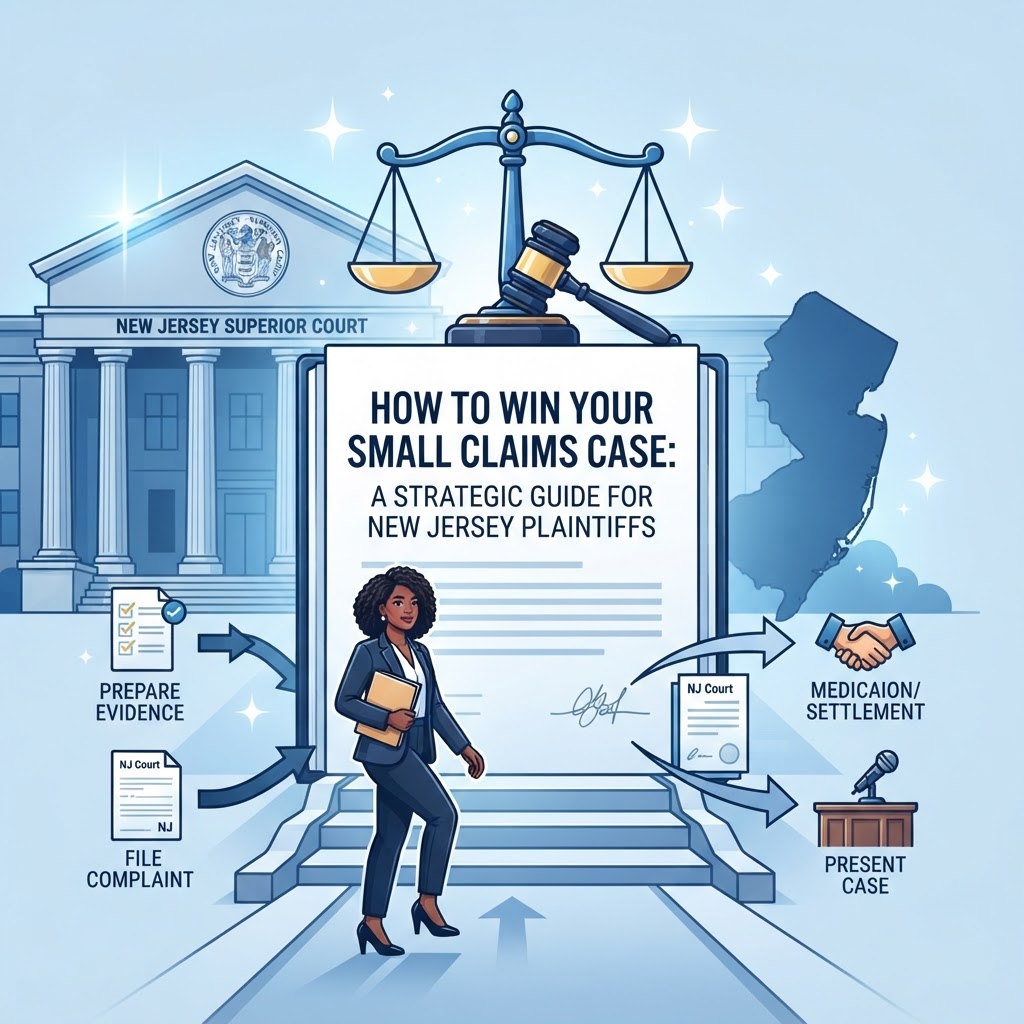
How to Win Your Small Claims Case: A Strategic Guide for New Jersey Plaintiffs
Master the art of presenting your small claims case with our comprehensive guide to evidence, courtroom preparation, and legal strategy. Learn how to navigate New Jersey small claims procedures and maximize your chances of a favorable judgment.
Winning a Small Claims Case in New Jersey: A Comprehensive Legal Guide
Winning a small claims case in New Jersey requires meticulous preparation, a firm grasp of the New Jersey Rules of Court, and the ability to present your evidence in a logical, non-emotional fashion. Success rests on your capacity to prove that the defendant owes you a specific debt and that you have taken the necessary procedural steps to establish your claim legally. The Special Civil Part is designed to be accessible to pro se litigants, yet it remains a formal court of law where technical failures can lead to summary dismissals.
Understanding New Jersey Small Claims Limits and Jurisdiction
In New Jersey, the Special Civil Part of the Superior Court handles small claims matters. Under the New Jersey Rules of Court, specifically Rule 6:1-2, you may bring an action for monetary damages not exceeding $3,000. If your claim exceeds this amount, you have two primary options: you may either waive the excess amount to keep the case within the $3,000 small claims limit, or you may file a complaint in the regular Special Civil Part (for claims up to $20,000) or the Law Division of the Superior Court (for claims exceeding $20,000). The Law Division involves significantly more complex procedures, formal discovery, and potential jury trials, which often necessitate hiring an attorney.
Filing fees vary by county based on local administrative mandates, but you should generally expect to pay between $30 and $75 for the initial filing. For example, in counties like Bergen or Essex, fees are standardized by the state judiciary, but service of process fees can fluctuate. If you choose to have the court clerk serve the defendant via certified mail, the fee is typically around $10 to $15. If you hire a professional process server or a county sheriff, costs may range from $25 to $100 depending on the number of attempts and the distance traveled.
It is vital that you file a small claims case in the correct venue. According to Rule 6:1-3, venue is proper in the county where the defendant resides, where the defendant is employed, or where the cause of action (the incident) occurred. If you file in the wrong county, the defendant may file a motion to change venue, which could result in a transfer fee or the dismissal of your case entirely. Always verify the specific county court address via the New Jersey Courts website before submitting your paperwork.
Step-by-Step Guide to the Litigation Process
1. Pre-filing Demands
While not always strictly required by law for every type of debt, it is standard practice to send a formal demand letter. This document serves as your final attempt to resolve the issue out of court and establishes a paper trail. You can utilize a demand letter service to ensure your letter carries the proper legal weight and documentation required if you eventually reach court. The letter should clearly state the amount owed, the reason for the debt, and a deadline for payment (typically 14 to 30 days).
2. Filing the Complaint
To initiate the process, you must complete the Small Claims Complaint form (Form DC-165). You must clearly state the nature of your claim, the date the debt was incurred, and the exact dollar amount requested. Under Rule 6:2-1, your complaint must include the full name and address of the defendant. If the defendant is a business, you must verify the registered agent for service of process through the New Jersey Division of Revenue and Enterprise Services.
3. Service of Process
Once the clerk receives your complaint, you must serve the defendant as mandated by Rule 6:2-3. This is typically done via certified mail, return receipt requested, or via personal service by a process server. Proof of service, such as the signed green card from the postal service or an affidavit of service from a process server, must be returned to the court clerk within the timeframe specified in the summons. Failure to file proof of service can result in your case being administratively closed.
4. Mediation
New Jersey courts under Rule 1:40-4 strongly encourage mediation. Most small claims cases are diverted to a court-appointed mediator before a judge ever hears the facts. A mediator is a neutral third party who helps both sides reach a voluntary settlement. If you reach a settlement, you will sign a consent order, and the case will be closed. If no agreement is reached, the case moves to a trial.
5. The Court Hearing
If mediation fails, the case proceeds to a bench trial before a judge. You must be prepared to present your case concisely, as judges often have a very limited time window for each small claims docket. You should arrive at least 15 minutes early and be ready to answer questions regarding your evidence. For additional regional tips, review our small claims guides by state.
Concrete Example: Breach of Contract Scenario
Imagine you hired a contractor to install a new deck for $2,800. You paid a $1,000 deposit via check, but the contractor never showed up and refuses to return your money. Your evidence should include:
- The written contract or estimate signed by both parties.
- Bank statements showing the cleared check of the $1,000 deposit.
- Copies of all text messages, emails, or call logs showing your attempts to contact the contractor.
- A copy of the formal demand letter sent 30 days prior.
In court, you are seeking the $1,000, plus the filing fee ($45) and service fees ($20), for a total claim of $1,065. If you win, the judge will issue a judgment for $1,065. However, note that collecting the judgment is a separate process involving information subpoenas or bank levies.
Second Numeric Example: Property Damage Liability
Suppose you are a landlord and a tenant causes $2,500 worth of damage to your property, which exceeds the security deposit held. You seek the $2,500 plus $150 in professional cleaning costs and $65 in court filing fees. Total requested: $2,715. You must bring to court:
- The signed lease agreement showing the tenant's liability for damages.
- The move-in/move-out inspection report.
- Itemized invoices for the repairs.
- Dated photographs showing the condition of the apartment before and after the tenant's residency.
Essential Evidence Checklist
Success in small claims hinges on tangible evidence. Judges generally disregard hearsay. Focus on these items:
- Contracts and Agreements: Original signed documents, letters, or emails that outline the terms of your agreement.
- Financial Records: Invoices, canceled checks, bank statements, and credit card receipts.
- Photographic or Video Evidence: High-quality, dated photos are critical if your claim involves property damage or poor workmanship.
- Expert Opinions: Written estimates from other professionals who can testify to the cost of fixing a mistake or the value of damaged goods.
- Chronology Log: A simple, typed document that lists dates, times, and summaries of every interaction with the defendant, including phone calls and in-person meetings.
Five Costly Mistakes to Avoid
- Overlooking the Statute of Limitations: Under N.J.S.A. 2A:14-1, most contract claims must be filed within six years of the breach. If you wait longer, the defendant can move to dismiss the case regardless of the merit.
- Failure to Calculate Costs Correctly: Do not forget to include court filing fees and service fees in your initial complaint. If you win, you are entitled to recover these costs, but only if you explicitly requested them in your original filing.
- Poor Organization: Walking into court with a disorganized stack of papers wastes time and annoys the judge. Use a binder with tabs for each piece of evidence (Plaintiff’s Exhibit A, B, C, etc.).
- Emotional Testimony: Avoid personal attacks or shouting. The judge is interested in facts. If you become angry or overly emotional, you lose credibility and the judge may instruct you to focus strictly on the evidence.
- Failing to Bring Copies: Never assume the judge has copies of your documents. Always bring three copies of every piece of evidence: one for the judge, one for the defendant, and one for yourself. If you have 10 photos, you need 30 total prints.
The Importance of Professional Document Preparation
The legal system in New Jersey is governed by strict adherence to the New Jersey Rules of Court. Even a small error, such as failing to properly serve the defendant or misstating the nature of the claim, can result in your case being delayed or dismissed. Clear, professional documentation is the foundation of any successful court strategy. CourtLinked prepares documents as a paralegal service, is not a law firm, and does not give legal advice. By ensuring your forms are completed correctly and filed in accordance with local court procedures, you significantly increase the likelihood that your case will be heard on its merits rather than being dismissed on a technicality. Preparation is the bridge between a valid grievance and a court-ordered judgment. Stick to the facts, follow the procedural rules of the Special Civil Part, and maintain professional decorum at all times to maximize your potential for a favorable outcome.
Last reviewed Nov 4, 2026 · Preparing and filing across all 50 states since 2004. Not a law firm, no legal advice. Editorial standards
Related CourtLinked services
Need help filing your small claims case?
File My CaseRelated State Guides
Related Articles
More guides from the CourtLinked Law Library on similar small claims topics.